|
The El Paso shooter wasn’t a “lone wolf.” His act of white supremacist terror is part of a century of racial violence targeting fronterizo communities.
|
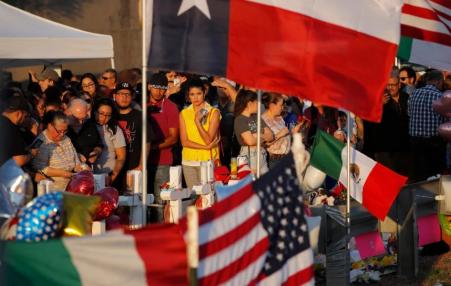
People visit a makeshift memorial at the scene of a mass shooting in El Paso. , AP Photo/John Locher
|
In the immediate aftermath of the El Paso shooting—the largest massacre of Latinx people in the history of the United States—politicians of all stripes stood before the cameras and gave their diagnosis of what just happened. They sounded like the proverbial blind men who touched one part of the elephant and confused the different fragments for the whole. El Paso Mayor Dee Margo, a Republican who once praised the “freedom fence” for keeping out “riff raff,” emphasized that the atrocity was committed by an outsider. Other voicesblamed mental health, video games, and the lack of gun control laws.
But none of these diagnoses went deep enough, looking only at the symptoms. Before we know how to fight back effectively against white supremacist terrorism like the El Paso massacre, we have to know exactly what we’re up against. History offers an important instrument to determine the root causes of what I characterize as a deadly epidemic.
The chilling manifesto reportedly posted online by the alleged shooter tapped into entrenched narratives with deep roots in the history of the U.S.-Mexico border. It’s unlikely that the 21-year-old from Allen, Texas, knew just how utterly repetitive his words and actions were.
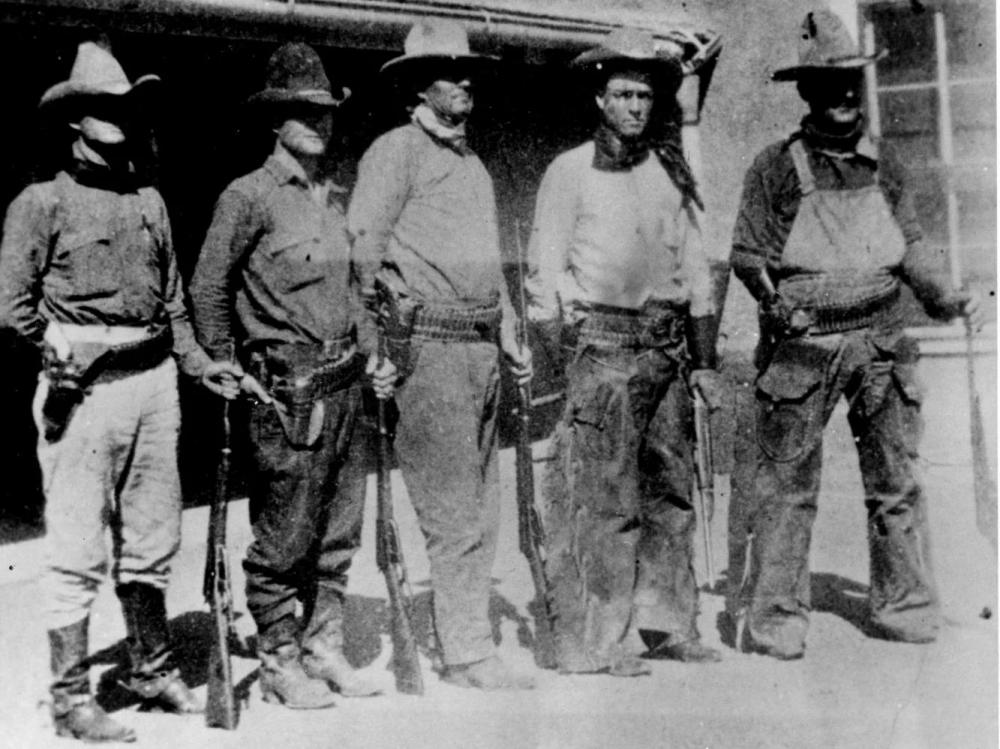
The height of Texas Ranger violence against Mexicans occurred from 1915 to 1919, with some 300 ethnic Mexicans murdered between 1915 and 1916 alone. UNIVERSITY OF NORTH TEXAS
The shooter wrote that he was protecting whites in America from “cultural and ethnic replacement” brought on by “the Hispanic invasion of Texas.” He claimed that “Hispanics will take control of the local and state government of my beloved Texas, changing policy to better suit their needs.”
|
Showing posts with label Mexican. Show all posts
Showing posts with label Mexican. Show all posts
Monday, August 12, 2019
the Long Legacy of Anti-Mexican Violence at the Border


Wednesday, June 12, 2019
Number of Mexican unauthorized immigrants decline. Pew
Pew Research Center:
Mexicans decline to less than half the U.S. unauthorized immigrant population for the first time.
More.
Wednesday, October 05, 2016
Farm Workers Win Election in Washington State
FARM WORKERS WIN A WATERSHED ELECTION IN WASHINGTON STATE
By David Bacon
The Nation, 10/3/16
http://davidbaconrealitycheck.blogspot.de/2016/10/farm-workers-win-watershed-election-in.html
https://www.thenation.com/article/why-these-farm-workers-went-on-strike-and-why-it-matters/

The children of migrant farm workers and their supporters march to the processing plant at Sakuma Brothers Farms
Burlington, WA-There is not much love lost between the owners of Sakuma Brothers Farms and Ramon Torres, the president of Familias Unidas por la Justicia. Sakuma Brothers is one of the largest berry growers in Washington state, and Familias Unidas is a grassroots union organized by the company's workers. Torres used to work in the Sakuma fields. He was fired after the strikes by pickers in 2013 in which the union was formed.
This month, on September 12, the workers finally voted in an election to demonstrate what really needed no proof - that they supported the union they formed three years ago. This election is a watershed: Familias Unidas por la Justicia is the first union organized by farm workers in the United States in many years.
The balloting took place over four hours at the company office, two hours north of Seattle, surrounded by Sakuma's blueberry fields. After all the votes had been cast, Torres and a small group of workers and supporters drove over to the polling place to watch the count. A company manager balked, however. The ever. The count couldn't take place as long as Torres was on the property, he said.
After a lot of arguing, the workers retired to a local schoolyard, together with Richard Ahearn, former regional director of the National Labor Relations Board. There, on the tailgate of a pickup belonging to State Senator John McCoy, Ahearn counted the ballots. The result: 195 for the union, and 58 against.
Jeff Johnson, who heads the Washington State Labor Federation, AFL-CIO, was part of the workers' group. "The irony of where the votes were tallied was hard to miss," he said later. "The majority of students at that elementary school are Latino, Senator McCoy has been a fierce advocate for these workers, and this is as much a public victory as a union victory."
The union is a grassroots organization formed by the pickers themselves, and is led by indigenous Mixtec and Triqui migrants from the southern Mexico states of Oaxaca, Guerrero and Chiapas. A union contract at Sakuma Brothers could give this union the stability and resources needed to make substantial changes in the economic conditions of its own members, and of farm workers across western Washington.
Strikes and organizing among agricultural laborers, especially indigenous migrants, has been on the rise all along the Pacific coast over the last several years. The election in Burlington and a new contract will further raise the expectations of thousands of people working in the fields, from northern Mexico to the Canadian border. "This is a new dawn," Torres said. "When we were celebrating afterwards, people began saying, 'From now on we know what the future of our children is going to be.'"
By David Bacon
The Nation, 10/3/16
http://davidbaconrealitycheck.blogspot.de/2016/10/farm-workers-win-watershed-election-in.html
https://www.thenation.com/article/why-these-farm-workers-went-on-strike-and-why-it-matters/
The children of migrant farm workers and their supporters march to the processing plant at Sakuma Brothers Farms
Burlington, WA-There is not much love lost between the owners of Sakuma Brothers Farms and Ramon Torres, the president of Familias Unidas por la Justicia. Sakuma Brothers is one of the largest berry growers in Washington state, and Familias Unidas is a grassroots union organized by the company's workers. Torres used to work in the Sakuma fields. He was fired after the strikes by pickers in 2013 in which the union was formed.
This month, on September 12, the workers finally voted in an election to demonstrate what really needed no proof - that they supported the union they formed three years ago. This election is a watershed: Familias Unidas por la Justicia is the first union organized by farm workers in the United States in many years.
The balloting took place over four hours at the company office, two hours north of Seattle, surrounded by Sakuma's blueberry fields. After all the votes had been cast, Torres and a small group of workers and supporters drove over to the polling place to watch the count. A company manager balked, however. The ever. The count couldn't take place as long as Torres was on the property, he said.
After a lot of arguing, the workers retired to a local schoolyard, together with Richard Ahearn, former regional director of the National Labor Relations Board. There, on the tailgate of a pickup belonging to State Senator John McCoy, Ahearn counted the ballots. The result: 195 for the union, and 58 against.
Jeff Johnson, who heads the Washington State Labor Federation, AFL-CIO, was part of the workers' group. "The irony of where the votes were tallied was hard to miss," he said later. "The majority of students at that elementary school are Latino, Senator McCoy has been a fierce advocate for these workers, and this is as much a public victory as a union victory."
The union is a grassroots organization formed by the pickers themselves, and is led by indigenous Mixtec and Triqui migrants from the southern Mexico states of Oaxaca, Guerrero and Chiapas. A union contract at Sakuma Brothers could give this union the stability and resources needed to make substantial changes in the economic conditions of its own members, and of farm workers across western Washington.
Strikes and organizing among agricultural laborers, especially indigenous migrants, has been on the rise all along the Pacific coast over the last several years. The election in Burlington and a new contract will further raise the expectations of thousands of people working in the fields, from northern Mexico to the Canadian border. "This is a new dawn," Torres said. "When we were celebrating afterwards, people began saying, 'From now on we know what the future of our children is going to be.'"
Wednesday, July 20, 2016
Organize Against a Trump Victory

DSA believes that
a Donald Trump presidency would represent a victory for the most reactionary
nativist, misogynist, Islamophobic and racist forces in the country. A Trump
administration would bring immediate harm to many people and would create
conditions hostile to organizing for progressives. Therefore, DSA will work
with the emerging labor, immigrant, and anti-racist-led “Dump Trump” movement.
For this reason, we do not endorse the #BernieOrBust tactic, though we
understand the sentiment behind it. Our perspective can best be summarized as:
“Dump the Racist Trump: Build the Left from the Grassroots Up.”
See the complete
list of talking points here:
See more:
Trump, Racism and the Left.
We Cannot Have a
Candidate Who Insults Mexicans and Latinos, women, African Americans and
Muslims.
Friday, March 11, 2016
Tenemos Familias | Bernie Sanders
Many of these workers can not vote. It is up to us to vote for them.
If you cannot vote, you can still campaign for candidates and assist opposing campaigns with literature distribution. One of the most effective things you can do is to work with campaigns and to talk with your friends, neighbors, and families.
Friday, February 26, 2016
The Latino Vote Must Take Down Donald Trump !

By Duane Campbell,
Mexican American Digital History Project.
Trump’s Racially Divisive
Politics Must Be Exposed and Opposed !
The intolerant agitation promoted by Republican Donald Trump and support
of its substance by most Republican candidates is a call to the “silent white
majority” and a demand that 11 million immigrants be deported. This campaign is a dangerous and divisive
racial message. It must be vigorously opposed.
We know these campaigns to be dangerous. It is not only the ranting of a
fringe right.
If you cannot vote, you can still campaign
for candidates and assist opposing campaigns with literature distribution. One of the most effective things you can do
is to work with campaigns and to talk with your friends, neighbors, and
families.
Trump’s popularity among Republican voters has dramatically risen in the
polls. He leads the Republican Party
campaign for president and determines the terms of the debate . Cruz
and Rubio have a similar policy on immigration, Build walls, deport people. This fear mongering political message has
found a very receptive base within our society among xenophobic and angry conservative
sectors.
Thursday, November 12, 2015
Trump Proposes an Inhumane Immigration Plan - Washington Post

Ed. note. To its credit, the Washington Post recognized the Trump deportation plan for what it is.
Washington Post
By Editorial Board November 11
“WE HAVE a country that’s going to hell.” So pronounced Donald Trump, candidate
for the Republican presidential nomination, at Tuesday
night’s debate. If Mr. Trump thinks that now, it’s likely many
Americans would come to agree with him were they to see the economic and social
upheaval unleashed in carrying out his plan to forcibly deport more than
11 million undocumented immigrants, a major portion of whom are employed,
have lived in the United States 15 years or more and have children and
other relatives who are U.S. citizens.
Mr. Trump, who has stirred up so much enthusiasm for mass
deportations, is now offering what he evidently regards as an
exemplary template: the far more modest but still massively cruel
round-’em-up-and-throw-’em-out program carried out, mainly in the
summer of 1954, under the administration of President Dwight D.
Eisenhower.
Ed. note. As we argued on Sept 1, Trump is Dangerous.
http://antiracismdsa.blogspot.com/2015/09/trump-is-dangerous.html
Ed. note. As we argued on Sept 1, Trump is Dangerous.
http://antiracismdsa.blogspot.com/2015/09/trump-is-dangerous.html
Thursday, September 10, 2015
Mass Deportation: How Do You Deport 11 Million People?
Good video. Ignores the 1,000,000 Mexicans deported in the 1930's, including over 500,000 US citizens,and the 1,000,000 Mexicans deported in Operation Wetback in the 1950's.
Monday, June 22, 2015
Mexican Farmworkers in Historic Strike
Al Jazeera Documentary Shows Mexican Farmworkers’ Struggles in Historic Strike
Rachel Luban June 20, 2015
In These Times
A historic farmworker uprising ignited this March in Baja California, Mexico. Thousands of crop pickers stopped work at peak harvest in the valley of San Quintin, a major source of the U.S.’s tomatoes, cucumbers and berries, demanding better pay, legally mandated benefits and an end to sexual harassment in the fields. Fault Lines’ “Invisible Hands” premieres on Al Jazeera America on Monday, June 22nd at 10 p.m. Eastern time/ 7 p.m. Pacific.

Farmworkers in Baja California, Mexico earned $7 to $8 per day—not hour—before the historic strike, making it even more difficult to walk off the job and forgo what little wages they earned., Peter Haden / Flickr / In These Times,
[Reprinted with permission from In These Times. All rights reserved.]
A historic farmworker uprising ignited this March in Baja California, Mexico. Thousands of crop pickers stopped work at peak harvest in the valley of San Quintin, a major source of the U.S.’s tomatoes, cucumbers and berries, demanding better pay, legally mandated benefits and an end to sexual harassment in the fields, among other improvements. The months-long movement received surprisingly little media attention on this side of the border—even though, according to a new documentary by Al Jazeera America, it is the first strike of this scale in Mexico in over a decade.
The short documentary, “Invisible Hands,” offers some of the first footage for U.S. audiences of the front lines of the uprising. It shows police crouching behind barriers to shoot rubber bullets at protestors; it shows hundreds of workers crowded outside negotiations with growers and government representatives in nighttime darkness, their backs turned to the police; most important, it shows what the men and women behind the protests endure to get produce to U.S. grocery stores.
Host Josh Rushing says, “It’s hard to understand how they could get by on the wages they’re paid here,” which were $7 to $8 per day—not hour—when the protests began. The workers interviewed in the documentary do barely get by. Ana, a raspberry picker who started working in the fields at age 12, now has children of her own to take care of. Even though she works at least six days a week, sunup to sundown, food is scarce. Her family can’t afford meat and often forgoes cereal, milk and cheese. “We only buy eggs, soup, rice, beans, the cheapest oil there is,” she says. They have no refrigerator—they can’t afford the electricity.
The workers’ poverty puts them in a weak bargaining position and makes walking off the job even more difficult. While the companies face lost profits, the workers face hunger. How long they can hold out without pay? “Invisible Hands” shows how the protestors’ militancy cannot keep their demands from plunging: they first demand almost $20 a day; the growers counteroffer with a raise of only about 50 cents. The workers return with a much lower proposal of $13 a day. But even that is too much for the growers. The protests all but ended this month with a mixed victory for the pickers: They have been promised government-required benefits and between $9.50 and $11.50 a day, depending on where they work—far less than they had originally demanded.
The documentary focuses almost exclusively on the wage struggles of the San Quintin workers, but hints of other battles within the strike pop up throughout. At a checkpoint where workers raise money to be able to continue striking, a woman holds up a sign reading “No more sexual harassment against women workers.” Ana is seen working long, meagerly paid days, highlighting the lack of overtime pay the pickers are also fighting against.
If these all seem like problems for Mexican growers to solve, “Invisible Hands” implicates the U.S. in the workers’ destitution. It is the newest episode in Al Jazeera America’s series “Fault Lines,” which explores the United States’s economic and political role in the world. In this case, U.S. companies’ role is to exert downward pressure on the wages and working conditions of the people “at the bottom of our food system,” as Rushing says.
“The tendency of the industry is for the retailer to squeeze the supplier,” says Eric Holt-Gimenez of the Institute for Food and Development Policy, a progressive U.S.-based think tank. “So who does the supplier squeeze? The supplier squeezes the workers.”
Fernando Rodriguez, the CEO of Los Pinos, a major exporter of tomatoes, says paying workers more than the minor increases the growers offered would put him out of business. While he speaks to Rushing onscreen, workers literally run through his fields with buckets of green tomatoes—they are paid based on how much they pick. The costs of production and transportation are steep, Rodriguez says, and supermarkets have a higher profit margin than he does.
The workers’ poverty puts them in a weak bargaining position and makes walking off the job even more difficult. While the companies face lost profits, the workers face hunger. How long they can hold out without pay? “Invisible Hands” shows how the protestors’ militancy cannot keep their demands from plunging: they first demand almost $20 a day; the growers counteroffer with a raise of only about 50 cents. The workers return with a much lower proposal of $13 a day. But even that is too much for the growers. The protests all but ended this month with a mixed victory for the pickers: They have been promised government-required benefits and between $9.50 and $11.50 a day, depending on where they work—far less than they had originally demanded.
The documentary focuses almost exclusively on the wage struggles of the San Quintin workers, but hints of other battles within the strike pop up throughout. At a checkpoint where workers raise money to be able to continue striking, a woman holds up a sign reading “No more sexual harassment against women workers.” Ana is seen working long, meagerly paid days, highlighting the lack of overtime pay the pickers are also fighting against.
If these all seem like problems for Mexican growers to solve, “Invisible Hands” implicates the U.S. in the workers’ destitution. It is the newest episode in Al Jazeera America’s series “Fault Lines,” which explores the United States’s economic and political role in the world. In this case, U.S. companies’ role is to exert downward pressure on the wages and working conditions of the people “at the bottom of our food system,” as Rushing says.
“The tendency of the industry is for the retailer to squeeze the supplier,” says Eric Holt-Gimenez of the Institute for Food and Development Policy, a progressive U.S.-based think tank. “So who does the supplier squeeze? The supplier squeezes the workers.”
Fernando Rodriguez, the CEO of Los Pinos, a major exporter of tomatoes, says paying workers more than the minor increases the growers offered would put him out of business. While he speaks to Rushing onscreen, workers literally run through his fields with buckets of green tomatoes—they are paid based on how much they pick. The costs of production and transportation are steep, Rodriguez says, and supermarkets have a higher profit margin than he does.
“This is a tremendously wealthy food system,” Holt-Gimenez says. “Six trillion dollars a year. It’s just very poorly distributed.” It is the nature of the food system, he says, to render workers like Ana invisible. “When you pick up an apple, you don’t see the labor in that apple . . . You walk down the grocery aisle, think about all this phantom labor embodied in all those products. We don’t see it.”
“Invisible Hands” begins to make that phantom labor visible.
“We break ourselves working in the fields,” says a raspberry picker for BerryMex, a supplier for U.S. company Driscoll’s. Fearing retaliation, she speaks with her face covered by the lavender bandanna she wears in the field. She shows Rushing the thorns in her hands and arms she hasn’t been able to pick out. “It’s like sandpaper,” he says, feeling her skin.
When he tells her how much raspberries sell for in the U.S., she scarcely believes him. “How is it possible that they sell their product for so much money and they pay us so little for it?” The growers pay them “una miseria,” a pittance, she says again and again.
Fault Lines’ “Invisible Hands” premieres on Al Jazeera America on Monday, June 22nd at 10 p.m. Eastern time/ 7 p.m. Pacific.
Rachel Luban is a writer living in Maryland. She contributes to Full Stop and her work has appeared on Jezebel, The Rumpus, and In Our Words. Follow her on Twitter: @rachelcluban.
Portside is proud to feature content from In These Times, a publication dedicated to covering progressive politics, labor and activism. To get more news and provocative analysis from In These Times, sign up for a free weekly e-newsletter or subscribe to the magazine at a special low rate.
“Invisible Hands” begins to make that phantom labor visible.
“We break ourselves working in the fields,” says a raspberry picker for BerryMex, a supplier for U.S. company Driscoll’s. Fearing retaliation, she speaks with her face covered by the lavender bandanna she wears in the field. She shows Rushing the thorns in her hands and arms she hasn’t been able to pick out. “It’s like sandpaper,” he says, feeling her skin.
When he tells her how much raspberries sell for in the U.S., she scarcely believes him. “How is it possible that they sell their product for so much money and they pay us so little for it?” The growers pay them “una miseria,” a pittance, she says again and again.
Fault Lines’ “Invisible Hands” premieres on Al Jazeera America on Monday, June 22nd at 10 p.m. Eastern time/ 7 p.m. Pacific.
Rachel Luban is a writer living in Maryland. She contributes to Full Stop and her work has appeared on Jezebel, The Rumpus, and In Our Words. Follow her on Twitter: @rachelcluban.
Portside is proud to feature content from In These Times, a publication dedicated to covering progressive politics, labor and activism. To get more news and provocative analysis from In These Times, sign up for a free weekly e-newsletter or subscribe to the magazine at a special low rate.
Thursday, April 02, 2015
Why Mexican Farmworkers Are On Strike

Sonali Kolhatkar
March 26, 2015 Truthdig
As many as 50,000 mostly indigenous workers have stopped harvesting produce for more than a week in protest of labor law violations. What they want is for their basic needs to be met, such as obtaining health care, getting overtime pay and vacation days, and being paid wages higher than the dismal $8 a day that most of them earn.
A farmworker holds his knife before beginning work near Holtville, Calif., earlier this year. The Mexican strike is big news among farmworker communities in the U.S. with ties to Mexico., AP / Gregory Bull,
The green Driscoll’s label on the organic berries that I buy each week are a comforting symbol of a family-owned company that got its start in California. Sometimes the berries are marked “Product of USA,” but more often than not, they are labeled as originating in Mexico. That is because Reiter Affiliated Cos., which sells berries through its affiliate BerryMex under the Driscoll’s label, grows much of its produce in Mexico. On its website Reiter claims to be “the largest fresh, multi-berry producer in the world and the leading supplier of fresh strawberries, raspberries, blueberries and blackberries in all of North America.” Now, the farmworkers picking many of those berries are on strike, demanding a change to the brutally impoverished conditions under which they live.
Tuesday, October 07, 2014
Thursday, October 24, 2013
Growing Clash Between Immigrants Rights Activists and Washington DC Power Brokers
GROWING CLASH BETWEEN IMMIGRANT RIGHTS ACTIVISTS AND WASHINGTON DC POWER BROKERS By David Bacon http://www.truth-out.org/news/item/19564-growing-clash-between-immigrant-rights-activists-and-washington-power-brokers OAKLAND, CA (10/21/13) -- This fall, when Congress couldn't pass immigration reform bills -- even ones deeply unpopular among many immigrants themselves -- one of the most important responses came from Oaxaca. In the capital of this southern Mexico state a representative of a Silicon Valley union sat down with a state agency and an organization of indigenous migrants, and signed an agreement for mutual cooperation. All three groups pledged to work to protect the rights of Oaxacans who have migrated to the U.S. -- about 800,000 now live in California alone. "Our objective," the agreement reads, "is the protection of the human and labor rights of Oaxacan workers and their families, in the food and commercial industries." It lists a number of shared commitments, including explaining to immigrant workers their labor rights in the U.S., helping them file claims when they're hurt at work, and advocating for them when they face government agencies. |
Friday, March 08, 2013
Why Organized Labor is active in immigrant rights
by
Amy Dean

Immigrants' rights are workers' rights.
These days, that idea is a principle held dear by the US labor movement. But
that wasn't always the case.
As recently as the mid-1990s, many
unions took protectionist stances against allowing new immigrants to come to
this country. It was only after these unions saw the abuses that became
prevalent under an employer-driven system for verifying immigration status that
the labor movement embraced a new position. The movement recognized that for
working people to thrive, all employees had to have full rights in the
workplace.
Today, labor is one of the key forces
pushing for comprehensive immigration reform in Washington, DC. To learn more
about the movement's advocacy and more about how unions transformed themselves
into outspoken champions of immigrant rights, I spoke with Maria Elena Durazo.
A daughter of Mexican immigrant farm workers, Durazo rose to become the leader
of the hotel and restaurant workers union in Los Angeles, the dynamic UNITE
HERE Local 11. And, as chair of the national AFL-CIO’s Immigration Committee,
Durazo is now a leading point person in the national immigration debate.

Knowing that many people are confused
when hearing about union activism around immigration, I asked Durazo a
straightforward question: Why is this issue a top priority for labor?
"It's bad for American workers for
there to be 11 million-plus people out there working with no rights,"
Durazo said. "[These immigrants] are subject to exploitation. They are
subject, as a result of that, to accept lower wages. They are subject to
working in dangerous conditions. That is bad for those immigrant workers, and
it is bad for American workers as a whole."
She continued: "We cannot have a
prosperous nation and recreate the middle class as long as there is an
underclass of 11 million people who do not have rights. By fixing this and
getting them all on the road to citizenship, we address a huge issue that is
the cause of enormous exploitation - of wage theft and other massive violations
of labor laws."
Monday, February 25, 2013
The Case of Marco Rubio ( and Ted Cruz)
Rodolfo F.
Acuña

Rubio’s statement undermines the
social construct of a Hispanic group that bonds the disparate Latino groups.
Many of the activist members of this group dismissed Rubio as a “gusano” – a
worm or a maggot – a term popularly used to refer to reactionary Cuban exiles
that came here during the 1960s.
Prior to his epiphany Rubio had no
interest in Mexican or Latino immigrants; his sudden awakening and concern
about immigration was kindled because of the strength of the Latino vote, and
Mr. Rubio’s presidential aspirations. Based on his surname Rubio claims the
right to take ownership of the issue, even though his base is the Tea Party and
the far right of the Republican Party.
Tuesday, October 02, 2012
Cultural Nationalism
Cultural Nationalism ,Chicanocentricism, Cowardness
Take Your Pick

One of the advantages of growing old is
that, if you look back in time, you see patterns in behavior and events. You
can anticipate that the boulder that Sisyphus is pushing up the hill will roll
back.
This morning I clicked on to the Los Angeles
Times and read that Gov. Jerry Brown -- who signed the Agricultural Labor
Relations Act in 1975 -- vetoed the Farm Worker Safety Act, legislation.
Many supporters were
disillusioned. It was the 50th year anniversary of the United Farm Workers’
struggle to get farmworkers the same protections that many animals enjoy.
Moreover, Jerry Brown was a favorite among Latino voters. I remember two
years ago a left-leaning Mexican American attorney saying that his priority was
to get Brown elected and he would not contribute to anyother cause.
In the context of history, Brown’s flip
flopping is no surprise. I remember in 1978 his opposition to Proposition 13
which contributed to destruction of California’s education system, only to join
the sponsors once the initiative passed. Brown offered no moral
leadership. Brown also recently vetoed the Trust Act that would have
limited the state's law enforcement's interactions with federal immigration
enforcement efforts. It would have been a bold answer to Arizona’s
nullification of federal powers.
The adage to never trust a gringo or a
liberal who comes speaking Spanish rings true. Brown knows that the
United Farm Workers do not have the same cache among liberals that they did in
the 1960s and 70s so he relies on Mexicans and Latinos having a short memory
and on liberals not caring enough
about farmworkers and immigrants. How many voters are there who care?
Thursday, September 20, 2012


Thursday, August 16, 2012
A Great Day for Activism- and for America
by Randy Shaw
Beyond Chron- August 16,2012
http://www.beyondchron.org/news/index.php?itemid=10406
For the estimated 1.2 million young undocumented immigrants
who began signing up for President Obama's "Deferred Action
for Childhood Arrivals" legalization program, August 15, 2012
will forever signify the power of grassroots activism. Those
eligible under the program will be able to legally work and
live in the United States but will not gain permanent
legalization status or a path to citizenship. Obama
implemented his "most ambitious immigration initiative" in
response to both growing Latino political power and the
courageous and inspiring grassroots pressure from young DREAM
ACTivists. It is these young people, not the fake,
billionaire-backed Tea Party Republicans, who represent the
true power of grassroots activism to create meaningful change.
When we look at the progressive movements that have made real
gains since President Obama's election in 2008, only two stand
out: marriage equality and immigrant rights. Both have a way
to go, and the lack of comprehensive immigration reform
coupled with increased deportations has left many disappointed
with progress in this area.
But the ability of DREAM ACTivists to win tangible gains for
over one million young immigrants remains an historic
achievement. And they accomplished this almost entirely with
the type of true grassroots activism that many previously
doubted could still make a difference.
Beyond Chron- August 16,2012
http://www.beyondchron.org/news/index.php?itemid=10406
For the estimated 1.2 million young undocumented immigrants
who began signing up for President Obama's "Deferred Action
for Childhood Arrivals" legalization program, August 15, 2012
will forever signify the power of grassroots activism. Those
eligible under the program will be able to legally work and
live in the United States but will not gain permanent
legalization status or a path to citizenship. Obama
implemented his "most ambitious immigration initiative" in
response to both growing Latino political power and the
courageous and inspiring grassroots pressure from young DREAM
ACTivists. It is these young people, not the fake,
billionaire-backed Tea Party Republicans, who represent the
true power of grassroots activism to create meaningful change.
When we look at the progressive movements that have made real
gains since President Obama's election in 2008, only two stand
out: marriage equality and immigrant rights. Both have a way
to go, and the lack of comprehensive immigration reform
coupled with increased deportations has left many disappointed
with progress in this area.
But the ability of DREAM ACTivists to win tangible gains for
over one million young immigrants remains an historic
achievement. And they accomplished this almost entirely with
the type of true grassroots activism that many previously
doubted could still make a difference.
Wednesday, July 18, 2012
ICE Agents continue to defy Presidential policy decision on immigrants

by Duane Campbell
On July 5, 2012, the California Senate passed the California Trust Act to set California policy in opposition to Arizona’s anti immigrant SB 1070. On the same day, Sacramento police arrested Juana Reyes outside of a South Sacramento Wall Mart for selling tamales . She was arrested upon a request from Wall Mart, charged, and later all charges were dropped. In the meantime, Immigration and Customs Enforcement (ICE) was informed and she was “held” by Sacramento County Sheriffs. The arresting officers told her children they would never see their mother again. She spent the next two weeks in jail- her U.S. citizen children ages 7 and 10 were placed in children’s protective service.
On July 5, 2012, the California Senate passed the California Trust Act to set California policy in opposition to Arizona’s anti immigrant SB 1070. On the same day, Sacramento police arrested Juana Reyes outside of a South Sacramento Wall Mart for selling tamales . She was arrested upon a request from Wall Mart, charged, and later all charges were dropped. In the meantime, Immigration and Customs Enforcement (ICE) was informed and she was “held” by Sacramento County Sheriffs. The arresting officers told her children they would never see their mother again. She spent the next two weeks in jail- her U.S. citizen children ages 7 and 10 were placed in children’s protective service.
Such
arrest, detention, and orders for deportation was totally unnecessary under the
conditions of the California Trust Act (AB1081) which has yet to be signed by
Governor Brown.
Today,
some 35 demonstrators, including members of DSA, the ACLU, Occupy Sacramento and others joined Juana Reyes in a demonstration to insist that her
deportation by stopped and that her family be protected. Assemblymember Tom Ammiano , author of
the Trust Act, commented, “ Had the Trust Act ( AB 1081) been in place Juana
Reyes wouldn’t need a lawyer,
wouldn’t need a press conference, and would not be facing deportation. Instead,
she would still be working hard to provide for her two small children – as hse
has for her two decades in the U.S.- she would still be trying to live a law
abiding life.”
Attorney
Julia Vera, working with the Northern California ACLU, said that Juana Reyes
was released on a $1,500 bond, an amount she could not raise by selling
tamales. Members of her local
church raised the funds for her bond.
Monday, January 16, 2012
The Purge of Mexican Americans in Tucson schools
by Salomón Baldenegro
Estimadas/os: First, let’s get the media-driven nonsense out of the way: “Ethnic Studies” was not dismantled in theTucson Unified School District
Estimadas/os: First, let’s get the media-driven nonsense out of the way: “Ethnic Studies” was not dismantled in the
The other bit of nonsense we need to get out of the way is the fiction—purveyed most recently in the Arizona Daily Star’s editorial of Sunday, January 15—that TUSD did what it had to do, that it really had no choice but to dismantle Mexican American Studies.
The indisputable fact of the matter is that TUSD had a choice: to go along with the Mexican haters Horne and Huppenthal or appeal Huppenthal’s decision, which would have put a hold on the threatened financial penalties on TUSD until the issue was resolved in court. TUSD made the conscious and deliberate choice to support Huppenthal.
Now to the matter of TUSD’s Mexican Purge:
The Purging of the Mexicans has begun in earnest in TUSD, one day after the pusillanimous TUSD school board, led by its chief Mexican hater Mark Stegeman, voted 4-1 to join hands withTom Horne and John Huppenthal and dismantle the Mexican American Studies curriculum.
Students forced to witness the Purge
The very next day after its nefarious vote, while classes were in session, TUSD conducted a purge of any and all books and teaching materials having to do with Mexican Americans and/or that deal with topics that are banned (e.g., civil rights) from MAS classrooms. Award-winning journalist Jeff Biggers reports that,
“According to district spokeperson Cara Rene, the books ‘will be cleared from all classrooms, boxed up and sent to the Textbook Depository for storage.’ ”
(The link below takes you to Biggers’ article in Salon.)
TUSD teachers and students who witnessed the purging of the books corroborate what Biggers reports. (Below is a link to a Three Sonorans article that contains relevant video about this.)
Tuesday, December 06, 2011
Occupy and the immigrant communities
David Bacon
The banners at Occupy Seattle

Subscribe to:
Posts (Atom)