Showing posts with label Latino. Show all posts

Thursday, September 26, 2024

Latino Book Festival


The second annual Sacramento Latino Book and Family Festival will take place this weekend at Sacramento City College.

The event celebrates literacy and this year features 60 authors, along with actor and activist Edward James Olmos. There will also be Aztec dancers and more entertainment. 

Rene Aguilera, the festival’s organizer and award-winning author Reyna Grande joined KCRA 3 on Wednesday to talk about the event. 

Grande, who is from Woodland, is the author of books including “The Distance Between Us” and “A Dream Called Home.” 

Aguilera said she was honored to represent the community at the event and encouraged people to read “and celebrate our stories.” 

Sunday, November 06, 2022

Latino Voting-- Votar es Poder !

 FOR IMMEDIATE RELEASE

Friday, November 5, 2022 

Hispanic / Latino Community Organizations Unite to EncourageLatinos in the Greater Sacramento Region to Vote this November 8th

 Sacramento, CA – Hispanic / Latino Community Leaders and Community Organizations throughout the Greater Sacramento Region who serve this often-ignored community are calling for all Latinos to let their voices be heard during the upcoming elections next Tuesday, November 8, 2022.

Only 27% of Latino registered voters turned out to vote during the primary elections that’s 12% below Sacramento’s County average for all registered voters. That’s why, many local Latino/Hispanic organizations representing various points of view in the community with a legacy of advocacy and representation for Latinos in the region are uniting to plead with all who identify as Latinos to cast their vote in person or by mail.

“We need to end the myth that Latinos/as are unaware or indifferent to the importance of our vote. It’s time that we utilize this critical tool to amplify our voice. Latinos/as are no longer a sleeping giant. Let’s get loud. Vote,” states Cathy Rodriguez Aguirre, President/CEO of the Sacramento Hispanic Chamber of Commerce.

As the nation’s largest minority group, the Latino community can play a key role in elections.

“We must vote for experienced leaders who can address issues like economic growth, job creation, education, voting rights, health care accessibility, language access, transparency, discrimination, and social justice,” states Marty Puentes, President of LULAC.

Our participation is necessary to safeguard the vulnerable portions of our society. But this can only happen if everyone turns out to vote this Tuesday, November 8, 2022. Regardless of party affiliation, the entire community must galvanize the electorate and vote.

“The power within the Latino community can be most effective at the ballot box. We must use our vote as our voice… without our participation in this election, our voice will not be heard,” states Alexis R. Arriaga, President of United Latinos Promoviendo Accion Civica.

¡Comunidad! The future is in your hands – VOTE ON TUESDAY NOVEMBER 8, 2022.

In Unity,

La Familia Counseling CenterLatino Economic CouncilSacramento Hispanic Chamber of CommerceCien AmigosLatino Center of Art and CultureBrown IssuesUnited Latinos of SacramentoBenito Juarez AssociationLULAC – League of United Latin American CitizensLatino Coalition for a Healthy CATeatro NagualBridge Network Corporation


SPANISH BELOW

DECLARACION PARA LOS MEDIOS DE COMUNICACION

Para Difusión InmediataSábado 5 de noviembre de 2022

Monday, October 24, 2022

Cost of Living, Housing and Inflation are Top Issues

NEW POLL: Cost of Living, Inflation, and Housing Top Issues for California Latinos Ahead of 2022 Midterm Elections

Yet, voter engagement still alarmingly low less than three weeks from Election Day

SAN FRANCISCO--()--The Latino Community Foundation announced the results of their second California statewide poll of Latino voters ahead of the 2022 Midterm Elections. California’s Latino voters, the second largest voting bloc in the state, can potentially decide the balance of power in Congress. Yet, outreach to them is dismally low and 31% say they are still undecided.

“Latino voters demonstrate a strong commitment to progressive policy issues. Yet, there is such a low level of engagement of these crucial voters by candidates, with only 29% of Latino voters saying they have been contacted and asked to vote”

Tweet this

“Latino voters demonstrate a strong commitment to progressive policy issues. Yet, there is such a low level of engagement of these crucial voters by candidates, with only 29% of Latino voters saying they have been contacted and asked to vote,” said Jacqueline Martinez Garcel, CEO of the Latino Community Foundation. “Our democracy is stronger when voters are engaged in every election. Especially considering that Latino voters can determine the balance of power in Congress at a moment in time when we are facing one of the worst inflations in decades and we are still trying to heal and rebuild from the COVID pandemic.”

According to Matt Barreto, co-founder of BSP Research and Professor of Political Science at UCLA, “Two-thirds of Latino registered voters in California say they are certain to vote, but 31% say they are on the fence and not yet certain. If campaigns want to see massive Latino turnout, they need to engage heavily to get out the vote in the final weeks. Over half of California Latinos say they will vote early using a mail ballot and 19% say they will vote early in-person. That leaves just 29% of Latinos who plan to vote on Election Day. Get out the vote starts now.”

The Poll also found:

  • 73% said inflation and jobs and the economy are their top concern;
  • 80% of Latinos say the cost of living is going up faster than they can keep up, yet Latino voters in California are more likely to say they are optimistic that things are getting better;
  • Latinos in California give Democratic candidates a large margin of 58% to 20% for Republicans in the election for U.S. House, unlike national polls that suggest Republicans are making in-roads with Latinos;
  • 57% of Latino voters said they had heard or read little to nothing about the Inflation Reduction Act, demonstrating a steep disconnect between policies they overwhelming support and a missed opportunity for the Administration to build goodwill on this historic passed legislation.

Click to download toplines and crosstabs of the poll.

The Latino Community Foundation commissioned the statewide poll of California’s Latino Voters from BSP Research. They surveyed 1,200 Latino registered voters across California for a margin-of-error of +/- 2.8%. The poll was conducted on-line and by phone in English and Spanish at the discretion of the respondent. Interviews were conducted between September 26, 2022 – October 5, 2022.

"This poll represents a unique deep-dive into the California Latino electorate with one of the largest and bilingual sample of Latino voters from across the entire state,” says Gary Segura, President of BSP Research. “The findings clearly show Latinos expect their elected officials to deliver on climate change, affordable housing, immigrant rights and much more. However, the poll also shows that more outreach needs to be done by individual candidates to connect with and convince Latino voters. From ballot measures to the U.S. Congress, Latino voters can be the difference makers, but only if candidates reach out and engage the Latino community."

About the Latino Community Foundation

The Latino Community Foundation is on a mission to unleash the civic and economic power of Latinos in California. LCF has the largest network of Latino philanthropists in the country and has invested $20 million to build Latino civic and political power and leadership in the state. It is the only statewide foundation solely focused on investing in Latino youth and families in California. For more info, please visit: www.latinocf.org.

About BSP Research

BSP Research is a Latino-owned polling, research and analytics firm headquartered in Los Angeles, California, and directed by four PhD-holding political scientists.

Contacts


Wednesday, April 27, 2022

Latino Voting

 Every 30 seconds, a Latinx person turns 18. That means that, in the five minutes that it takes you to read this article, 10 Latinx youth will turn 18, 2,880 in the next 24 hours, and over a million in the next 365 days—each one potentially becoming eligible to vote.

These demographic trends are not new, and already we are seeing the impact of our growing community. In the 2020 presidential election, 16.6 million Latinx community members cast their vote, a 30.9 percent increase compared to 2016. 

Our community has the potential to change the face of national and local elections while increasing representation in government and thus vastly improving the socioeconomic state of our community. According to Voto Latino, however, there were still 12 million Latinx people eligible to vote who did not register for the 2020 election.

While it is common to blame our community, the truth is that this is a constructed reality and the Latinx community’s lack of participation is by design. Voter apathy and lack of community engagement are founded on the lies that are continuously told within and to our community.

As a young Latina voter, I have been lied to.

Wednesday, September 15, 2021

About Hispanic Heritage Month


Gavin Newsom defeats California recall election in historic vote !

Celebrating Hispanic Heritage Month- Sept.15 – Oct 15, 2021


By Dolores Delgado Campbell 

Hispanic Heritage Month begins in the U.S. on Sept. 15 of each year and celebrates several of the independence struggles in Latin America from 1810- through the 1820s. 

Spain ruled most of Latin America from 1521 until 1820. The movements of independence from Spanish rule began most notably on Sept. 15, 1810 in Dolores, Mexico with the Grito de Dolores when Fr, Miguel Hidalgo declared Mexico’s independence from Spain. Hispanic Heritage Month celebrates these movements of independence.  

2021 marks the 500th Anniversary of the fall of Tenochtitlan, the ancient capital of the Aztecs, today’s Mexico City, and also the 200th Anniversary  of Mexican Independence. To commemorate these historical landmarks, the Mexican Government declared 2021 as the Year of Historical Reconciliation. The Consulate General of Mexico in Sacramento is participating in these celebrations with a series of binational cultural events.   “500 years of Indigenous Resistance-1521 the fall of Tenochtitlan”, programmed from Aug 16th to 31st. (in Spanish). 

There is more about the history further down in this post, but what about this complex and at times confusing  term Hispanic?

Hispanic or Latino refers to people in the U.S. from Puerto Rico, Mexico, South or Central America, as well as the  indigenous people of the once dominant Spanish empire in the Americas. The majority of these people do not call themselves Hispanic. 

The divisions and contentions over the terms Hispanic, Latino, Mexican Americans, Chicanos and others have complex historical antecedents. We are not going to resolve them here. 

The development of the term “Hispanic” was promoted by the Nixon administration to describe the collective of the variety of people descended from Latin America. Choosing this term, however, had significant political connotations and results.  In general, the use of Hispanic promotes the idea of a broad, inclusive Spanish influence.  At the same time it tends to ignore the very vast ethnic and cultural influences of the millions of indigenous people in the Americas. 

Some people prefer Hispanic; some would rather use other terms including Latino.  

So, what is a person seeking to interact with these communities to do?  Relax.  Listen to what people say about themselves.  You will hear a diversity of terms. First-generation immigrants tend to name their native country — ie. “I am Bolivian, or Argentinian,” while second- and third-generation people use the more universal terms Hispanic or Latino.  People who speak only English tend to use Hispanic more, while bilinguals tend to use Latino or other terms.  Note: not all Latinos are immigrants, some come from families that were here long before the U.S. claimed the west – such as myself..

One caution   Please don’t tell people how to define themselves. They can do that for themselves.  It is particularly not our role to define other peoples’ identities.  Listen and learn.

On population matters, the  results of the 2020 Census for redistricting purposes are just in. The nation’s population is becoming increasingly diverse due to major growth in the Latino, Asian, and multiracial populations and an aging white population that declined for the first time ever.


A total of 331.4 million were tallied in the 2020 Census, an absolute increase of 22.7 million people in the country. The Latino population led the way with slightly more than one of every two persons added to the country’s population through birth or international migration between 2010 and 2020 being Latino.  Overall, the Latino population increased by 23% during the decade while the white population declined by 8.6%.


While California is still the country’s most populist state, at the same time, White people are no longer the majority in the state.

In 2020, more than 39 percent of Californians identified themselves as Hispanic or Latino, compared with the approximately 35 percent who reported they were white and not Hispanic.


The shift makes California one of only five states or territories where white people do not make up the largest population  group. The others are Hawaii, New Mexico, Washington, D.C., and Puerto Rico.


Also note that Asians are among the fastest-growing ethnic groups


The percentage of Californians who identify as Asian or part-Asian grew by more than 27 percent between 2010 and 2020, one of the biggest increases among ethnic groups.

By comparison, the proportion of Californians who identified as Black or part-Black increased by 5 percent.


About the history  of Hispanic Heritage month we started with.

The war of independence in Mexico  lasted until 1821.  This  challenge to  Spanish power in Mexico led to the collapse of Spanish power in the Americas  with independence struggles winning in Chile, Columbia, Venezuela , Ecuador and Peru among others.  Five Latin American countries; Costa Rica, El Salvador, Guatemala, Honduras and Nicaragua celebrate the anniversaries of their independence on Sept. 15.

After  1810 the independence movements went through several stages. Many of the leaders were imprisoned or executed by forces loyal to Spain including  Fr, Hildalgo.

 A notable leader in South America was Simon Bolivar who organized and fought for over a decade to liberate the area now part of Chile, Columbia, Venezuela and Peru. By  1820, many of the leaders went beyond a demand for independence and took more radical positions, including the abolition of slavery.

Recommended readings.

Forget the Alamo: The Rise and Fall of an American Myth.  Burrough, Tomlinson, and Stanford.  2021.

An Indigenous People’s History of the United States. 2014.   Roxanne Dunbar- Ortiz. ( formerly a DSA member).  

This essay is an update of a piece posted in Democratic Left in 2014. 

Dolores Delgado Campbell 


Sacramento 


Tuesday, February 23, 2021

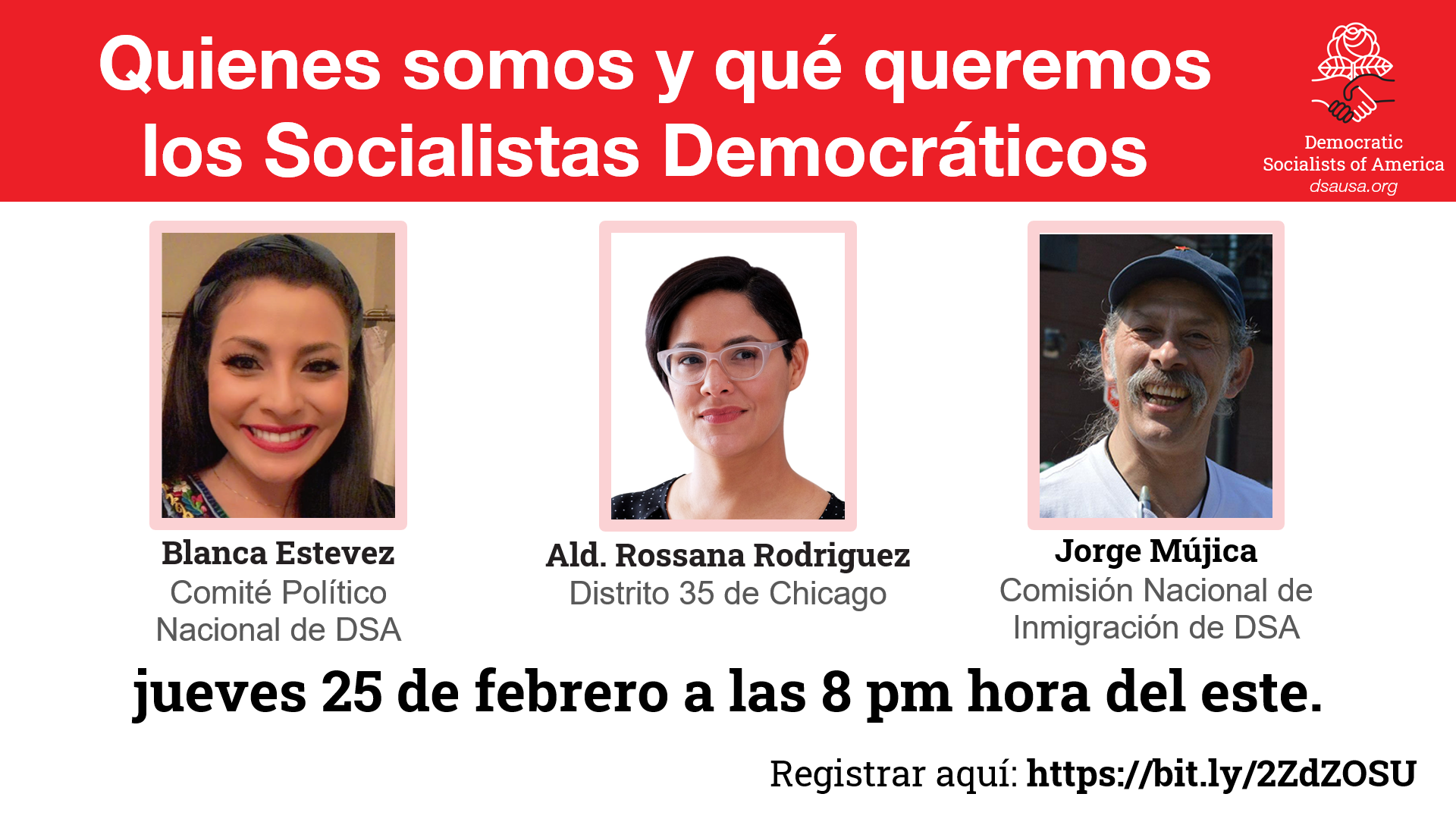
Quienes somos y qué queremos los Socialistas Democráticos


DSA Immigrants' Rights Working Group

Quienes somos y qué queremos los Socialistas Democráticos

Start: Thursday, February 25, 2021  8:00 PM  Eastern Daylight Time (US & Canada) (GMT-04:00)

End: Thursday, February 25, 2021  9:30 PM  Eastern Daylight Time (US & Canada) (GMT-04:00)

Host Contact Info:  immigrantrights@dsacommittees.org 

Qienes_flyer
El Grupo de Trabajo por los Derechos de los Inmigrantes de DSA los invita a un seminario web en español: "Quienes somos y qué queremos los Socialistas Democráticos."

Escuche a algunos de nuestros miembros sobre su trabajo en DSA y en sus comunidades.
Moderador: Blanca Estevez - Comité Político Nacional de DSA

Jorge Mujica, Organizador de trabajadores inmigrantes y de bajos ingresos con Arise Chicago. Arise Chicago crea asociaciones entre comunidades religiosas ytrabajadores para luchar contra la injusticia en el lugar de trabajo mediante la educación, la organización y la promoción de cambios en las políticas públicas. Miembro del Consejo Nacional de la Unión Nacional de Escritores y copresidente del IMWG de DSA.

Ald. Rossana Rodríguez - Concejal del Distrito 35 de Chicago y miembrx de DSA. Sus prioridades como Concejala incluyen proteger la asequibilidad del vecindario, apoyar a la población inmigrante de nuestro barrio y crear procesos más democráticos para que los residentes del barrio participen en las decisiones que afectan sus vidas.


Join the Immigrants' Rights Working Group of Democratic Socialists of America for a Spanish webinar:  Quienes somos y qué queremos los Socialistas Democráticos.

Hear from some of our members about their work in DSA and their communities. 

Moderator: Blanca Estevez - DSA National Political Committee

Jorge Mujica,  Immigrant and low-income workers Organizer with Arise Chicago. Arise Chicago builds partnerships between faith communities and workers to fight workplace injustice through education, organizing, and advocating for public policy changes. Member of the National Council of the National Writers Union, and co chair of the IMWG of DSA. 

Ald. Rossana Rodriguez - Chicago 35th Ward Alderwoman and DSA member. Her priorities as Alderwoman include protecting neighborhood affordability, supporting our ward’s immigrant population, and creating more democratic processes so that ward residents are involved in the decisions that impact their lives.

Zoom Registration info in instructions and reply.


ATTEND THIS EVENT

Tuesday, January 05, 2021

Latinos Win in Georgia !


We just made history: We pulled off the biggest Latinx voter turnout operation in Georgia history and contacted EVERY Latinx voter in the state!


The polls recently closed, so we don’t yet know the results of the election.But we do know this: When the surprise runoff was announced, we put our heads down and hit the pavement, working with our partners GLAHR Action network to hire 200 organizers and recruit an army of hundreds of volunteers. 


In just 8 weeks, our team broke record after record. We knocked on 321,000 doors, made 276,000 phone calls, and sent 377,000 text messages to get our gente to the polls and build power for our community. 


Thank you to each and every one of you who participated in our phone and text banks, joined our door knocking, or helped amplify our message. Here is a little bit more of what we would like to highlight:


But we still have lots of work to do. So we have an important question: If you are Latinx, Boricua, or Chicanx, will you become a Mijente member today and join the fight for justice and radical change?


As AOC said yesterday: Mijente “no juegan.” And she’s right. We throw down for our gente and run history-making campaigns. But the numbers don’t tell the whole story. 


For example, earlier today, two of our organizers, Julio and Sandra, were asked to stick around at their local polling location to help dozens of Spanish speaking voters who needed assistance casting their ballots because the polling location did not have interpreters. Without Julio and Sandra -- and dozens of other organizers like them across the state -- it’s possible that hundreds or even thousands of our people could be disenfranchised. 


Our victory today is of a lineage of long term, grassroots community organizing by organizations like GLAHR Action Network and Georgia Latino Alliance for Human Rights who have been on the front lines for human and civil rights for the growing Latinx community in Georgia. 


Victories like the one today will only embolden community members who are everyday discovering their power and potential. 


But we have a lot of work ahead of us. And we’re going to need to work together and organize together to ensure our communities are treated with the respect and dignity they deserve.

Mijente is a national movement of everyday Latinos standing up to the injustices and building safety for our gente. We are organizers, teachers, caretakers, healers, lawyers, council members, and so much more — each of us doing what we can.


Join us by becoming a member today.


En la lucha, 

Tania Unzueta
Political Director


Thursday, January 30, 2020

Latino Voter Outreach in Iowa


Nation’s Oldest & Largest Latino Civil Rights Organization to Discuss Successful Voter Outreach Campaign; 70% of Adult Latinos Are Now Registered to Vote in the Hawkeye State


Des Moines, Iowa - Today, January 30th, the League of United Latin American Citizens (LULAC) announced the results of the organization’s successful Latino voter outreach efforts in Iowa. During a press conference at the Iowa State Capitol, LULAC National President, Domingo García, was joined by LULAC Iowa leaders and newly registered first-time Latino voters to discuss the importance of the powerful Latino electorate in Iowa and the implications for the 2020 Caucuses.


According to the State of Iowa, the Latino population in Iowa increased by 135.8% from 2000-2018. LULAC has a long record of defending voting rights for Latinos in Iowa. In 2016, LULAC initiated a successful voter registration campaign during the presidential election. The impressive ground operation executed by LULAC Iowa’s eighteen councils-- which included the LULAC Vote Van that traveled over 5,000 miles across the state-- ensured that Latinos represented one out of eight Iowa caucus-goers in 2016.


LULAC continued its voter outreach following the 2016 election and this cycle, 70% of adult Latinos are currently registered to vote in Iowa, meaning Latinos will represent one out of every four Caucus goers in 2020. In a state with a smaller population, LULAC’s grassroots work means that Iowa’s Latinos will finally have a big seat at the caucus table.


LULAC has been at the forefront of protecting voter rights in the Hawkeye State. In October 2019, LULAC celebrated a victory when District Court Judge Scott D. Rosenberg ruled in favor of the organization in a lawsuit that challenged Iowa’s voter ID law. The ruling resulted in the court rejecting a controversial rule that would have allowed state voter records to be compared to the federal immigration database known as SAVE. As a result of the unlawful rule, certain voters would have been identified as ineligible to vote and removed from Iowa’s voter lists. The ruling held that Iowa Secretary of State Matt Schultz acted outside his authority in creating the rule.


“Underestimating the Latino vote in Iowa could cost the Democratic primary candidates the Iowa Caucus this year,” said Domingo García, LULAC National President. “We know this because our local LULAC councils spent years throughout the state doing outreach, talking to our neighbors, hitting the phones, holding community meetings, and getting Latinos registered to vote. One of every four voters that will participate in the Iowa Caucus on Monday will be Latino. If that doesn’t encourage candidates to care about what matters to our community, it’s unclear what will.”


“The Latino community has become the largest minority voting block as we head into the 2020 elections. Every 30 seconds, a Latino turns 18 in this country,” said LULAC CEO Sindy Benavides. “These statistics matter even more in states with smaller populations like Iowa, which sets the tone for the rest of the Democratic presidential primary. LULAC’s eighteen Iowa councils organized on the ground, resulting in more than 50,000 registered Latino voters because of their tremendous efforts.”

Sunday, April 28, 2019

Latino Vote Increased in 2018.

Trump can be defeated. 
The following media release was published by National Association of Latino Elected and Appointed Officials (NALEO) Educational Fund on Wednesday:
WASHINGTON, D.C. — The National Association of Latino Elected and Appointed Officials (NALEO) Educational Fund today released its analysis of new Election 2018 turnout data from the U.S. Census Bureau’s Current Population Survey (CPS).Results from the CPS data show that Latino voter turnout increased by 13 percentage points in Election 2018, a 50 percent increase in Latino voter turnout from Election 2014. More than 40 percent of the Latino citizen voting-age population cast ballots in 2018, up from 27 percent in the previous midterm election.*
“These data confirm what we witnessed across the country: that Latinos were showing up in historic numbers to make their voices heard in Election 2018,” stated Arturo Vargas, National Association of Latino Elected and Appointed Officials (NALEO) CEO. “With the upcoming primaries and caucuses only months away, we know excitement is building and that Election 2020 is shaping up to be another one for the record books.  Our recent poll data shows that Latinos are eager to make their voices heard, with eight in ten Latino registered voters stating they are likely to vote in the upcoming presidential election.”
Other major findings include:
  • Election 2018 marked the highest Latino turnout for a mid-term election since at least 2002. Nearly 11.7 million Latinos cast ballots in 2018, up from 6.8 million in 2014. The percentage of Latino adult citizens who made their voices heard increased, up to more than 40 percent in 2018 from 27 percent in 2014.*
  • The power of the Latina vote was real in 2018. Latina voters outperformed their male counterparts in Election 2018, with 43 percent casting ballots in 2018, compared to 37 percent of Latino males.
  • California, Florida and Texas also had higher Latino turnout compared to 2014. Latino turnout in each of these states was significantly higher in 2018, (43 percent, 44 percent and 34 percent), compared to the previous midterm election (25 percent, 36 percent and 22 percent respectively).
  • Increases in turnout were particularly striking for California, Texas and Florida. The Golden State saw a 74 percent increase in Latino citizen voting-age population turnout over 2014, with the Lone Star State experiencing a 53 percent increase over 2014. Florida followed with an increase of 23 percent.

Friday, August 03, 2018

Latino Voting in the Trump Era:

Friday, July 07, 2017

Should Organizations Boycott Texas? SB 4.

To Boycott or not to Boycott Texas that is the Question?


By WCVI President Antonio Gonzalez
Twitter: @agonzalez1217


Texas' SB4 the "show me your papers" bill was signed into law on May 7 by Republican Gov. Abbott. On Sept 1, 2017 SB4 will take effect outlawing local "Sanctuary Cities" policies embraced by places like Dallas and Travis Counties. SB4 obligates local cities to spend local funds to cooperate with certain federal immigration enforcement policies; it also obligates local police to operate de-facto as immigration agents on the streets virtually guaranteeing the likelihood of racial profiling of some part of the 10 million US citizen Latinos who call Texas home.
The fight against SB4 mobilized Latino community and immigrant activists, local governments and the mostly Mexican American democratic caucus of the Texas legislature. But alas Texas' Republican-dominated state government has morphed from a business-friendly bipartisan regime to Tea-Party extremism since 2010, as extremist-Republicans have defeated common-sense legislative Republicans in four conservative primary seasons. Thus, Latinos and their allies had little chance to stop SB4 though they put up a good fight.
The question for Latino and immigrant leaders and organizations now is what to do?  Groups like ACLU and MALDEF have sued to enjoin the law from taking place on Sept 1. But given the givens of anti-immigrant ideologues in control in the White House, Congress, and now the Supreme Court it seems likely that SB4 will prevail, for now.