Showing posts with label democracy. Show all posts
Showing posts with label democracy. Show all posts
Thursday, September 18, 2025
Choosing Democracy: Immigrant Defense and the Fight Against Fascism.
Choosing Democracy: Immigrant Defense and the Fight Against Fascism.: Excellent article. I am unable to repost for unknown reasons. https://open.substack.com/pub/liberationroad/p/immigrant-defense-is-the-fro...


Wednesday, November 06, 2024
The Resistance Starts Now

The Resistance Starts Now
I still have faith in America, but we must mobilize to protect those at risk if Trump achieves his worst impulses.
NOV 06, 2024
Friends,
I won’t try to hide it. I’m heartbroken. Heartbroken and scared, to tell you the truth. I’m sure many of you are, too.
Donald Trump has decisively won the presidency, the Senate, and possibly the House of Representatives and the popular vote, too.
I still have faith in America. But right now, that’s little comfort to the people who are most at risk.
Millions of people must now live in fear of being swept up by Trump’s cruel mass deportation plan – documented immigrants, as he has threatened before, as well as undocumented, and millions of American citizens with undocumented parents or spouses.
Women and girls must now fear that they’ll be forced to give birth or be denied life-saving care during an ectopic pregnancy or miscarriage.
America has become less safe for trans people – including trans kids – who were already at risk of violence and discrimination.
Anyone who has already faced prejudice and marginalization is now in greater danger than before.
Also in danger are people who have stood up to Trump, who has promised to seek revenge against his political opponents.
Countless people are now endangered on a scale and intensity almost unheard of in modern America.
Our first responsibility is to protect all those who are in harm’s way.
We will do that by resisting Trump’s attempts to suppress women’s freedoms. We will fight for the rights of women and girls to determine when and whether they have children. No one will force a woman to give birth.
We will block Trump’s cruel efforts at mass deportation. We will fight to give sanctuary to productive, law-abiding members of our communities, including young people who arrived here as babies or children.
We will not allow mass arrests and mass detention of anyone in America. We will not permit families to be separated. We will not allow the military to be used to intimidate and subjugate anyone in this country.
We will protect trans people and everyone else who is scapegoated because of how they look or what they believe. No one should have to be ashamed of who they are.
We will stop Trump’s efforts to retaliate against his perceived enemies. A free nation protects political dissent. A democracy needs people willing to stand up to tyranny.
How will we conduct this resistance?
By organizing our communities. By fighting through the courts. By arguing our cause through the media.
We will ask other Americans to join us – left and right, progressive and conservative, white people and people of color. It will be the largest and most powerful resistance since the American revolution.
But it will be peaceful. We will not succumb to violence, which would only give Trump and his regime an excuse to use organized violence against us.
We will keep alive the flames of freedom and the common good, and we will preserve our democracy. We will fight for the same things Americans have fought for since the founding of our nation – rights enshrined in the constitution and Bill of Rights.
The preamble to the Constitution of the United States opens with the phrase “We the people”, conveying a sense of shared interest and a desire “to promote the general welfare”, as the preamble goes on to say.
We the people will fight for the general welfare.
We the people will resist tyranny. We will preserve the common good. We will protect our democracy.
This will not be easy, but if the American experiment in self-government is to continue, it is essential.
I know you’re scared and stressed. So am I.
If you are grieving or frightened, you are not alone. Tens of millions of Americans feel the way you do.
All I can say to reassure you is that time and again, Americans have opted for the common good. Time and again, we have come to each other’s aid. We have resisted cruelty.
We supported one another during the Great Depression. We were victorious over Hitler’s fascism and Soviet communism. We survived Joe McCarthy’s witch-hunts, Richard Nixon’s crimes, Lyndon Johnson’s Vietnam war, the horrors of 9/11, and George W Bush’s wars in Iraq and Afghanistan.
We will resist Donald Trump’s tyranny.
Although peaceful and non-violent, the resistance will nonetheless be committed and determined.
It will encompass every community in America. It will endure as long as necessary.
We will never give up on America.
The resistance starts now.
Wednesday, June 26, 2024
Demand that the U.S. oppose the Coup in Bolivia
Subject: Send a letter: Call on your electeds: denounce the coup in Bolivia!

I wrote a letter for the Action Network letter campaign: Call on your electeds: denounce the coup in Bolivia! .
On June 26, 2024 military forces entered the Bolivian capital of La Paz in an apparent attempt to depose the democratically-elected government of Sergio Arce, who represents the Movement for Socialism party and its popular, grassroots indigenous base. World leaders have already denounced the coup, including Lula of Brazil, AMLO of Mexico, and even the secretary-general of the US-backed Organization of American States. However, the US State Department and even progressive congresspeople have up to this point remained silent. The right-wing reaction must not be allowed to depose one of Latin America's most popular left-wing governments! Call on your representatives and President Biden to clearly and loudly denounce the coup and restore sovereignty to President Arce and the people of Bolivia. Solidarity with Bolivia! ¡Solidaridad con Bolivia!
Can you join me and write a letter? Click here: https://actionnetwork.org/letters/bolivia?source=email&
Thanks!
Friday, February 02, 2024
The Reality Check: A NEW LIFE FOR MEXICO'S OLDEST UNION
The Reality Check: A NEW LIFE FOR MEXICO'S OLDEST UNION: A NEW LIFE FOR MEXICO'S OLDEST UNION Interview with Humberto Montes de Oca by David Bacon NACLA, Center for Mexican Studies UCLA https:/...
Saturday, January 01, 2022
Where Do We Go From Here ? - A Strategy Statement
WHERE DO WE GO FROM HERE?
DSA, North Star, and the Crisis
https://www.dsanorthstar.org/blog/where-do-we-go-from-here-dsa-north-star-and-the-crisis
The Political Moment
Successful coups d’état can follow failed ones. On the one-year anniversary of the January 6th assault on the Congress, we in the U.S. face the threat of an authoritarian movement seizing state power, dismantling our democratic institutions, and launching repressive attacks on progressive organizations. Republican-controlled state governments are expanding voter suppression, gerrymandering, and administrative control of elections. Over 60 percent of Republican voters believe President Biden’s election to be fraudulent. Among them is a hard core of heavily-armed fanatics who believe violence is necessary to purify the nation.
The authoritarian threat is global. Donald Trump’s collaborators include Narendra Modi in India, Victor Orban in Hungary, Jair Bolsonaro in Brazil, Vladimir Putin in Russia, and Rodrigo Duterte in the Philippines. Describing such demagogues as populist obscures their neo-fascist nature and their support from corporate interests. Theirs is a budding alliance that strengthens corporate interests’ ability to perpetuate climate-destroying fossil fuel consumption and accumulate wealth from wage theft, tax evasion, and financial deregulation. Their drive for profit runs roughshod over workers’ rights and concentrates growing economic power in fewer hands. Their neglect of the common good precluded effective responses to Covid-19 and enabled an anti-vax movement, leading to catastrophic loss of life.
We in North Star would like to emphasize the gravity of this threat, but we also recognize the historical precedents for an effective movement against it. People of color are already playing a leading role in resistance to neo-fascism in the United States. Growing voices across the political spectrum support the fight for universal, fundamental human needs and human rights. White people are increasingly aware of the importance of white supremacy in corroding U.S. democracy.
The 2020 Senate and 2021 local election results in Georgia were an excellent example of how multi-racial unity with active participation from left and progressive forces can increase grassroots activism and produce victories.
The labor movement has fortified its power through advocacy for the $15 minimum wage. Upsurges have come from gig workers, teachers, and fast food workers. Challenges mount against such exploitative mass employers as Amazon, Walmart, and Starbucks. Workers are voting with their feet against low wages and unacceptable working conditions, refusing unrewarding jobs. Undocumented young people brought to the U.S. as children – the “Dreamers” – have become symbols of the contributions immigrants make to this country. Abuses visited upon new immigrants and asylum seekers have revolted public opinion.
Working Together in Defense of Democracy
DSA and the broader Left must join forces to confront the international rise of authoritarianism. Together we should work to build a center-left coalition in defense of democracy. DSA must jettison a growing tendency towards a “go it alone” approach that devalues coalition work and glosses over the importance – indeed, the necessity – of a center-left coalition to defend democracy from neo-fascism.
The immediate task is mobilizing to prevent the Republican Party from retaking Congress in this year’s midterm elections and strengthening its hold on state and local governments. We cannot accept the conventional wisdom predicting inevitable Democratic Party defeat. A Republican takeover would shut down investigations of the January 6th attack on the Capitol and set the stage for the House of Representatives choosing the next president. To prevent a Republican takeover, efforts should focus on winnable races.
With over 90,000 dues-paying members and significant organizing staff, DSA should help to build a "Mississippi Summer"-style mobilization, actively seeking joint leadership with organizations focused on racism, labor, climate change, immigration, reproductive rights and other leading priorities. Not incidentally, a Left that takes a leading role in defending democracy against authoritarianism will win supporters from a variety of political communities.
Our focus on democracy and anti-fascism should include the full range of issues important to the working class. Our support for basic needs such as health care, the Fight for 15, free college, and the like answers the question, “Democracy, for what?” In this way, the campaign simultaneously meets the political moment and sets a progressive agenda for the future.
The best messages to employ in the current crisis are elaborated in the "race/class alliance" approach proposed by Ian Haney Lopez in the book Merge Left:Fusing Race and Class, Winning Elections, and Saving America, and by Heather McGhee in The Sum of Us: What Racism Costs Everyone and How We Can Prosper Together. Lopez and McGhee show that undecided and even right-leaning voters will respond to appeals framed around the concept that we are each better off when we are all better off. The objectives are to overcome color-blind economism and condescending, do-gooder attitudes toward people of color, and to expose the economic roots of the ruling class’s divide and conquer strategy of pitting white workers against people of color.
One method for delivering these messages is called "deep canvassing." It emphasizes shared humanity, where canvassers express genuine curiosity about the lives of others and the reasoning behind their political views. Thousands of activists are being trained in this method. It has been used successfully in community issues, labor, and electoral campaigns.
DSA’s Contribution
DSA’s initial task is to forge working relationships with like-minded organizations on the Left. Such an alliance will then be well-situated to reach out to broader political strata.
DSA has both strengths and weaknesses in meeting this political moment. Given its growth over the past five years, it has the most potential of all groups on the Left. It has more active members and has realized political victories, especially in electoral politics. The youth, energy, technical, and organizing capabilities of our members are impressive. Most who have joined in the past five years are confident and optimistic.
At the same time, DSA suffers from self-imposed constraints. In particular, unity against authoritarianism requires working with those who hold some views that we do not accept. Unity on the Left in the first instance means rejection of sectarianism, especially identification of centrist forces as a political enemy equivalent to Trump’s movement.
A failure to recognize the authoritarian threat was reflected in our unwillingness to acknowledge the need to vote for Biden-Harris in 2020. It has resurfaced in hostility towards Alexandra Ocasio-Cortez and Jamaal Bowman with regard to Israel and Palestine, or worse, in calls to expel Bowman from DSA. To limit DSA support to avowed democratic socialist candidates forces impossible choices on DSA members working in community coalitions on behalf of progressive candidates for elective office. It is particularly inimical to the development of the broad coalition that we need.
Many members seem to endorse a “go-it-alone” strategy that envisions DSA at the center of a working-class, socialist upsurge in the foreseeable future. The reality is that only a minority of working people is ready to identify as socialist. By its support for a broad array of progressive issues, DSA can show that socialism is relevant to people’s lives. Recitation of dogma will not bring working people to socialism.
Political breakthroughs, such as the election of five avowed democratic socialists to the U.S. Congress, are viewed by some members with suspicion, if not hostility. Attacks from our ranks on members of Congress who are the public face of democratic socialism are utterly counter-productive.
DSA has attracted radicals who are so disgusted by both political parties that they fail to understand that our growth and current strength are due primarily to our coalition efforts in electoral politics, especially our role in the Bernie Sanders campaigns, AOC’s victory, and the expansion of ‘the Squad’ and the Progressive Caucus in Congress. DSA’s membership grew in large part out of broad opposition to President Trump’s egregious behavior and policies. A “go it alone” approach devalues coalition work and glosses over the importance – indeed, the necessity – of a center-left coalition to defend democracy from neo-fascism.
Another factor holding DSA back from coping with the crisis is an unawareness of the key role white supremacy is playing now in the U.S. DSA is still a mostly white organization, despite the unprecedented barrage of attacks being launched against people of color. The shortcomings are two-fold.
First, there is a failure to appreciate the internalized bias prevalent among white intellectuals. We may think our politics purges us of everyday prejudices. It does not.
Second, DSA is plagued by economist reductionism that downplays the devastating impact of racist ideology on the working class. This is a basic reason why DSA is not viewed as a home by thousands of activists in BIPOC organizations who are otherwise supporters of democratic socialism. DSA alienates by its arrogant adherence to a race-neutral, purportedly class focus, not granting the centrality of white supremacy.
In addition, DSA purports to be a socialist feminist organization, but in this respect its practice is wanting. Our internal culture and organizing abound with such patriarchal attitudes as arrogance, competitiveness, and interpersonal venom. Toxic behavior is socially condoned, as are white supremacy and classism. All interfere with our ability to organize. To embody our values and be true to our “big tent” identity, DSA must foster the “soft” qualities of tolerance and dialogue, qualities essential to the project of building a broad, anti-authoritarian coalition.
In summary, we argue that DSA lacks a viable strategic perspective on how to build power: a Gramscian understanding of the political terrain on which we struggle, with an analysis and long-term strategy for how to best situate ourselves on that terrain, choosing battles that we have the best chance of winning and avoiding those that lead to almost certain political defeat. We also need to see our internal political and democratic cultures as works in progress, with much room for improvement.
North Star’s Role
North Star has assets it can bring to bear on the challenges DSA and the Left face. Among us are veteran organizers located throughout the country with contacts in the progressive, civil rights, labor, feminist, and environmental movements.
Given the above, North Star understands its role in DSA as:
· Developing organizational clarity on the imminent danger of a neo-fascist seizure of political power, and the concomitant loss of American democracy, as the defining feature of the political moment;
· Urging DSA to play a constructive role, as the primary focus of its work, in organizing a broad progressive coalition that can expand towards the political center to oppose that neo-fascist danger;
· Rejecting attacks on elected officials who are the public face of DSA;
Conclusion
North Star’s next steps include:
· Canvass our email list to determine interest in promoting a unified center-left alliance to defend democracy;
· Urge our members to collaborate outside of the discussions on this listserve;
· Participate more actively in DSA chapters, publications, and other bodies such as commissions and working groups;
· Reach out to supporters of other organizations to determine interest in this effort;
· Study race/class alliance messaging;
· Be trained in the Deep Canvassing method.
We must not fail to take this opportunity to act in defense of democracy. It is a pivotal point in the struggle for human needs, human rights, and global sustainability, without which there can be no democratic socialism.
…………………
Approved by the North Star Caucus Steering Committee 12/26/2021
Approved by vote of the membership, 12/31/2021
Thursday, January 17, 2019
Stand Up Against Nativism ! Trump !

Plus ca change: In a survey released yesterday by the Pew Research Center, Americans opposed expanding what we have in the way of a border wall by a 58 percent to 40 percent margin, but that 58 and that 40 couldn’t be more entrenched. Not surprisingly, given the centrality of nativism, racism and Trumpism to the modern GOP, “Republican support for the wall,” Pew reports, “is at a record high, while Democratic support has reached a new low.” Moreover, Pew continues:
I take these numbers to fairly represent what has become an unbridgeable divide between our two nations. I take them as an indication that those who are seeking the “center” in American politics will fail to find one. Neither side has any significant political incentive to plant a flag in midfield; neither side believes in the other side’s facts, epistemology, or sense of right and wrong. For the sentient American majority, the only long-term solution is to mobilize and enlarge our ranks to overcome the anti-majoritarianism of both the Republicans and the Constitution, and thereby win the political power that would strip from Republicans their capacity to inflict their bigotry on their fellow Americans. ~ HAROLD MEYERSON
Friday, January 13, 2017

Tuesday, July 12, 2016
"Justice is what love looks like in public"
“Justice is what love looks like in public.”
- Cornel West
DSA National Political Committee Statement on the Killings of Alton Sterling and Philando Castile and the Dallas Police Officers (July 12, 2016)
The Need for A Democratic Transformation of the Criminal Justice and Police System
Democratic Socialists of America condemns the recent police killings of Alton Sterling and Philando Castile. These are the latest in the endless taking of black lives by the excessive and precipitous use of deadly police force. Despite the increased attention to these arbitrary killings by the militant protest of #BlackLivesMatter, the deaths of Freddie Gray, Michael Brown, Sandra Bland, Eric Garner, Walter Scott and scores of others go unpunished.
This devaluing of the lives of African Americans derives from a racist criminal justice system that serves to repress and contain low-income communities rather than promote peace and well-being. The close working relationship between prosecutors and police precludes the impartial investigation and prosecution of police violence. Thus, in addition to greater community control of policing and the demilitarization of police, DSA calls for independent investigation of all uses of lethal police force.
As an organization committed to nonviolent political action to achieve social justice, DSA also condemns the murder of police in Dallas this past week. This senseless loss of life occurred during a peaceful protest against police brutality and in a city where a relatively integrated police force has taken some useful steps towards community and accountable policing.
Wednesday, April 27, 2016
Stop with the Clinton campaign message that Bernie should end this campaign.
I would like my friends who are campaigning for Hillary to
stop telling us all that Bernie should withdraw from the race. Your whining serves no useful purpose.
Bernie’s campaign is about building a left opposition in the
U.S. Great progress has been made in this effort. Some 40% of Democrats now consider themselves
socialist, some mean social democrats.
Do you think that this campaign is like a basketball game or
something ? Someone wins, someone loses, you cheer and you go home ? It is far more important than a game. This
campaign is about taking our economy back from the super rich and creating a
positive future for our country.
We still have much to do, particularly the election in
California. We are not going home. We are building an opposition movement. I read the generational divide. You haven’t convinced the millennial
generation that he should drop out. You
don’t seem to get it. Your advice has
not been taken, so you give more advice.
And your campaign message that Bernie is getting too
divisive is hollow. You are obviously
only listening to the Clinton campaign.
If you follow both campaigns, or progressive media, you will find that
the Clinton campaign has been at least as divisive and taunting.
We need to build an opposition movement to defeat Trump.
Friday, July 03, 2015
The Eurozone is Anti Democratic- Vote No
Why We Recommend a NO in the Referendum - In 6 Short Bullet Points
By Yanis Varoufakis
July 1, 2015
Yanis Varoufakis
Negotiations have stalled because Greece's creditors (a) refused to reduce our un-payable public debt and (b) insisted that it should be repaid `parametrically' by the weakest members of our society, their children and their grandchildren
The IMF, the United States' government, many other governments around the globe, and most independent economists believe - along with us - that the debt must be restructured.
The Eurogroup had previously (November 2012) conceded that the debt ought to be restructured but is refusing to commit to a debt restructure
Since the announcement of the referendum, official Europe has sent signals that they are ready to discuss debt restructuring. These signals show that official Europe too would vote NO on its own `final' offer.
Greece will stay in the euro. Deposits in Greece's banks are safe. Creditors have chosen the strategy of blackmail based on bank closures. The current impasse is due to this choice by the creditors and not by the Greek government discontinuing the negotiations or any Greek thoughts of Grexit and devaluation. Greece's place in the Eurozone and in the European Union is non-negotiable.
The future demands a proud Greece within the Eurozone and at the heart of Europe. This future demands that Greeks say a big NO on Sunday, that we stay in the Euro Area, and that, with the power vested upon us by that NO, we renegotiate Greece's public debt as well as the distribution of burdens between the haves and the have nots.
[Yanis Varoufakis is Greece's Finance Minister]
How I Would Vote in the Greek Referendum
By Joseph Stiglitz
June 29, 2015
The Guardian (UK)
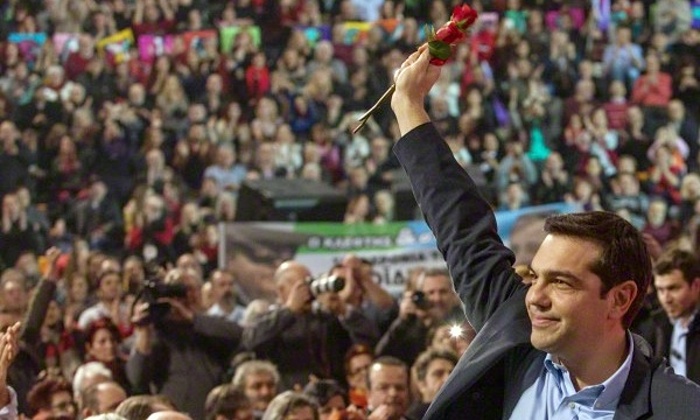
Alexis Tsipras, the prime minister of Greece, greets supporters after a rally of the governing Syriza party.
credit - Photograph: Sotiris Barbarousis/Sotiris Barbarousis/epa/Corbis // The Guardian
The rising crescendo of bickering and acrimony within Europe might seem to outsiders to be the inevitable result of the bitter endgame playing out between Greece and its creditors. In fact, European leaders are finally beginning to reveal the true nature of the ongoing debt dispute, and the answer is not pleasant: it is about power and democracy much more than money and economics.
Saturday, June 27, 2015
Greece- This Is What Class War Looks Like
| Greek People to Vote July 5 on “Blackmailing Ultimatum” Anastasios Papapostolou June 26, 2015 Greek Reporter Late Friday night Greek Prime Minister Alexis Tsipras announced Greece will hold a referendum on July 5 to ask Greek citizens if they approve the proposed bailout agreement put forward by Greece’s foreign creditors. “I call on the Greek people to rule on the blackmailing ultimatum asking us to accept a strict and humiliating austerity without end and without prospect, ” Tsipras said. Included: Tsipras’ address to the Greek people and a link to the creditors’ proposal.  Greek Prime Minister Alexis Tsipras, European Union-European Parliament/Martin Schulz, Greek Prime Minister Alexis Tsipras announced that Greece will hold a referendum on July 5 to ask the Greek people if they approve of a bailout deal with the country’s creditors. In a nationally televised address after midnight Friday in Athens, Tsipras announced the July 5 vote and excoriated a take it-or-leave it offer as a violation of European Union rules and “common decency”. “After five months of tough negotiations, our partners unfortunately resorted to a proposal-ultimatum to the Greek people,” Tsipras said. “I call on the Greek people to rule on the blackmailing ultimatum asking us to accept a strict and humiliating austerity without end and without prospect.” for background on the conflict see http://www.dsausa.org/a_greek_tragedy_act_iii_dl |
Monday, October 06, 2014
Hong Kong movement for Democracy

When the British handed Hong Kong over to China in 1997, the Chinese government promised both in the Sino-British Joint Declaration and the mini constitution of Hong Kong (the Basic Law) that a democratic system eventually would be implemented in Hong Kong.
However the current resolution passed by the Chinese National People’s Congress for implementing that promise by 2017 would sharply restrict candidates for political office to those preselected by an unrepresentative body representing mainly business interests.
The struggle to create a political system with more democratic self-determination is an essential step towards rectifying the growing economic inequality in Hong Kong.
As democrats and as socialists we support our sisters and brothers in Hong Kong who are fighting for the same goals we have in the USA.
Wednesday, May 21, 2014
The Crisis in Democracy and Education
James Banks. In Educating Citizens in an American Society
says,

“A
fundamental premise of a democratic society is that citizens will participate
in the governing of the nation and that the nation-state will reflect the
hopes, dreams, and possibilities of its people. People are not born democrats.
Consequently, an important goal of the schools in a democratic society is to
help students acquire the knowledge, values, and skills needed to participate
effectively in public communities. Educating students to be democrats is a
challenge in any kind of society. It is a serious challenge in a society
characterized by cultural, ethnic, racial, and language diversity, especially
when these variables are used to privilege some individuals from some groups
and to deny others equal opportunities to participate.” (p. 1)
The promotion of democracy should be a central
goal of schooling. Teachers should promote and cultivate democratic values. One
way we promote democracy is to teach about civic responsibility, the electoral
process, and the U.S. Constitution. A second way is to teach using social
participation and service learning strategies . A third way to promote
democracy in the classroom is by developing in students a preference for fairness,
justice, and mutual respect; these are issues of classroom management.
Excerpts from Choosing Democracy: a practical guide to
multicultural education. ( 4th. edition. 2010)
Monday, October 31, 2011
Arizona's experiment in Democracy Failing;
Arizona's Experiment in Democracy Failing... Badly
By Roberto Dr. Cintli Rodriguez
The experiment in Democracy seems to be failing badly in Arizona. Here, government, the state legislature, law enforcement, the educational system, the courts and the media are a testament to this colossal failure. Here, rampant hate and bigotry starts at the top and here, it is government by [ugly] mob rule.
A court proceeding earlier this month in Phoenix – with a decision expected any day now – attests to this experiment gone awry; the court hearing was as absurd as the daily Kangaroo trials in Tucson known as Operation Streamline (70 migrants are charged, tried, convicted and sentenced in one hour). This Phoenix proceeding was part of an appeals process, being held to determine whether Tucson’s Mexican American Studies (MAS) Department is out of compliance with HB 2281, the state’s anti Ethnic Studies or mind control measure. The program graduates nearly 100% of its students and sends over 70% percent of them to college. Yet, these phenomenal accomplishments are of little consequence for those trying to eliminate it.
Monday, February 07, 2011
Support Democracy in Egypt
Hany Khalil, who wrote the op-ed piece below, is a founding member of the War Times organizing crew. He wrote this piece especially for folks who may not be deeply informed about recent Egyptian history. If you've got friends and acquaintances who might get something from this view from an Egyptian American schoolteacher, please forward Hany's piece on to them.
To Support Democracy in Egypt, Suspend U.S. Military Aid
By Hany Khalil
(Photos of San Francisco Demonstration by Neal Cassidy)
As an Egyptian American, I welcome the Egyptian people’s call for President Mubarak to go. So should all of us, for democracy will be good for Egyptians and Americans both.
 For thirty years Mubarak’s authoritarian government has held down the Egyptian people with an iron fist. Under emergency laws imposed in 1981, Egypt’s hated security police routinely violate basic civil liberties guaranteed in our own Bill of Rights. Freedom of assembly, freedom of expression, freedom from cruel and unusual punishment, the right to a speedy and fair trial – none are protected in Egypt. Dissent is rewarded with indefinite detention without charge, beatings, and torture.
For decades Mubarak’s party, the NDP, has rigged elections. In last fall’s elections, the NDP used restrictions on public campaigning, arbitrary arrests, violence, and ballot stuffing to push the opposition out of parliament. The result: The opposition’s share of seats in parliament dropped from 25% to 3%.
Until recently, President Mubarak had planned to hand over the reins of the government to his son Gamal, as if he were the head of a Pharaonic dynasty rather than an elected president.
Under Mubarak, connections and bribery decide who gets jobs, permits, contracts, and favorable treatment by government officials.
Sunday, July 12, 2009
HIstory of the coup in Honduras

Honduras had a new kind of coup
The upheaval epitomizes a new kind of Latin American struggle, in
which elected leftist leaders defy the status quo and test the limits
of democracy.
By Tracy Wilkinson
July 12, 2009
Reporting from Tegucigalpa, Honduras — On Saturday, June 27, the order
came down: Arrest the president.
That night, Honduran military officers stopped taking calls from U.S. officials.
At sunrise Sunday, army commanders firing warning shots into the air
marched through the back door of the president's home, rousted him
from bed and took him away, still in his pajamas.
It was over in 15 minutes. But the coup that toppled President Manuel
Zelaya was a slow boil, over many months, of an increasingly arbitrary
and provocative leader, the often-exaggerated fears of a hidebound
elite and a military with divided loyalties.
That simmering crisis exploded into one of the most serious challenges
facing Latin America in a decade. In some ways, it was a throwback to
the old Latin America, when coups and men in uniform more often than
not decided who ruled. But it was also emblematic of a struggle
underway today on the continent, where a crop of leftist leaders with
authoritarian tendencies have risen to power through elections, defied
the status quo and tested the bounds of democracy.
The following account is based on interviews with numerous Hondurans
and foreigners involved in the coup or the events that led to it. Some
details are still in dispute.
::
When he won the presidential election in 2005 by a narrow margin,
Zelaya was something of an outsider -- gruff, not fully part of the
elite that had always governed. Even Hondurans who admire him,
however, say he became enamored of the power he thought he had.
His ticket, he soon decided, was to align himself with the emerging
bloc in the region headed by Venezuelan President Hugo Chavez, an
erratic, charismatic populist who evokes passionate extremes of
admiration and hatred. Zelaya adopted Chavez's socialist rhetoric, his
bluster, even the gimmicky dress. (He started wearing a white cowboy
hat as his symbol.)
Zelaya managed to push through legislation that helped the poor and
ruffled the elite, including a huge raise in the minimum wage, in a
country where 40% of the population lives on less than a dollar a day.
But power was more important to him than solid ideology.
"For him, it was all about becoming a big figure," said Juan Ramon
Martinez, a historian and political analyst who had many dealings with
Zelaya. "If he had to dance the cha-cha-cha, he'd do it. If he had to
spout Marxist rhetoric, he'd do it."
Ideology might not have been important to Zelaya, but it was to his
inner circle, whose members traced their roots to Honduras' small
radical left that emerged in the 1970s. They had gone to university
together, fought against the brutal military dictatorships of the day,
suffered persecution. Eventually they went into human rights or became
lawyers, but didn't abandon their goals.
They helped coax Zelaya to the left, and last year he stepped firmly
into the Chavez camp by joining a group of Latin America's leftist
presidents formed five years ago by the Venezuelan leader and Cuba's
Fidel Castro.
With the old left gaining power, the old right leapt into action, with
businessmen and the news media at their service, hitting back at
Zelaya relentlessly.
Then came an old trauma. Zelaya began speaking of changing the
constitution, and his enemies decided he was making a move to end term
limits and so he could stay in office -- much as Chavez had done in
Venezuela.
The Honduran Constitution bars presidential reelection, a provision
born of a history replete with rulers who overstayed their welcome.
Most famously, Tiburcio Carias, a military man with close ties to the
foreign-owned fruit companies that made Honduras the original banana
republic, rewrote the constitution to stay in office from 1933 to
1949.
In March, Zelaya called for a vote June 28 to weigh support for
changing the constitution. Initially, the wording of the convocation
was innocuous enough, and momentum built behind the "consulta
popular," as it was being called. It had a lot of support among a
disaffected majority for whom Honduras' 27-year experiment in
democracy had failed to improve daily life.
On May 12, the attorney general's office ruled against holding the
vote. Zelaya ignored the order and pressed ahead with his campaign.
Congress, led by Roberto Micheletti, a transportation magnate from
Zelaya's Liberal Party, also opposed the vote. Honduras' tiny rich
class is notoriously loath to share its wealth, and members saw
Zelaya's move to tinker with the constitution as the last straw. They
organized street protests and a media blitz against the referendum.
"Never had a ruler so frightened the instruments of political and
economic power," historian Martinez said.
Pressure mounts
In mid-June, events started to veer precipitously toward disaster.
On June 12, the military high command met secretly, pointedly leaving
Zelaya out of the loop. Coup rumors that had ricocheted around the
capital for weeks grew stronger. Five days later, Zelaya's defense
minister quit, though this development would not be revealed for a
week.
Ignoring an appeals court ruling that again declared the June 28 vote
illegal, Zelaya announced that the army would help with the election
by distributing and collecting ballot boxes.
This threw the army command into turmoil: It was being tasked to carry
out an operation that had been judged illegal.
On Thursday, June 25, troops deployed throughout the capital as
Congress met to depose Zelaya. Politicians, including Micheletti,
worked to put together the legal and constitutional cover to remove a
president who was breaking the law.
The next day, La Gaceta, the government's official register of laws,
published the decree convoking the following Sunday's vote. Zelaya's
enemies contend that the wording of the final decree had been changed
in a way that would allow hasty revision of the constitution through a
constituent assembly. Non-Honduran analysts say a series of
legislative steps would still have been required.
But logic really didn't matter at this point; the die was cast.
U.S. officials apparently underestimated how serious and how advanced
the crisis was. In the final weekend before the coup, they were
frantically telephoning Honduran contacts in an attempt to avert it.
They spoke on several occasions to commanders of the Honduran army,
with which the United States has had a long relationship.
But in the hours before the coup, U.S. officials found they could no
longer reach the officers.
A defining move
Juan Ramon Martinez likes to get up early on Sundays. Quiet time to
write and think. About dawn on June 28, he was sitting at his computer
in his home a block or two from one of President Zelaya's residences.
Suddenly he heard gunfire. He stepped gingerly out the front door to
ask the young watchman what was happening. "Golpe de estado!" the man
answered in a loud whisper. A coup. Martinez turned to see a huge
soldier in battle dress standing in the street a few feet away. "Get
back in your house!" the soldier barked.
Fifteen minutes later, it was over. An army team, under the command of
a general and two colonels, had seized Zelaya.
Up to this point, the coup plotters might have been able to justify
their actions to the international community by arguing that the
military was fulfilling a legitimate court order to arrest the
president. What happened next, however, deprived them of that luxury.
The military bundled Zelaya away to a military aircraft. Still in his
pajamas, the president was flown to Costa Rica.
Even among some who supported the removal of Zelaya, the decision to
expel him went beyond the pale, and the army's chief juridical advisor
now acknowledges that the expulsion was illegal.
"It has made Honduras look bad for an action being taken to benefit a
democratic system," said Jorge Canhuate Larash, one of the country's
most powerful businessmen.
The military has assumed responsibility for what it says was a
last-minute decision to remove Zelaya from the country, arguing that
to leave him in a prison in Honduras would have invited mobs to
attempt to break him free. But many here don't think they made the
decision alone.
It is not clear what kind of role the Roman Catholic Church, another
pillar of power and influence here, played before to the coup;
Cardinal Oscar Andres Rodriguez Maradiaga was at the Vatican that
week. But within days he lent fervent support to the action.
Nine days after the coup and two days after Zelaya attempted
unsuccessfully to land at the airport, the cardinal was overheard on
his cellphone to the attorney general, urging him to produce drug
trafficking evidence against Zelaya. "My son," he said, "we need that
proof. It's the only thing that will help us now."
Two days later, one of Latin America's veteran negotiators, Costa
Rican President Oscar Arias, invited Zelaya and Micheletti to his home
for talks. But the ousted leader and the man who deposed him refused
to sit in the same room.
More talks were vaguely planned, Micheletti flew back to Honduras, and
Zelaya bounced around from capital to capital, in any country that
would have him.
From the Los Angeles Times
Special correspondent Alex Renderos contributed to this report.
Thursday, October 02, 2008
Defend Bolivia's Democracy
Respect Bolivia's Democracy
By Bill Fletcher, Jr.- BlackCommentator.com Executive Editor
October 2, 2008
http://www.blackcommentator.com/293/293_aw_bolivia_democracy.html
There is a struggle underway in Bolivia which has been
largely overlooked or misrepresented in the mainstream
circles in the USA. For the first time ever in Bolivia,
the majority of the population exercises its rights as
fully recognized citizens through electoral and civic
participation. Efforts to battle poverty and
illiteracy, the largest societal ills, are underway.
Indian families, who for centuries suffered the
consequences of racist policies, including economic
deprivation, and physical violence, (much like African
Americans, Latinos, Asians and Native Americans in the
USA) are finally respected and recovering their
dignity.
While one would have hoped for enthusiasm here at home,
the response to Bolivia's efforts within establishment
political circles in the USA has been less than
welcoming. Under the leadership of Evo Morales, that
country's first Indian president, Bolivia is pursuing a
national economic development plan to uplift all of its
citizens. According to a 2005 United Nation Development
Programme report, at least six out of ten Bolivians
have incomes below the poverty line, and wealth
polarization is very significant between those at the
bottom, and the rich elite which has traditionally
dominated Bolivian society. The infant mortality rate
fares no better and is one of the worst in the region.
Faced with this reality, the Bolivian government
understands that rectifying its historical inequalities
is no small feat, but nevertheless, a necessary one for
the nation to advance.
In North America in the late 1800's, the Confederate
States of America seceded from the United States of
America and waged a bloody civil war against the North.
Wealthy landowners plotted to keep the wealth of the
South to themselves and out of the hands of Northern
industrialists who were developing the nation at a
rapid pace. While the retention of economic and
political power by Southern elites was the real issue
at hand, racist arguments and slavery (the basis for
their wealth) were used to justify their treasonous
actions to the world.
Today, an analogous secessionist movement is underway
in Bolivia's wealthiest region, Santa Cruz. After a
referendum vote recently ratified Evo Morales as
Bolivia's democratically elected president by an
overwhelming majority, there should be no more support
given to such illegal measures. This province holds
abundant natural resources and much of Bolivia's wealth
is derived from its natural gas, farmland, iron ore,
water and forests. As their constitution reads, these
riches should be used for the development of the entire
society, not for the benefit of a few.
Currently, democracy is on the line as a small sector
of opposition actors known to use racist violence
against the poor, have called for the overthrow of the
president and for secession. They have done so by
utilizing the national media which has mobilized the
most radical right-wing sectors to take to the streets
and engage in civil disobedience. Unfortunately, these
actions have been all but civil, including the
instigation of violence. Although the Bush
Administration has chosen to stand by those calling to
secede and in so doing support the most racist and
backward elements of Bolivian society, it is the hope
of fair and genuinely democratic-minded people that
Bolivia's right to sovereignty and respect for its
constitution will be honored by the United States.
Secession, and the balkanization of Bolivia would be a
disaster for the people of Bolivia (and the region),
just as such processes have been disasters in Eastern
and Central Europe, Africa and Central Asia. The
nation-state is tasked with helping to redistribute the
wealth of a country. In those countries with
enlightened leaders, such redistribution pays attention
to historic injustices that must be repaired. For this
reason, we in the USA should be very careful before
responding favorably to abstract calls for democracy
that actually hide the ambitions of the wealthy elites.
After all, in our own history the Confederate States of
America claimed that they were fighting a war against
Northern alleged aggression and oppression. Most
histories, however, tell a very different story.
We in the USA should respect Bolivia's right to self-
determination and refrain from unhelpful interference.
Just as the struggle against secession in North America
between 1861-65 was an internal matter for the people
of the USA to settle, so too is it for the people of
Bolivia today.
______
BlackCommentator.com Executive Editor, Bill Fletcher,
Jr., is the Executive Editor of BlackCommentator.com, a
Senior Scholar with the Institute for Policy Studies,
the immediate past president of TransAfrica Forum and
co-author of the book, Solidarity Divided: The Crisis
in Organized Labor and a New Path toward Social Justice
(University of California Press), which examines the
crisis of organized labor in the USA.
By Bill Fletcher, Jr.- BlackCommentator.com Executive Editor
October 2, 2008
http://www.blackcommentator.com/293/293_aw_bolivia_democracy.html
There is a struggle underway in Bolivia which has been
largely overlooked or misrepresented in the mainstream
circles in the USA. For the first time ever in Bolivia,
the majority of the population exercises its rights as
fully recognized citizens through electoral and civic
participation. Efforts to battle poverty and
illiteracy, the largest societal ills, are underway.
Indian families, who for centuries suffered the
consequences of racist policies, including economic
deprivation, and physical violence, (much like African
Americans, Latinos, Asians and Native Americans in the
USA) are finally respected and recovering their
dignity.
While one would have hoped for enthusiasm here at home,
the response to Bolivia's efforts within establishment
political circles in the USA has been less than
welcoming. Under the leadership of Evo Morales, that
country's first Indian president, Bolivia is pursuing a
national economic development plan to uplift all of its
citizens. According to a 2005 United Nation Development
Programme report, at least six out of ten Bolivians
have incomes below the poverty line, and wealth
polarization is very significant between those at the
bottom, and the rich elite which has traditionally
dominated Bolivian society. The infant mortality rate
fares no better and is one of the worst in the region.
Faced with this reality, the Bolivian government
understands that rectifying its historical inequalities
is no small feat, but nevertheless, a necessary one for
the nation to advance.
In North America in the late 1800's, the Confederate
States of America seceded from the United States of
America and waged a bloody civil war against the North.
Wealthy landowners plotted to keep the wealth of the
South to themselves and out of the hands of Northern
industrialists who were developing the nation at a
rapid pace. While the retention of economic and
political power by Southern elites was the real issue
at hand, racist arguments and slavery (the basis for
their wealth) were used to justify their treasonous
actions to the world.
Today, an analogous secessionist movement is underway
in Bolivia's wealthiest region, Santa Cruz. After a
referendum vote recently ratified Evo Morales as
Bolivia's democratically elected president by an
overwhelming majority, there should be no more support
given to such illegal measures. This province holds
abundant natural resources and much of Bolivia's wealth
is derived from its natural gas, farmland, iron ore,
water and forests. As their constitution reads, these
riches should be used for the development of the entire
society, not for the benefit of a few.
Currently, democracy is on the line as a small sector
of opposition actors known to use racist violence
against the poor, have called for the overthrow of the
president and for secession. They have done so by
utilizing the national media which has mobilized the
most radical right-wing sectors to take to the streets
and engage in civil disobedience. Unfortunately, these
actions have been all but civil, including the
instigation of violence. Although the Bush
Administration has chosen to stand by those calling to
secede and in so doing support the most racist and
backward elements of Bolivian society, it is the hope
of fair and genuinely democratic-minded people that
Bolivia's right to sovereignty and respect for its
constitution will be honored by the United States.
Secession, and the balkanization of Bolivia would be a
disaster for the people of Bolivia (and the region),
just as such processes have been disasters in Eastern
and Central Europe, Africa and Central Asia. The
nation-state is tasked with helping to redistribute the
wealth of a country. In those countries with
enlightened leaders, such redistribution pays attention
to historic injustices that must be repaired. For this
reason, we in the USA should be very careful before
responding favorably to abstract calls for democracy
that actually hide the ambitions of the wealthy elites.
After all, in our own history the Confederate States of
America claimed that they were fighting a war against
Northern alleged aggression and oppression. Most
histories, however, tell a very different story.
We in the USA should respect Bolivia's right to self-
determination and refrain from unhelpful interference.
Just as the struggle against secession in North America
between 1861-65 was an internal matter for the people
of the USA to settle, so too is it for the people of
Bolivia today.
______
BlackCommentator.com Executive Editor, Bill Fletcher,
Jr., is the Executive Editor of BlackCommentator.com, a
Senior Scholar with the Institute for Policy Studies,
the immediate past president of TransAfrica Forum and
co-author of the book, Solidarity Divided: The Crisis
in Organized Labor and a New Path toward Social Justice
(University of California Press), which examines the
crisis of organized labor in the USA.
Subscribe to:
Posts (Atom)