Why We Recommend a NO in the Referendum - In 6 Short Bullet Points
By Yanis Varoufakis
July 1, 2015
Yanis Varoufakis
Negotiations have stalled because Greece's creditors (a) refused to reduce our un-payable public debt and (b) insisted that it should be repaid `parametrically' by the weakest members of our society, their children and their grandchildren
The IMF, the United States' government, many other governments around the globe, and most independent economists believe - along with us - that the debt must be restructured.
The Eurogroup had previously (November 2012) conceded that the debt ought to be restructured but is refusing to commit to a debt restructure
Since the announcement of the referendum, official Europe has sent signals that they are ready to discuss debt restructuring. These signals show that official Europe too would vote NO on its own `final' offer.
Greece will stay in the euro. Deposits in Greece's banks are safe. Creditors have chosen the strategy of blackmail based on bank closures. The current impasse is due to this choice by the creditors and not by the Greek government discontinuing the negotiations or any Greek thoughts of Grexit and devaluation. Greece's place in the Eurozone and in the European Union is non-negotiable.
The future demands a proud Greece within the Eurozone and at the heart of Europe. This future demands that Greeks say a big NO on Sunday, that we stay in the Euro Area, and that, with the power vested upon us by that NO, we renegotiate Greece's public debt as well as the distribution of burdens between the haves and the have nots.
[Yanis Varoufakis is Greece's Finance Minister]
How I Would Vote in the Greek Referendum
By Joseph Stiglitz
June 29, 2015
The Guardian (UK)
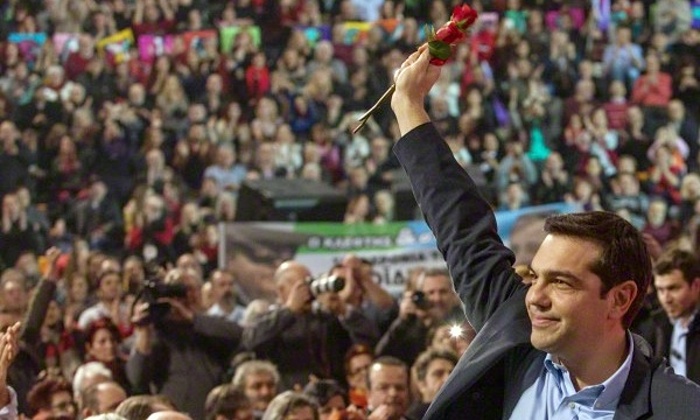
Alexis Tsipras, the prime minister of Greece, greets supporters after a rally of the governing Syriza party.
credit - Photograph: Sotiris Barbarousis/Sotiris Barbarousis/epa/Corbis // The Guardian
The rising crescendo of bickering and acrimony within Europe might seem to outsiders to be the inevitable result of the bitter endgame playing out between Greece and its creditors. In fact, European leaders are finally beginning to reveal the true nature of the ongoing debt dispute, and the answer is not pleasant: it is about power and democracy much more than money and economics.


