Thursday, January 30, 2020

Latino Voter Outreach in Iowa


Nation’s Oldest & Largest Latino Civil Rights Organization to Discuss Successful Voter Outreach Campaign; 70% of Adult Latinos Are Now Registered to Vote in the Hawkeye State


Des Moines, Iowa - Today, January 30th, the League of United Latin American Citizens (LULAC) announced the results of the organization’s successful Latino voter outreach efforts in Iowa. During a press conference at the Iowa State Capitol, LULAC National President, Domingo García, was joined by LULAC Iowa leaders and newly registered first-time Latino voters to discuss the importance of the powerful Latino electorate in Iowa and the implications for the 2020 Caucuses.


According to the State of Iowa, the Latino population in Iowa increased by 135.8% from 2000-2018. LULAC has a long record of defending voting rights for Latinos in Iowa. In 2016, LULAC initiated a successful voter registration campaign during the presidential election. The impressive ground operation executed by LULAC Iowa’s eighteen councils-- which included the LULAC Vote Van that traveled over 5,000 miles across the state-- ensured that Latinos represented one out of eight Iowa caucus-goers in 2016.


LULAC continued its voter outreach following the 2016 election and this cycle, 70% of adult Latinos are currently registered to vote in Iowa, meaning Latinos will represent one out of every four Caucus goers in 2020. In a state with a smaller population, LULAC’s grassroots work means that Iowa’s Latinos will finally have a big seat at the caucus table.


LULAC has been at the forefront of protecting voter rights in the Hawkeye State. In October 2019, LULAC celebrated a victory when District Court Judge Scott D. Rosenberg ruled in favor of the organization in a lawsuit that challenged Iowa’s voter ID law. The ruling resulted in the court rejecting a controversial rule that would have allowed state voter records to be compared to the federal immigration database known as SAVE. As a result of the unlawful rule, certain voters would have been identified as ineligible to vote and removed from Iowa’s voter lists. The ruling held that Iowa Secretary of State Matt Schultz acted outside his authority in creating the rule.


“Underestimating the Latino vote in Iowa could cost the Democratic primary candidates the Iowa Caucus this year,” said Domingo García, LULAC National President. “We know this because our local LULAC councils spent years throughout the state doing outreach, talking to our neighbors, hitting the phones, holding community meetings, and getting Latinos registered to vote. One of every four voters that will participate in the Iowa Caucus on Monday will be Latino. If that doesn’t encourage candidates to care about what matters to our community, it’s unclear what will.”


“The Latino community has become the largest minority voting block as we head into the 2020 elections. Every 30 seconds, a Latino turns 18 in this country,” said LULAC CEO Sindy Benavides. “These statistics matter even more in states with smaller populations like Iowa, which sets the tone for the rest of the Democratic presidential primary. LULAC’s eighteen Iowa councils organized on the ground, resulting in more than 50,000 registered Latino voters because of their tremendous efforts.”

Border Wall Blown Over by Wind

Gusty winds blew over a portion of President Trump's border wall with Mexico in California

USA TODAY
A construction crew works on a fallen section of the US-Mexico border wall as seen from Mexicali, Baja California state, Mexico, on January 29, 2020.
A portion of President Donald Trump’s border wall blew over from gusty winds Wednesday, falling on the Mexican side of the border.
The newly installed panels were a part of an ongoing project to improve existing parts of the wall in Calexico, California.  
Agent Carlos Pitones of the Customs and Border Protection in El Centro, California, told CNN that the new concrete foundation had not yet cured when the wall panels fell down amid windy conditions.
“We are grateful there was no property damage or injuries,” Pitones said.

Wednesday, January 29, 2020

When Ice Comes Knocking - Resist


Follow link to step by step procedures.

Link to the publication: 
https://issuu.com/news_review/docs/ice_110918?e=2059002/65749844


Sunday, January 26, 2020

Not Me; Us - the Sanders Campaign

 Not Me; Us - the Sanders Campaign: Naomi Klein, IT MADE FOR  a tough juxtaposition. Late Monday night, CBS News  reported  that Bernie Sanders had just done exactly wha...

Friday, January 24, 2020

Mexico National Guard Stops Honduran Caravan

FRONTERA HIDALGO, Mexico (AP) — Hundreds of Central American migrants were hauled onto buses by Mexican national guardsmen and immigration agents after crossing into the country early Thursday and walking for hours along a rural highway.
The migrants had stopped for the day at a shaded crossroads when hundreds of national guard troops advanced their lines to within 100 yards (meters) of the migrants. A brief negotiation stalled, the migrants knelt to the ground in prayer and began to chant “we want to pass.”
National guardsmen in riot gear advanced banging their plastic shields with batons and engaged the migrants. There was shoving and pepper spray as migrants were rounded up.
Many of the people allowed themselves to be escorted to the buses without resistance. Women cradling small children or holding kids’ hands wept as they walked toward the buses.
Others resisted and were subdued by guardsmen. One man dragged by four guardsmen shouted “they killed my brother, I don’t want to die,” presumably in reference to the possibility of being returned to his country.
A woman crying as she walked toward a bus said, “I have a great need for my children.”
A paramedic attended to an injured woman lying on the highway shoulder.The road was left littered with water bottles, plastic bags and clothing. An irate man in a blue shirt yelled at the agents “this is a war against the Hondurans,” gesturing angrily.
It was a sudden climax after the day had seemed to be winding down.
Carrying U.S. and Honduran flags at the head of the procession, the migrants had been walking on a highway toward hundreds of national guardsmen since crossing the Suchiate river from Guatemala at dawn.
Jose Luis Morales, a Salvadoran de facto spokesman for the caravan, said the migrants wanted to negotiate to be allowed to pass peacefully.

Monday, January 13, 2020

Democrats Have Yet to Win the Latino Vote- and the Election

THE DEMOCRATIC CANDIDATES NEED TO STOP MAKING EXCUSES AND AVOID OBAMA’S MISTAKES. THE HISPANIC POPULATION IS MUCH MORE THAN AN ELECTORAL FAD.
MIAMI : I am dreading the 2020 presidential race, which I think will be the most brutal Americans have ever witnessed. Irrespective of who the Democratic nominee is, President Trump will use all the power and dirty tricks at his disposal to remain in power for another four years.
As was the case in 2016, if Democrats want to have any chance of defeating Mr. Trump they will need the strong support of Latino voters. This time, however, they will have to work extra hard to get it.
The truth is that no candidate will be able to win the White House without Latino votes. Not even Mr. Trump, who got 29 percent of the Hispanic vote in 2016. A higher Latino turnout in states like Florida and Arizona could have produced a completely different outcome that year. Mr. Trump would never have won the presidency without Florida’s 29 electoral votes and Arizona’s 11.
The number of eligible voters of Hispanic background who did not cast a ballot in 2016 was heartbreakingly high. Over half of the 27 million eligible Hispanic voters stayed home. Why? Although many of them didn’t want to vote for Mr. Trump, in part because he had made racist remarks about Mexican immigrants, they weren’t at all enthusiastic about Hillary Clinton.
This year, for the first time in history, Hispanics will be the largest minority group of potential voters in the United States. According to the Pew Research Center, 32 million Latinos will be eligible to vote in 2020, compared with 30 million African-Americans.
If Hispanics shake off their apathy and turn out in record-high numbers in crucial states, a Democrat may well defeat President Trump. But for this to happen, the Democrats must be honest with the Latino community: They must vow not to fall into the same traps they have in the past.

Saturday, January 11, 2020

War Is a Racket


The last week has been a roller coaster.
Many of us have breathed a slight sigh of relief as things deescalate a bit around Iran. But this doesn’t mean it’s over. Far from it. The need for a broad based, working-class anti-war movement, led by the communities most affected, has become yet more clear. The bipartisan drumbeat for war in Washington and in the capitalist media, the surveillance rhetoric coming from Democratic mayors, and the way Republicans labeled any debate as traitorous, were immediate and could be revived at any time. And the silent war against civilians, of sanctions, will continue and will disproportionately hurt the poor. We have seen that civilians always suffer in the war zone.
Besides the catastrophic results of even a proxy war in the Middle East for Iranians, Iraqis and others in the region, including undocumented, displaced Afghans in Iran, the domestic impact here can’t be overstated. Medicare for All would be off the table. Abolishing student debt would be off the table. Disaster response for Puerto Rico, rocked by their worst earthquakes in a century, would be off the table. A Green New Deal, our only hope for stopping the kind of climate change induced extreme weather that has led to massive fires in Australia and massive floods in Indonesia (mirroring our own fires and floods in 2019), would be off the table. A federal housing guarantee, which would directly benefit the tens of thousands of homeless veterans that the U.S. capitalist class has discarded after using their bodies for war, would be off the table.
Investment in public programs that benefit us all would be cut so that poor and working class people could be sent abroad to kill other poor and working class people.
And, those that would see us divided would continue to drive deeper wedges. Here in New York, there has been a string of violent antisemitic attacks. Many of us responded with solidarity. But the media and the politicians are using the opportunity to call for repeal of a hard-fought bail reform law which took effect January 1st. Internet trolls pit black people and Jews against each other, a project which would only be strengthened by war, along with Islamophobia and xenophobia.
Yet, as always, I have hope.
Prior to Trump’s assassination play, Iran was rocked by working class protests against the rising cost of fuel. 
India’s Hindu nationalist prime minister Narendra Modi faces widespread protests over draconian measures targeting India’s Muslim minority, the latest a mass strike of 250 million people just yesterday.
And here in the U.S., DSA and our allies in struggle are in the streets and building our power.

Monday, January 06, 2020

Mexicanos solicitantes de asilo en EU podrían ser enviados a Guatemala

Mexicanos solicitantes de asilo en EU podrían ser enviados a Guatemala: Los connacionales serán incluidos en los grupos 'susceptibles', indicó el Servicio de Ciudadanía e Inmigración de Estados Unidos.

National Migration Week- Pope

In his 2019 World Day of Migrants and Refugees message, the Holy Father reiterates
(Mt 18:10). It is not just about migrants: it is a question of seeing that no one is excluded. A globalization of indifference has led to many of us to ignore the cries of the poor, turn our backs on the marginalized, and remain indifferent to those struggling to find a better life. We are called to help create the conditions that will lead to a better life for everyone on the planet. 
From January 5-11, 2020, the Catholic Church in the United States will celebrate National Migration Week. The theme for this year’s celebration is “Promoting a Church and a World for All,” which reflects the need for Catholics to be inclusive and welcoming to all our brothers and sisters. It is a call for unity to stand in solidarity with and care for those who are excluded and marginalized. 
Welcoming the newcomer and promoting a church for all counters what Pope Francis has referred to as “a globalization of indifference,” which has led to many of us to ignore the cries of the poor, turn our backs on the marginalized, and remain indifferent to those struggling to find a better life. We are called to be an active Church in support of all of God’s children, for “the Church which ‘goes forth’... can move forward, boldly take the initiative, go out to others, seek those who have fallen away, stand at the crossroads and welcome the outcast” (Evangelii Gaudium, 24). 
It is with this ideal in mind – that we call for a church that welcomes, protects, promotes, and integrates all, including immigrants and refugees. These four verbs have been used by Pope Francis to frame our obligations toward migrant populations. As he expressed in his message: 
Welcoming means, above all, “offering broader options for migrants and refugees to enter destination countries safely and legally.” We must nurture societies that aim as much as possible to include, rather exclude. A culture of encounter that emphasizes humanity and inherent human dignity best counters anti-immigrant sentiment and welcoming is a vital step in that journey. 
Protecting migrants “may be understood as a series of steps intended to defend the rights and dignity of migrants, independent of their legal status.” The Catholic Church has long emphasized the importance of protecting the human dignity of migrants, both through the implementation of humane policies and through their accompaniment. 

Friday, January 03, 2020

National Migration Week

National Migration Week:
Jan. 5 - 11, 2020


For nearly a half century, the Catholic Church in the United States has celebrated National Migration Week, which is an opportunity for the Church to reflect on the circumstances confronting migrants, including immigrants, refugees, children, and victims and survivors of human trafficking. The theme for National Migration Week 2020, “Promoting a Church and a World for All” draws attention to the fact that each of our families have a migration story, some recent and others in the distant past. Regardless of where we are and where we came from, we remain part of the human family and are called to
live in solidarity with one another.


The United States Conference of Catholic Bishops has produced a toolkit of resources to promote participation in National Migration Week.
Download the toolkit 
here

Wednesday, January 01, 2020

Fighting “Border Madness,” from 1980s Chicano Activism to the Abolish ICE Movement

The movement against racist immigration policing and the detention of child migrants in San Diego in the 1980s offers important lessons in keeping open borders at the forefront of activism. 

December 11, 2019
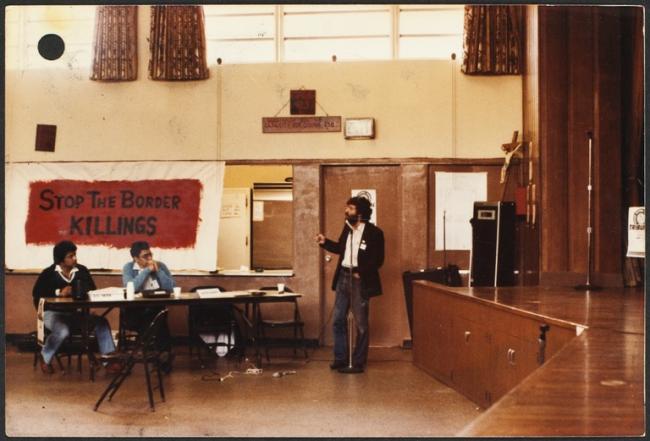
Community members presenting testimony at the Chicano National Immigration Tribunal. (Photo courtesy of the Herman Baca Papers at the University of California San Diego Special Collections and Archives)

This December, we are asking readers to make a tax-deductible contribution before the year is over to ensure NACLA continues to provide only the best in progressive news and analysis on Latin America. Visit nacla.org/donate

In February 1980, Herman Baca, a Chicano activist from San Diego, wrote a letter to President Jimmy Carter demanding he put an end to “border madness.” In the letter Baca detailed how officials from the Immigration and Naturalization Service (INS) were detaining Mexican migrant children in local jails and immigration facilities. In particular, he denounced the detention of a 12-month-old baby as “barbaric” and “inhumane.” While Baca urged Carter to enter into discussion with policymakers, he believed that ultimately the detention of migrant children would only end with the abolition of the INS.
Continuing this activism, in 1981, Baca organized the first community-based call for the abolition of the INS. The call cited the detention of migrant children as an example of the abuse the organization would never cease committing. Such abolition advocacy, which is captured in Baca’s papers held at the University of California San Diego Special Collections and Archives, shows that the movement to abolish institutions of immigration policing did not emerge recently in the face of the Trump administration’s “zero tolerance” policy. While scholars have grounded the movement to abolish Immigrations and Customs Enforcement (ICE) in the ideological history of abolitionism, most have focused on prison abolitionism, overlooking previous movements to eliminate immigration policing. A closer look at Chicano activism in the late 1970s and early 1980s shows that immigration police have long targeted migrant children and that activists have been denouncing related violence for decades. Recognizing that the fight to abolish immigration policing is not new helps to better imagine a just world without immigration policing.

Friday, December 20, 2019

ICE To Collect Data From Adults Picking Up Migrant Kids From Shelters:


Under a secret plan by Trump aide Stephen Miller, federal agents could gather information to target migrants for deportation, The Washington Post reports.

Immigration and Customs Enforcement agents will be able to collect fingerprints and other information from adults who come to get unaccompanied migrant children from shelters under a new plan designed by President Donald Trump’s senior immigration adviser, Stephen Miller, according to The Washington Post
This month the White House planned to have ICE agents embedded in the Department of Health and Human Services’ Office of Refugee Resettlement, which runs government shelters for unaccompanied children who cross the border into the U.S. ― but senior officials at HHS rejected the plan, the Post reported, citing unnamed current and former administration officials. 
However, HHS officials agreed to let ICE collect fingerprints and other biometric information from adults who came to claim unaccompanied children. If the adults were deemed “ineligible” to take the child into custody, ICE could use the information to arrest and deport them.   
This appears to skirt laws meant to limit HHS’ refugee program from being used to deport potential sponsors of unaccompanied children and may drive fear among migrants and discourage potential sponsors living in the United States ― often family members ― from coming forward to get the children out of government shelters.
HuffPost reached out to the White House, ICE and HHS for comment but did not immediately receive a response. 

Tuesday, December 17, 2019

Young Latinos Have Strong Preference for Sanders


By Adrian D. Pantoja

In a previous analysis, I noted that Bernie Sanders is a clear favorite among Latino voters in California. A recent study by The Latino Community Foundation shows that young Latinos have an even stronger preference for Sanders, with over two-thirds rating the senator favorably. The favorability gap between Sanders and the other Democratic contenders is significant, yet all are evaluated higher than Donald Trump. Interestingly, the data show a significant gender gap when it comes to Donald Trump.
Latinas rate Trump unfavorably by 83 percent, while male Latinos rate him unfavorably by 69 percent—a 14 point gap. Regrettably, Elizabeth Warren, the top remaining female candidate, has failed to use this to her advantage. In fact, Warren is rated less favorably by Latinas (44 percent favorable) than by Latinos (52 percent favorable). Given the high stakes of the California primary, the failure of key Democratic candidates to reach out to young Latinas may prove to be a strategic mistake.
Moreover, young Latinos are advantaged because they are overwhelmingly U.S.-born citizens. A lack of citizenship has long stymied the growth of the Latino electorate. That barrier is eroding as the balance of power shifts toward younger voters. Capitalizing on their numbers and energy could prove to be decisive in determining the winner of the Democratic presidential primary. Presently, one candidate appears to be doing just that—Bernie Sanders.
Sanders’ lead among young Latinos is due to his policy issues, the establishment of offices in Latino communities, hiring significant numbers of Latino staff and receiving endorsements from influential Latinos. He is offering a blueprint that others should follow for winning young Latino voters and the wider Hispanic electorate.
***
Adrian D. Pantoja is a Professor of Politics at Pitzer College and Senior Analyst for Latino Decisions.

Thursday, December 12, 2019

U.S. Labor Defends Mexican Labor

DRIVING THE DAY
HOW LABOR BEAT MEXICO ON TRADE: After weeks of negotiations, Mexico was nearly ready to walk away from the USMCA. The issue: whether the AFL-CIO could send American inspectors into Mexican factories where workers weren't being given their full union rights. But, in the end, Mexico agreed to last-minute concessions that will allow multinational inspection teams to investigate allegations of labor violations, POLITICO's Sabrina Rodriguez and Ian Kullgren report. The new enforcement mechanism was enough to win the endorsement of AFL-CIO President Richard Trumka, marking the first time the federation had endorsed a trade agreement since 2001.
Under the deal, "the U.S. can file a complaint to Mexico if it suspects that a factory is denying its workers their union rights," Rodriguez and Kullgren report. "If Mexico agrees that there is a problem at the factory, the Mexican government has 45 days to solve the problem."
But if Mexico does not mitigate the problem, the U.S. can demand creation of a panel made up of three independent labor experts, one of them American, to investigate the facility. (Mexico will be similarly free to investigate and inspect American factories.)
One big victory for Democrats and labor, Rodriguez and Kullgren write, "is that the U.S. can impose stiff penalties on Mexican factories if they fail to uphold union rights. If a factory has recurring violations, the U.S. can block the goods made there from entering the country." 
Ed. note: 
If this seems a little arrogant- it is. Mexico reformed its labor laws to overcome this particular problem of company unions last Spring under the AMLO government.  But, governments come and go.  This tries to establish free labor unions under any government.  Note: Mexico can also investigate U.S. work sites, That should be interesting for Uber, Amazon, and others.

Wednesday, December 11, 2019

Methodist church’s nativity scene depicts Jesus, Mary and Joseph as separated and caged family

Methodist church’s nativity scene depicts Jesus, Mary and Joseph as separated and caged family: A Christmas nativity display outside a Methodist church in southern California features a separated and caged Holy Family, in direct criticism of inhumane administration policies that have included attacks on refugees and the forcible separation of family.

Tuesday, December 10, 2019

Border Patrol Refuses free Vaccination for Migrants

U.S. Border Officials Refuse Free Flu Vaccine For Migrants


US border officials deny request by doctors to administer free flu vaccine to detained migrants. Common Dreams: “A group of doctors seeking to vaccinate migrants detained by President Donald Trump’s Customs and Border Patrol were denied at the gates of the Chula Vista Border Patrol Station in San Ysidro, San Diego Monday. ‘Refusing to vaccinate is inhumane,’ tweeted Immigrant Families Together director Julie Schwietert Collazo. ‘The agency is willingly putting lives at risk of death.’ It was the latest example of what critics of the administration call the “intentional cruelty” of Trump’s immigration policies. ‘People are needlessly suffering and dying,’ said Dr. Marie DeLuca, one of the physicians who was turned away. ‘You can’t lock people up in inhumane conditions, watch them get sick, and then refuse them access to medical care.’ The doctors were supported by a coalition of immigration advocates, including the groups Doctors for Camp Closures, Families Belong Together, and Never Again Action. Monday’s action marks the beginning of a planned week of action by the doctors and others at Chula Vista. In a statement, Families Belong Together chair Jess Morales Rocketto said that recent reporting from ProPublica on the death from flu and border patrol inaction of an immigrant child in detention gave the protest added urgency. ‘This administration’s cruel immigration agenda is intentionally barring life-saving medical care from children by refusing to provide vaccines during flu season,’ said Rocketto. ‘Earlier this year, as immigration authorities sat by, 16-year-old Carlos Gregorio Hernandez Vasquez died from the flu on the floor of his concrete jail cell.'”

Saturday, December 07, 2019

Capitalism, Imperialism, and Borders - Webinar


The Democratic Socialists of America’s Immigrant Rights Working Group organized a very successful webinar on the topic, No One Is Illegal! Capitalism, Imperialism and Borders on November 21. Hundreds of people registered and about eighty participated.  We were assisted by the national office of DSA. 

For those that missed the webinar live, find the link to the recording here.


 We encourage immigrant rights groups and activists  to share it and also organize discussions around it. The speakers explained the roots and nature of the attack on immigrants and presented a working class strategy for resistance and liberation.

This webinar is the first of several that we will be organizing. The next one will be a version of this one in Spanish. Please stay tuned for details on that one. We are also going to be putting together a webinar on practical tips and models for immigrant rights organizing. 

Many on the first webinar asked for more information from the panelists who joined us. See below for both their bios and publications. Also, to supplement these, we encourage everyone to read, share and discuss the many excellent articles in the DSA’s Fall 2019 Socialist Forum

Harsha Walia is a community organizer and cofounder of No One Is Illegal. She is the author of Undoing Border Imperialism. She’s based in Vancouver, British Columbia in Canada.

Todd Miller is the author of Empire of BordersBorder Patrol Nation. You can read an interview that summarizes his argument on Jacobin. He writes for NACLA among other publications. He’s based in Tucson, Arizona. 

Justin Akers Chacon is the author of No One is Illegal and Radicals in the Barrio. He wrote a recent article on Punto Rojo entitled The Anti-Migrant International. He is an immigrant rights activist in San Diego, California and a co-founder of the Coalition to Close the Concentration Camps.

Jorge Mújica is author of Voces Migrantes: Movimiento 10 de Marzo, a member of DSA, an Organizer with Arise Chicago, and a National Council member of the National Writers Union. He is based in Chicago, Illinois. 


Friday, November 29, 2019

Sanders Releases a Real Immigration Plan !


Sanders on Immigration
By far the most progressive plan of any of the candidates.
Key Points
·       Institute a moratorium on deportations until a thorough audit of past practices and policies is complete.
·       Reinstate and expand DACA and develop a humane policy for those seeking asylum.
·       Completely reshape and reform our immigration enforcement system, including breaking up ICE and CBP and redistributing their functions to their proper authorities.
·       Dismantle cruel and inhumane deportation programs and detention centers and reunite families who have been separated.
·       Live up to our ideals as a nation and welcome refugees and those seeking asylum, including those displaced by climate change.
Details
This country is a nation of immigrants. Other than the native peoples of the Americas, every one of our families came here from somewhere else. Some came by choice, some by necessity, and others in chains. As we have developed as a nation, each of us has contributed to the growth and prosperity of America in our own way. And our nation has been most successful and most true to its ideals when that prosperity has been shared among all of us. In many ways, that is what this campaign is about: building a movement to create an America where everyone shares in the prosperity that they and their ancestors helped create.

Read the plan