
THURSDAY, FEBRUARY 25, 2021 AT 5 PM PST – 6:30 PM PST
Border agency reports spike of nearly 6,000 immigrant children crossing into US alone
The surge is low compared to past years, but Covid-19 has reduced housing capacity, necessitating use of a controversial influx facility
Unaccompanied immigrant children deported from the US walk toward Mexico on 22 January. Photograph: José Luis González/Reuters Last modified on Mon 15 Feb 2021 05.03 EST
Thousands of unaccompanied immigrant children are attempting to flee to the United States amid the coronavirus pandemic, propelled by devastating natural disasters, chronic violence, and severe economic hardship at home.
US Customs and Border Protection encountered 5,871 kids at the south-west border without a parent or legal guardian last month, the largest influx yet since the start of the public health crisis in early 2020.
That sudden spike is still relatively modest compared to huge figures from fiscal year 2019, when Border Patrol apprehended more than 76,000 unaccompanied children, a trend that reached its zenith that spring.
But unlike in past years, the Office of Refugee Resettlement – which cares for those kids – has had to slash its housing capacity nearly in half in light of Covid-19. And, with nearly 5,700 of 7,100 total beds already accounted for, ORR is preparing to resurrect a controversial influx facility to create more space.
“Even though the numbers of children in custody are still relatively low by historical standards,” the lack of available shelter beds is cause for concern, warned Mark Greenberg, director of the Human Services Initiative at the Migration Policy Institute.
Greenberg added: “If we return to the levels that had been experienced in all recent years except 2020, it will pose a significant challenge because of Covid.”
As more migrants attempt the arduous journey across the US-Mexico border, CBP officials are citing push factors such as “underlying crime and instability” in their countries of origin and “inaccurate perceptions of shifts in immigration and border security policies”.
Before taking office, Joe Biden’s administration warned that its comparatively pro-immigrant agenda would not translate to an immediate shift in practice at the border. On Wednesday, White House press secretary Jen Psaki reiterated that, despite rare exceptions, the vast majority of migrants are still being turned away.
“Now is not the time to come,” she said.
Since 2014, a flood of immigrant children and families largely from Central America’s Northern Triangle have made their way to the US, many of them in search of refuge from a crush of gang-related violence, poverty and persecution. Between fiscal year 2013 and 2014, CBP apprehensions of unaccompanied children at the south-west border surged by 77%, while apprehensions for families more than quadrupled.
That significant change heralded a new era in US border migration, defined by asylum seekers and other vulnerable populations. In response to the humanitarian crisis, former president Donald Trump devised hard-line tactics to try to deter Central Americans and others from seeking protection in the US, then used Covid-19 as a rationale to effectively shutter the border altogether to defenseless migrants.
Under the guise of public health, the Trump administration subjected hundreds of thousands of people – and at least 13,000 unaccompanied children, according to the ACLU – to rapid expulsion from the US without due process during the pandemic.
A federal judge eventually blocked the US government from applying that policy to unaccompanied minors, and Biden has said he will not resume expulsions for kids who show up without a parent or guardian, according to CBS News.
But amid the border closure, children unable to safely enter US custody have turned to perilous border crossings, said Erika Pinheiro, policy and litigation director at Al Otro Lado.
“They suffer so much,” she said. “And the fact that the US government forces them to suffer more is really hurtful to think about.”
In an elaborate game of telephone, news articles about immigration enforcement in the US and Mexico have gotten distorted in the foreign press, then exploited by smugglers, who have every incentive to spread rumors encouraging people to cross the border.
“There’s sort of like one message that comes out of the news. It gets repeated down here, maybe not completely accurately, and then the smugglers really capitalize on that, too. So it sort of builds on itself,” Pinheiro said.
As the number of unaccompanied children encountered by border enforcement increases to levels not seen since the summer of 2019, ORR is preparing to reactivate a temporary influx care facility in Carrizo Springs, Texas, that will initially be able to house about 700 kids.
ORR said in a statement that officials anticipate “the need to start placing children at Carrizo Springs in 15 days or soon after”, a move that has alarmed some advocates.
“There’s no reason to warehouse these children in these potentially dangerous facilities,” Linda Brandmiller, an immigration attorney in San Antonio, told USA Today.
Unaccompanied kids have been arriving primarily from Guatemala, El Salvador and Honduras in recent years. The vast majority are teenagers.
“In a substantial number of cases, they are fleeing for their lives,” Greenberg said. “But whether that will allow them to qualify for asylum will depend upon how asylum policies are now changed.”
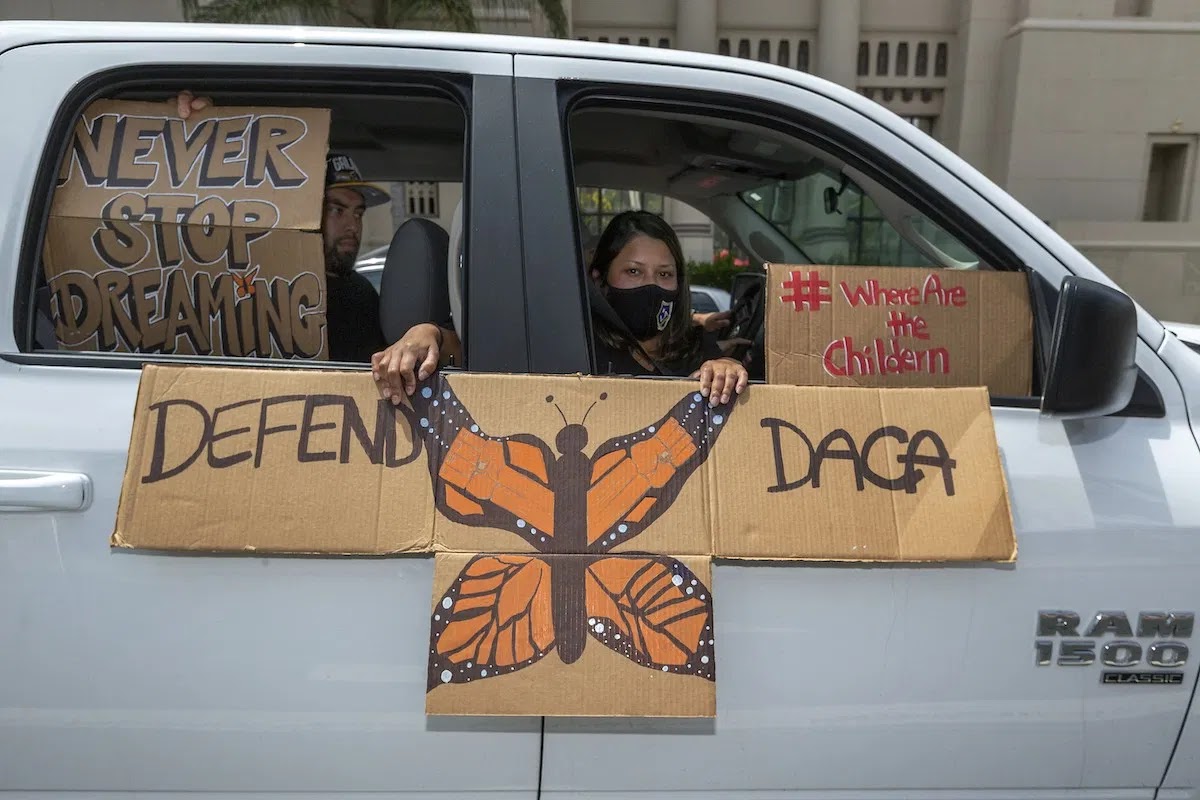
The first two weeks of Joe Biden’s presidency brought relief to millions of people across the country, including those who fight for immigrant justice. So far, we have seen several immigration actions by the Biden administration—including the restoration of Deferred Action for Childhood Arrivals (DACA), the end of the Muslim Ban, the creation of task force to reunite children with their families, the announcement of a moratorium on deportations, and the introduction of legislation to provide a path to citizenship for millions of undocumented people.
In short, President Biden has started the long process of undoing the damage wrought by the Trump administration and is turning federal immigration policies in a new direction.
President Biden deserves credit for honoring key Day One commitments to our communities. But reversing Trumpism can only be the first step. We don’t want to return to “normal.” We need to build toward a more just future.
We need a presidential administration that is prepared to dismantle cruel and inhumane detention and deportation policies and detention centers and reunite families who have been separated.
The Biden administration needs to keep taking action to dismantle the enforcement system, fundamentally reform the government agencies tasked with enforcing immigration to put human rights and needs first, and ensure that Congress adopts a path to citizenship for all of our community members.
Through several hundred executive orders and actions, Trump expedited the building of a racist border wall, tore children from their parents’ arms, banned people based on their religious identity, stripped immigrant youth and Temporary Protected Status (TPS) holders of their protections from deportations, imposed a racist wealth test on our immigration system, and turbo-charged an enforcement apparatus that was already well known for systematically violating people’s rights. The list goes on.
Of course, the Biden administration must make the full reversal of these nativist actions a top priority, and all of these executive actions must be undone. But returning to the 2016 status quo is simply not an acceptable option. It’s worth reiterating what we already know.
First, since 2001, the federal government has poured billions and billions of dollars into an immigration enforcement system that fuels human misery. More money is now spent on immigration enforcement than on all other federal enforcement combined, and the agencies in charge —Immigration and Customs Enforcement and Customs and Border Patrol, both part of the Department of Homeland Security— are notorious for violating detainees’ rights, torture, and even murder. In the last fiscal year, 21 immigrants died in ICE detention. A 2018 analysis found that CBP agents had killed 97 people over the prior 15 years, under both Republican and Democratic administrations.
Second, despite the widespread reporting on rampant abuses, these agencies have proven allergic to accountability. Immediately after Biden’s moratorium announcement, it became clear that ICE officials were refusing to implement the new administration’s policies—unsurprising given what we know about the white supremacist views of many within ICE and CBP.
These are not cases of bad apples who need to be retrained. These are ruthless agencies that must be dismantled.
In addition to fighting to protect the moratorium that has now been attacked by Republican Attorney General Ken Paxton, President Biden and incoming DHS Secretary-Elect Alejandro Mayorkas should establish a goal of ending immigration detention within two years. They can achieve this by immediately reducing detention levels starting by releasing everyone at heightened risk of COVID and simultaneously initiating a file review of every person in ICE custody.
The administration should also end state and local entanglement with federal immigration enforcement that has torn apart families across the country, end the notorious Operation Streamline, and immigration-relation prosecutions.
As it ends these policies, Biden and Mayorkas should adopt new prosecutorial discretion guidelines to significantly reduce the universe of people targeted for deportation with the goals of keeping families together; counteracting racial injustice in the immigration system; declining to pursue charges that are stale via a policy akin to a five-year statute of limitations; allowing people who are eligible for affirmative pathways to legal status a fair chance to comply with the law; and undertaking a complete EOIR docket review consistent with these new guidelines.
This list is not exhaustive, but provides a clear set of policies that would truly move this country away from the racist, abusive enforcement that has characterized the past two decades, and especially the past four years.
Finally, the Day One bill cannot just be a messaging bill. The administration must make it a top priority for passage this year, using every tool at its disposal to ensure legislators pass it on Capitol Hill. With Democrats in control of the White House and both chambers of Congress, there is no reason for delay. President Biden, Speaker Pelosi, and Majority Leader Schumer must work together to deliver the path to citizenship for millions of undocumented immigrants this year.
***
Greisa Martinez Rosas is the Executive Director of United We Dream. Javier H. Valdes is Co-Executive Director of Make the Road New York. Marisa Franco is the Director of Mijente.
Latino Rebels
https://www.nytimes.com/2021/02/06/us/migrants-border-coronavirus-san-diego.html?
Migrant Families Force Biden to Confront New Border Crisis
In recent days, hundreds of migrant families have been released into the United States by Border Patrol agents. Thousands more are hoping for a chance to enter under looser policies.
HOUSTON (AP) — President Joe Biden’s administration has deported hundreds of immigrants in its early days despite his campaign pledge to stop removing most people in the U.S. illegally at the beginning of his term.
A federal judge last week ordered the Biden administration not to enforce a 100-day moratorium on deportations, but the ruling did not require the government to schedule them. In recent days, U.S. Immigration and Customs Enforcement has deported immigrants to at least three countries: 15 people to Jamaica on Thursday and 269 people to Guatemala and Honduras on Friday. More deportation flights were scheduled Monday.
It’s unclear how many of those people are considered national security or public safety threats or had recently crossed the border illegally, the priority under new guidance that the Department of Homeland Security issued to enforcement agencies and that took effect Monday.
Some of the people put on the flights may have been expelled —which is a quicker process than deportation— under a public health order that former President Donald Trump invoked during the coronavirus pandemic and that Biden has kept in place.
In the border city of El Paso, Texas, immigration authorities on Friday deported a womanwho witnessed the 2019 massacre at a Walmart that left 22 people dead. She had agreed to be a witness against the gunman and has met with the local district attorney’s office, according to her lawyers.
Rosa was pulled over Wednesday for a broken brake light, detained based on previous traffic warrants, then transferred to ICE, which deported her before she could reach her attorney, said Melissa Lopez, executive director of the nonprofit Diocesan Migrant & Refugee Services, which represents her.
Rosa is being identified only by her first name because she fears for her safety in Juárez, a city across the U.S.-Mexico border from El Paso that’s known for violence and gang activity.
Jail records confirm that Rosa was booked into the El Paso jail on Wednesday for the warrants and left Friday. ICE had issued what’s known as a “detainer,” seeking to hold her on immigration violations the day she was arrested, according to the El Paso County Sheriff’s Office.
The El Paso district attorney’s office confirmed in a statement Monday that it had given Rosa’s attorneys the documentation needed to request a U.S. visa for crime victims. But the statement also said Rosa “is not a victim of the Walmart shooting case.” The district attorney did not immediately respond to follow-up questions.
Her lawyers say Rosa pleaded guilty in 2018 to driving under the influence and ICE later released her, underscoring that authorities under Trump previously found she wasn’t a threat to the public, Lopez said.
Both Biden and Vice President Kamala Harris vocally opposed the Trump administration’s immigration priorities during the presidential campaign.
“It’s important that President Biden and Vice President Harris realize that despite their very clear desires about how immigrants are treated, we continue to see on a local level immigrants being mistreated and disregarded,” Lopez said.
ICE said Friday that it had deported people to Jamaica and that it was in compliance with last week’s court order. The agency did not respond to several requests for further comment on additional deportation flights or Rosa’s case.
Officials in Honduras confirmed that 131 people were on a deportation flight that landed Friday. Another flight that landed in Guatemala on Friday had 138 people, with an additional 30 people expected to arrive Monday, officials there said.
The White House referred questions to the Department of Homeland Security, but a spokesman did not return requests for comment.
Democratic U.S. Rep. Veronica Escobar of Texas, whose district includes El Paso, said her office had flagged Rosa’s case to the White House.
“My concern is that ICE will continue to move quickly before the Biden administration has an opportunity to make assessments and provide further directives,” Escobar said Monday.
Two legal experts say that regardless of the judge’s order on the deportation moratorium, ICE could release immigrants with deportation orders, keep people detained or otherwise delay the deportation process.
“Scheduling deportations is still a matter of discretion for the agency,” said Steve Yale-Loehr, an immigration law professor at Cornell University.
U.S. District Judge Drew Tipton last week granted a temporary restraining order sought by Texas that bars enforcement of a 100-day deportation moratorium that had gone into effect January 22. Tipton said the Biden administration had violated the federal Administrative Procedure Act in issuing the moratorium and had not proven why a pause in deportations was necessary.
Tipton on Friday said he would extend his order through February 23. The Justice Department has not yet asked Tipton or a federal appeals court to block the order.
The White House on Friday reissued a statement saying it believed a moratorium was “wholly appropriate,” adding that “President Biden remains committed to taking immediate action to reform our immigration system to ensure it’s upholding American values while keeping our communities safe.”
Biden is expected to issue a series of immigration-related executive orders Tuesday amid the expected confirmation of Alejandro Mayorkas as Homeland Security secretary. Those orders are expected to include the formation of a task force to reunify families separated during the Trump administration.
***
Associated Press journalists Will Weissert in Washington, María Verza in Mexico City, and Sonia Pérez D. in Guatemala City contributed to this report.
What did the executive orders do? Form commissions to study the situation.
Trump Official’s Last-Day Deal With ICE Union Ties Biden’s Hands
A whistle-blower accused Kenneth T. Cuccinelli II of an abuse of power in making sweeping concessions to pro-Trump Immigration and Customs Enforcement agents.
https://www.nytimes.com/2021/02/01/us/politics/cuccinelli-biden-ice.html
Private prisons cover only about 8 percent of the prison population at the federal, state, and local level. Ending Justice Department contracts certainly sends a signal, but private prisons just don’t have that much of a footprint in domestic incarceration. They have an enormous footprint in immigration detention, where something like 72 percent of migrants under ICE’s control sleep in privatized detention beds, mostly managed by the two big private prison companies, CoreCivic and GEO Group. Yet the Biden order, like the Obama order from 2016 that it restores, only ends contracts between the Justice Department and the private prison industry, not the Department of Homeland Security. The latter would make an actual difference to the private prison business model, and make it extremely hard to detain immigrants in the near term. That road wasn’t taken.
David Dayen , American Prospect.
What Biden can do.
EFFECTS OF COURT ORDER BLOCKING DEPORTATION MORATORIUM
Mijente's 12-minute video reaction to Biden legislative proposal and moratorium
FACT SHEET:
President Biden Sends Immigration Bill to Congress as Part of His Commitment to Modernize our Immigration System
The U.S. Citizenship Act of 2021 establishes a new system to responsibly manage and secure our border, keep our families and communities safe, and better manage migration across the Hemisphere
President Biden is sending a bill to Congress on day one to restore humanity and American values to our immigration system. The bill provides hardworking people who enrich our communities every day and who have lived here for years, in some cases for decades, an opportunity to earn citizenship. The legislation modernizes our immigration system, and prioritizes keeping families together, growing our economy, responsibly managing the border with smart investments, addressing the root causes of migration from Central America, and ensuring that the United States remains a refuge for those fleeing persecution. The bill will stimulate our economy while ensuring that every worker is protected. The bill creates an earned path to citizenship for our immigrant neighbors, colleagues, parishioners, community leaders, friends, and loved ones—including Dreamers and the essential workers who have risked their lives to serve and protect American communities.
The U.S. Citizenship Act will:
PROVIDE PATHWAYS TO CITIZENSHIP & STRENGTHEN LABOR PROTECTIONS
● Create an earned roadmap to citizenship for undocumented individuals. The bill allows undocumented individuals to apply for temporary legal status, with
the ability to apply for green cards after five years if they pass criminal and national security background checks and pay their taxes. Dreamers, TPS holders, and immigrant farmworkers who meet specific requirements are eligible for green cards immediately under the legislation. After three years, all green card holders who pass additional background checks and demonstrate knowledge of English and U.S. civics can apply to become citizens. Applicants must be physically present in the United States on or before January 1, 2021. The Secretary of the Department of Homeland Security (DHS) may waive the presence requirement for those deported on or after January 20, 2017 who were physically present for at least three years prior to removal for family unity and other humanitarian purposes. Lastly, the bill further recognizes America as a nation of immigrants by changing the word “alien” to “noncitizen” in our immigration laws.
1
Embargoed for 5 AM January 20
● Keep families together. The bill reforms the family-based immigration system by clearing backlogs, recapturing unused visas, eliminating lengthy wait times, and increasing per-country visa caps. It also eliminates the so-called “3 and 10-year bars,” and other provisions that keep families apart. The bill further supports familes by more explicitly including permanent partnerships and eliminating discrimination facing LGBTQ+ families. It also provides protections for orphans, widows, children, and Filipino veterans who fought alongside the United States in World War II. Lastly, the bill allows immigrants with approved family-sponsorship petitions to join family in the United States on a temporary basis while they wait for green cards to become available.
● Embrace diversity. The bill includes the NO BAN Act that prohibits discrimination based on religion and limits presidential authority to issue future bans. The bill also increases Diversity Visas to 80,000 from 55,000.
● Promote immigrant and refugee integration and citizenship. The bill provides new funding to state and local governments, private organizations, educational institutions, community-based organizations, and not-for-profit organizations to expand programs to promote integration and inclusion, increase English-language instruction, and provide assistance to individuals seeking to become citizens.
● Grow our economy. This bill clears employment-based visa backlogs, recaptures unused visas, reduces lengthy wait times, and eliminates per-country visa caps. The bill makes it easier for graduates of U.S. universities with advanced STEM degrees to stay in the United States; improves access to green cards for workers in lower-wage sectors; and eliminates other unnecessary hurdles for employment-based green cards. The bill provides dependents of H-1B visa holders work authorization, and children are prevented from “aging out” of the system. The bill also creates a pilot program to stimulate regional economic development, gives DHS the authority to adjust green cards based on macroeconomic conditions, and incentivizes higher wages for non-immigrant, high-skilled visas to prevent unfair competition with American workers.
● Protect workers from exploitation and improve the employment verification process. The bill requires that DHS and the Department of Labor establish a commission involving labor, employer, and civil rights organizations to make recommendations for improving the employment verification process. Workers who suffer serious labor violations and cooperate with worker protection agencies will be granted greater access to U visa relief. The bill protects workers who are victims of workplace retaliation from deportation in order to allow labor agencies to interview these workers. It also protects migrant and seasonal workers, and increases penalties for employers who violate labor laws.
PRIORITIZE SMART BORDER CONTROLS
2
Embargoed for 5 AM January 20
● Supplement existing border resources with technology and infrastructure. The legislation builds on record budget allocations for immigration enforcement by authorizing additional funding for the Secretary of DHS to develop and implement a plan to deploy technology to expedite screening and enhance the ability to identify narcotics and other contraband at every land, air, and sea port of entry. This includes high-throughput scanning technologies to ensure that all commercial and passenger vehicles and freight rail traffic entering the United States at land ports of entry and rail-border crossings along the border undergo pre-primary scanning. It also authorizes and provides funding for plans to improve infrastructure at ports of entry to enhance the ability to process asylum seekers and detect, interdict, disrupt and prevent narcotics from entering the United States. It authorizes the DHS Secretary to develop and implement a strategy to manage and secure the southern border between ports of entry that focuses on flexible solutions and technologies that expand the ability to detect illicit activity, evaluate the effectiveness of border security operations, and be easily relocated and broken out by Border Patrol Sector. To protect privacy, the DHS Inspector General is authorized to conduct oversight to ensure that employed technology effectively serves legitimate agency purposes.
● Manage the border and protect border communities. The bill provides funding for training and continuing education to promote agent and officer safety and professionalism. It also creates a Border Community Stakeholder Advisory Committee, provides more special agents at the DHS Office of Professional Responsibility to investigate criminal and administrative misconduct, and requires the issuance of department-wide policies governing the use of force. The bill directs the Government Accountability Office (GAO) to study the impact of DHS’s authority to waive environmental and state and federal laws to expedite the construction of barriers and roads near U.S. borders and provides for additional rescue beacons to prevent needless deaths along the border. The bill authorizes and provides funding for DHS, in coordination with the Department of Health and Human Services (HHS) and nongovernmental experts, to develop guidelines and protocols for standards of care for individuals, families, and children in CBP custody.
● Crack down on criminal organizations. The bill enhances the ability to prosecute individuals involved in smuggling and trafficking networks who are responsible for the exploitation of migrants. It also expands investigations, intelligence collection and analysis pursuant to the Foreign Narcotics Kingpin Designation Act to increase sanctions against foreign narcotics traffickers, their organizations and networks. The bill also requires the Federal Bureau of Investigation (FBI), Drug Enforcement Agency (DEA) and DHS, in coordination with the Secretary of State, to improve and expand transnational anti-gang task forces in Central America.
ADDRESS ROOT CAUSES OF MIGRATION
3
Embargoed for 5 AM January 20
● Start from the source. The bill codifies and funds the President’s $4 billion four-year inter-agency plan to address the underlying causes of migration in the region, including by increasing assistance to El Salvador, Guatemala, and Honduras, conditioned on their ability to reduce the endemic corruption, violence, and poverty that causes people to flee their home countries. It also creates safe and legal channels for people to seek protection, including by establishing Designated Processing Centers throughout Central America to register and process displaced persons for refugee resettlement and other lawful migration avenues—either to the United States or other partner countries. The bill also re-institutes the Central American Minors program to reunite children with U.S. relatives and creates a Central American Family Reunification Parole Program to more quickly unite families with approved family sponsorship petitions.
● Improve the immigration courts and protect vulnerable individuals. The bill expands family case management programs, reduces immigration court backlogs, expands training for immigration judges, and improves technology for immigration courts. The bill also restores fairness and balance to our immigration system by providing judges and adjudicators with discretion to review cases and grant relief to deserving individuals. Funding is authorized for legal orientation programs and counsel for children, vulnerable individuals, and others when necessary to ensure the fair and efficient resolution of their claims. The bill also provides funding for school districts educating unaccompanied children, while clarifying sponsor responsibilities for such children.
● Support asylum seekers and other vulnerable populations. The bill eliminates the one-year deadline for filing asylum claims and provides funding to reduce asylum application backlogs. It also increases protections for U visa, T visa, and VAWA applicants, including by raising the cap on U visas from 10,000 to 30,000. The bill also expands protections for foreign nationals assisting U.S. troops.
###
4
|


