Showing posts with label poverty. Show all posts

Saturday, August 23, 2025

Democratic Progress in Mexico


Last week, Mexico's official statistical agency reported that 13.4 million people had been lifted out of poverty during AMLO's 2018-2024 government.

The main factors were a steady rise in the real minimum wage, year after year, and the "social programs" -- direct government payouts to people.

So for example AMLO instituted a pension for everyone over 65. It is a modest amount, and some complained that, in keeping with his administration's slogan "Por el bien de todos, primero los pobres" [For the good of all, first the poor], it should have been means-tested. But he said no, let's just do it, give all seniors a debit card and every couple of months, put some money in it. 

Likewise "scholarships" -- in reality just payments to families -- as a bribe for students to go to school. Again, the debit card does the trick.

And to make sure everyone can get one, the government has created what is in essence a huge consumer national bank, El Banco de Bienestar -- quite literally,  "The Welfare Bank." Now it is promoting a scheme for Mexicans in the United States to send remittances to the debit card of relatives in Mexico at a lower cost than competing services like Western Union.

President Claudia Sheinbaum (who took over last October) has kept expanding these programs, starting  with a pension for women beginning at age 60. For women from indigenous peoples, it already started. For other women, those aged 62 have started as well, the younger women start next year, as the government's redistributive capacity expands.

At the same time, Dr. Sheinbaum reported this morning in her daily news conference that foreign direct investment for the first two quarters of 2025 was a record-smashing $34+ billion, doubling the record set by the last full year of a neoliberal government in 2017 with then-President (now Spain resident on account of Spain forbids extradition of people like him) Enrique Peña Nieto.

This while Mexico's economy has become increasingly government-led: joint public-private infrastructure projects such as a railroad land canal between the Atlantic and Pacific to supplement and/or provide an alternative to the Panama Canal. It means cargo ships larger that Panama can handle could arrive on the West Coast, the containers put on trains to cross to the Atlantic, where their cargo could be redistributed so containers headed to Houston or New Orleans could go on one ship, those destined for Europe or the East Coast another.

Why do I suspect this is really important? Because that 13.4 million figure is truly astonishing after decades of neoliberalism during which the number of poor kept rising.

Last Sunday, trying to get material for Radio Migrante's Monday show, I kept doing Internet searches looking for major media in English that had covered it, or even minor media, and found nothing.

On Monday I finally found this on the Guardian: 

Sunday, June 19, 2022

Poor People's Campaign- March on Washington


Jessica Corbett 
June 17, 2022
Common Dreams
Bishop William Barber, a campaign co-chair, said the United States' current poverty level "is actually morally indefensible, constitutionally inconsistent, politically insensitive, and economically insane."

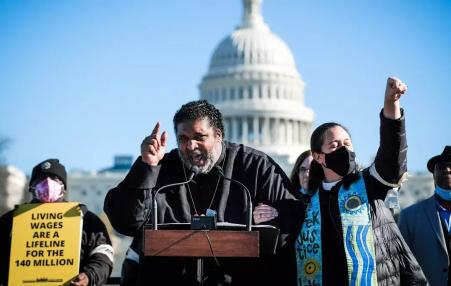
Activists with the Poor People's Campaign rally in Washington, D.C. on December 13, 2021. , Poor People's Campaign/Twitter


The Poor People's Campaign plans to hold a "generationally transformative and disruptive gathering of poor and low-wealth people, state leaders, faith communities, moral allies, unions, and partnering organizations" in the U.S. capital on Saturday, June 18.

The Mass Poor People's and Low-Wage Workers' Assembly and Moral March on Washington is scheduled to begin at 9:30 am local time. The campaign has put together an online FAQ page for participants.

Contrasting the planned event with a right-wing mob's attack on the U.S. Capitol last year, Bishop William Barber, the campaign's co-chair, said on Democracy Now!Friday that poor people and allies from across the country "are coming nonviolently to Washington, D.C."

Their key messages for those in power, Barber said, include: "We won't be silent or unseen anymore."

"The time has come for us to have a Third Reconstruction," Barber continued. "We had one in the 1800s, one in the 1960s. We need one now, that's about policy, reconstructing a moral framework, political framework in this country, because to have this level of poverty, that's un-talked-about too often and unseen and unheard, is actually morally indefensible, constitutionally inconsistent, politically insensitive, and economically insane."

"So people are coming," he said, "but poor people are coming to say not only do we need a moral reset—and low-wage workers are saying it—we represent 32% of the electorate now, poor people do, and 45% of the electorate in battleground states. And it's time for that power to be organized, mobilized, and felt in every election throughout this country."

Discussing the June 18 gathering and related eventspreceding it, Barber emphasized earlier this year that the D.C. assembly "is not just a day of action," but a "declaration of an ongoing, committed, nonviolent, truth-telling, multiracial, interfaith moral movement."

"We are not in this for a moment, but for a movement," he said. "June 18, and everything that leads up to it and after it, will be for the fundamental shifting of the narrative and changing this sickness that we're seeing in our nation."

Poor People's Campaign co-chair Rev. Dr. Liz Theoharis, who also appeared on Democracy Now! Friday, highlighted how the fight "to implement a single-payer universal healthcare system" and the "demand for living-wage jobs, for adequate housing, for immigration reform, for protecting this democracy, they're all connected."

An organizing manual for Saturday's event also notes the connections and declares that "we must do more to make America live up to her possibilities." Specifically, the document calls for doing more:

  • to fully address the interlocking injustices of systemic racism, poverty, ecological devastation and the denial of healthcare, militarism and the false narrative of Christian nationalism;
  • to change the narrative and build the power of those most impacted by these injustices; and
  • to realize a Third Reconstruction agenda that can build this country from the bottom up and realize the nation we have yet to be.

Those were also the focal topics at a Wednesday briefing with members of Congress, which featured remarks from Barber and Theoharis as well as several low-income Americans who called on Congress to actually prioritize people like them in policy decisions.

"Every dollar that we spend destroying communities overseas is a dollar not spent on universal healthcare, affordable housing, or meaningful social services and public education," said Kyle Bibby, a military veteran from New Jersey. "Every youth sent overseas for war is a life at risk for a sacrifice that we cannot justify. Every veteran returning who is saddled with trauma is a high toll to pay for wars that never had a clear goal—and many are returning to underfunded and forgotten communities.”

Morgan Leavy, a barista at Texas' first unionized Starbucks, said that "if a bunch of mostly young adults with little-to-no organizing experience can put enough pressure on a multibillion-dollar company to raise the minimum wage in less than a year, we absolutely expect our government to be able to do so too."

As Common Dreams reported earlier this month, Leavy is the kind of person the campaign co-chairs urged President Joe Biden to meet with in D.C.

Lamenting that "corporations are treated like people and people are treated like things," Barber asked, "Why don't poor people get meetings in the Oval Office instead of corporations?"

"It is time for the president to act on his pre-election promise to address poverty," he said, noting that "labor unions are joining our call to the president to use his power to lift the voices of impacted people and to act now."

Our work is licensed under Creative Commons (CC BY-NC-ND 3.0). Feel free to republish and share widely.
 

Sunday, May 13, 2018

Join the Poor People's Campaign for Justice -SACRAMENTO

‘Our People Are Being Hurt and We Won’t be Silent Anymore’
---
CaliforniaPoor People’s Campaign: A National Call for Moral Revival To Kick Off Six Weeks of Non-Violent Direct Action Monday in Sacramento
---
Protests Planned in over 30 State Capitals, Washington, D.C.
---
Movement Demands Sweeping Overhaul of Nation’s Voting Rights Laws, Policies to Address Poverty, Ecological Devastation, War Economy
SACRAMENTO, CALIFORNIA—The CaliforniaPoor People’s Campaign: A National Call for Moral Revival will kick off a six-week season of nonviolent direct action Monday in Sacramento.  The Campaign is demanding a massive overhaul of the nation’s voting rights laws, new programs to lift up the 140 million Americans living in poverty, immediate attention to ecological devastation and measures to curb militarism and the war economy. 
The Monday rally in California is one of over 30 actions across the country by poor and disenfranchised people, clergy and advocates who will engage in 40 days of nonviolent direct action and voter mobilization, among other activities. As a movement, we aim at transforming the nation’s political, economic and moral structures by building on the work of the original Poor People’s Campaign 50 years ago. 

To emphasize the urgent necessity for action,hundreds of participants are joining ‘Freedom Trains’,in solidarity with their 1968 counter parts. These caravans will be launching from  Los Angeles, San Diego and San Francisco. To Commemorate the daily hardships that Women  endure, these caravans will embark on Mother’s Day, May 13th, to join forces in Sacramento to focus on the first week’s theme: Somebody’s Hurting Our People: Women, Youth, Disabled, Children in Poverty and Right to Education.

Sunday, March 13, 2016

The American Way of Poverty - Forum

The American Way of Poverty ;
How the Other Half Still Lives
Author.  Sasha Abramsky. Speaking at the 7thannual  Progressive Forum.
March 17, 2016.  3 PM.  Folsom Hall 1063. 7667 Folsom Hall 
Sasha Abramsky is a widely published journalist, who specializes in social justice and poverty reporting. His work has appeared in the Nation, the American Prospect, Salon, Slate, the New Yorker online, Rolling Stone, Mother Jones, the New York Times, the Village Voice, and many other publications both in the US and the UK.
The Abramsky lecture will be followed by speakers from a number  of local organizations encouraging the student vote in 2016. 

Duane Campbell, (DSA) The Left and the Sanders Campaign.  Student Votes Matter; Presentations by student activists and others.  Free.
Text Box:  Text Box:  Sponsors:  Sacramento Progressive Alliance, Campus Progressive Alliance,  Democratic Socialists of America, California Faculty Association,


Saturday, August 08, 2015

Mexico is Getting Poorer


Emilio Godoy
August 5, 2015
Inter Press Service

While most of Latin America has been reducing poverty, Mexico is moving in the other direction: new official figures reflect an increase in the number of poor in the last two years. The negative impact of the 2014 fiscal austerity program, poorly-designed and mismanaged public policies, sluggish economic growth, and frozen family incomes are all factors underlying the rise in the number of people living in poverty in the region’s second-most populous country.


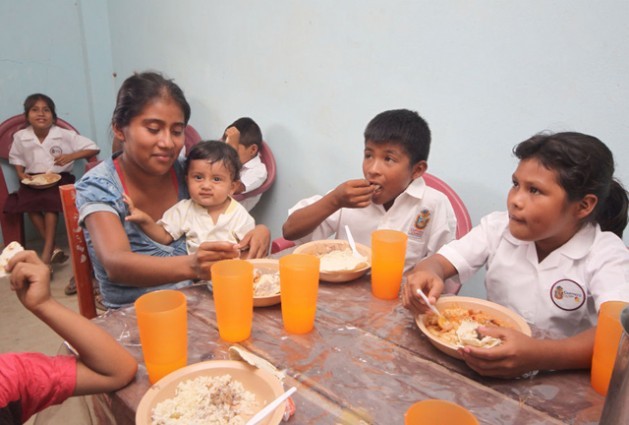
A mother eats lunch with her children in a rural Mexican school, part of the Crusade Against Hunger. , Government of Mexico,


While most of Latin America has been reducing poverty, Mexico is moving in the other direction: new official figures reflect an increase in the number of poor in the last two years, despite the billions of dollars channeled into a broad range of programmes aimed at combating the problem.

The negative impact of the 2014 fiscal reform, poorly-designed and mismanaged public policies, sluggish economic growth, and family incomes that have been frozen are all factors underlying the rise in the number of people living in poverty in the region’s second-most populous country, according to experts consulted by IPS.

“We have some well-designed social programmes, but many others have got off track,” said Edna Jaime, the head of México Evalúa, a think tank on public policies. “They claim to fight poverty and foment employment, but they have no effect. Many are captive; they serve political clientele instead of the public,” she told IPS.

Wednesday, October 29, 2014

Disinterested Voters, Is It Apathy or Manipulation and Gridlock?

by Jimmy Franco Sr.  Latino Point of View.

The November mid-term elections are now approaching and a political debate and divide is developing among many disgruntled voters as to whether to cast a ballot to support the continuing gridlock in congress and the governmental inaction that has resulted from this situation or abstain. California’s recent June electoral primary had the lowest proportional turnout ever as only a quarter of the voters even bothered to cast a ballot. For many Latinos who are disillusioned with the unprincipled Democrats and their disrespect and empty promises, a decision must be made whether to continue

A Latina activist ponders whether to support Democrats who retreated on immigration reform
following them in a slavish manner after being continually taken for granted or simply sit this one out. Many elitist pundits and die-hard Democratic Party loyalists lament the low rate of voter turnout at election time and tend to label and fault the voters as being either apathetic of even worse lazy and not caring. In reality, the majority of working-class voters, minorities and women do care about their jobs, wages, children’s education, rights and the continual rise in consumer prices. What these frustrated and angry voters have experienced and still observe is a government that takes their taxes while talkative politicians continue to break their campaign promises by not enacting any concrete laws to improve economic and social conditions for middle-class and lower-income people. This is particularly true at the federal level and even locally within the Los Angeles Unified school District where chaos and dysfunction dominate an educational system that is run by incompetents. Distrustful voters have witnessed a situation of ongoing political gridlock among the US Congress and the president for close to four years now. This legislative stalemate, name calling and inaction on pressing issues is what creates cynicism and non-voting among the electorate especially those who are low-income, minority and young. People no longer want to hear rhetoric, but want to see real changes occur within the real world in which they live. During the 2008 presidential election a ‘messianic’ Obama campaigned as the people’s anti-war candidate and he preached and enthralled voters with his idealistic messages about hope and peace, a new type of government with real representation, a reduction in military conflicts and nuclear weapons, and an improvement in the well-being of working people’s lives. This type of revivalist campaign talk and lofty beliefs particularly inspired the hopes of the young, minorities and women and energized them to turn out in large numbers to support and vote for his promise of change and the building of a new society.

Monday, July 07, 2014

No Childhood Here- Why Central American Children flee


New Report Helps Explain Why Central American Children Are Leaving Their Home Countries


http://immigrationimpact.com/2014/07/01/new-report-helps-explain-why-central-american-children-are-leaving-their-home-countries/
Portside Date: 
July 7, 2014
Author: 
Guillermo Cantor

Ever since President Barack Obama described [1] the record number of minors traveling alone and crossing the U.S.-Mexico border as an “urgent humanitarian situation requiring a unified and coordinated Federal response,” the debate about how to address the unaccompanied migrant children has become increasingly heated, especially about the reasons leading them to come here. News reports and congressional hearings [2]have covered various arguments to explain the reasons behind these children’s journeys. Unfortunately, what becomes clear is that many of those arguments are not backed by any factual evidence, and, what is even worse, some are intentionally aimed at derailing the eventual overhaul of our broken immigration system.
In an attempt to help fill the knowledge gap, the American Immigration Council is releasing a study [3] today that was conducted by Elizabeth Kennedy, a Fulbright Fellow currently doing research in El Salvador on child and youth migrants returned from Mexico and the United States. Based on evidence obtained through 322 interviews with children recently returned to El Salvador, as well as conversations with journalists and local, regional, and government officials, this report sheds light on some of the structural conditions that compel minors to migrate to the United States or other countries in the region.
In essence, the report [3] highlights the intricate ways in which violence, extreme poverty, and the desire to reunite with family members, help shape these kids’ decision to migrate. According to the report, “crime, gang threats, or violence appear to be the strongest determinants for children’s decision to emigrate. When asked why they left their home, 59 percent of Salvadoran boys and 61 percent of Salvadoran girls list one of those factors as a reason for their emigration.” In El Salvador, the report shows, the issue of gang violence is a widespread phenomenon. According to the findings, gang violence appears as the primary cause of emigration in 11 of 14 of El Salvador’s departments. In the departments of Cuscatlán and Usulután for example, over 85 percent of children flee for this reason.
Violence alone, however, does not explain the phenomenon of kids’ migration in its entirety. In some regions of El Salvador, for example, extreme poverty is identified as the most common reason for why children decide to leave. In addition, about 35 percent of the minors interviewed reported family reunification as a reason for their emigration, but in many of those cases the desire to reunite with a family member in the U.S. is cited in addition to the fear of crime and violence.
Crossing the border is an immensely risky journey. Given that being smuggled into the United States can itself end in death, it stands to reason that conditions must be extremely dire for Central American parents to send their children on such a dangerous journey. In fact, the report specifically demonstrates that leaving the country is, for these children (and their families), often a last resort. Children, furthermore, are not just coming to the United States in search of protection. According to UNHCR [4], a steep rise has also been observed in the numbers of asylum requests in in the neighboring countries of Belize, Costa Rica, Nicaragua, Panama, and Mexico.
All in all, the study highlights the fact that the majority of these children are in an extremely vulnerable situation. In this context, militaristic solutions are clearly not the answer.
- See more at: http://immigrationimpact.com/2014/07/01/new-report-helps-explain-why-cen... [5] since President Barack Obama described the record number of minors traveling alone and crossing the U.S.-Mexico border as an “urgent humanitarian situation requiring a unified and coordinated Federal response,” the debate about how to address the unaccompanied migrant children has become increasingly heated, especially about the reasons leading them to come here. News reports and congressional hearings have covered various arguments to explain the reasons behind these children’s journeys. Unfortunately, what becomes clear is that many of those arguments are not backed by any factual evidence, and, what is even worse, some are intentionally aimed at derailing the eventual overhaul of our broken immigration system.
In an attempt to help fill the knowledge gap, the American Immigration Council is releasing a study today that was conducted by Elizabeth Kennedy, a Fulbright Fellow currently doing research in El Salvador on child and youth migrants returned from Mexico and the United States. Based on evidence obtained through 322 interviews with children recently returned to El Salvador, as well as conversations with journalists and local, regional, and government officials, this report sheds light on some of the structural conditions that compel minors to migrate to the United States or other countries in the region.
In essence, the report highlights the intricate ways in which violence, extreme poverty, and the desire to reunite with family members, help shape these kids’ decision to migrate. According to the report, “crime, gang threats, or violence appear to be the strongest determinants for children’s decision to emigrate. When asked why they left their home, 59 percent of Salvadoran boys and 61 percent of Salvadoran girls list one of those factors as a reason for their emigration.” In El Salvador, the report shows, the issue of gang violence is a widespread phenomenon. According to the findings, gang violence appears as the primary cause of emigration in 11 of 14 of El Salvador’s departments. In the departments of Cuscatlán and Usulután for example, over 85 percent of children flee for this reason.
Violence alone, however, does not explain the phenomenon of kids’ migration in its entirety. In some regions of El Salvador, for example, extreme poverty is identified as the most common reason for why children decide to leave. In addition, about 35 percent of the minors interviewed reported family reunification as a reason for their emigration, but in many of those cases the desire to reunite with a family member in the U.S. is cited in addition to the fear of crime and violence.
Crossing the border is an immensely risky journey. Given that being smuggled into the United States can itself end in death, it stands to reason that conditions must be extremely dire for Central American parents to send their children on such a dangerous journey. In fact, the report specifically demonstrates that leaving the country is, for these children (and their families), often a last resort. Children, furthermore, are not just coming to the United States in search of protection. According to UNHCR, a steep rise has also been observed in the numbers of asylum requests in in the neighboring countries of Belize, Costa Rica, Nicaragua, Panama, and Mexico.
All in all, the study highlights the fact that the majority of these children are in an extremely vulnerable situation. In this context, militaristic solutions are clearly not the answer.
- See more at: http://immigrationimpact.com/2014/07/01/new-report-helps-explain-why-cen... [5] since President Barack Obama described the record number of minors traveling alone and crossing the U.S.-Mexico border as an “urgent humanitarian situation requiring a unified and coordinated Federal response,” the debate about how to address the unaccompanied migrant children has become increasingly heated, especially about the reasons leading them to come here. News reports and congressional hearings have covered various arguments to explain the reasons behind these children’s journeys. Unfortunately, what becomes clear is that many of those arguments are not backed by any factual evidence, and, what is even worse, some are intentionally aimed at derailing the eventual overhaul of our broken immigration system.
In an attempt to help fill the knowledge gap, the American Immigration Council is releasing a study today that was conducted by Elizabeth Kennedy, a Fulbright Fellow currently doing research in El Salvador on child and youth migrants returned from Mexico and the United States. Based on evidence obtained through 322 interviews with children recently returned to El Salvador, as well as conversations with journalists and local, regional, and government officials, this report sheds light on some of the structural conditions that compel minors to migrate to the United States or other countries in the region.
In essence, the report highlights the intricate ways in which violence, extreme poverty, and the desire to reunite with family members, help shape these kids’ decision to migrate. According to the report, “crime, gang threats, or violence appear to be the strongest determinants for children’s decision to emigrate. When asked why they left their home, 59 percent of Salvadoran boys and 61 percent of Salvadoran girls list one of those factors as a reason for their emigration.” In El Salvador, the report shows, the issue of gang violence is a widespread phenomenon. According to the findings, gang violence appears as the primary cause of emigration in 11 of 14 of El Salvador’s departments. In the departments of Cuscatlán and Usulután for example, over 85 percent of children flee for this reason.
Violence alone, however, does not explain the phenomenon of kids’ migration in its entirety. In some regions of El Salvador, for example, extreme poverty is identified as the most common reason for why children decide to leave. In addition, about 35 percent of the minors interviewed reported family reunification as a reason for their emigration, but in many of those cases the desire to reunite with a family member in the U.S. is cited in addition to the fear of crime and violence.
Crossing the border is an immensely risky journey. Given that being smuggled into the United States can itself end in death, it stands to reason that conditions must be extremely dire for Central American parents to send their children on such a dangerous journey. In fact, the report specifically demonstrates that leaving the country is, for these children (and their families), often a last resort. Children, furthermore, are not just coming to the United States in search of protection. According to UNHCR, a steep rise has also been observed in the numbers of asylum requests in in the neighboring countries of Belize, Costa Rica, Nicaragua, Panama, and Mexico.
All in all, the study highlights the fact that the majority of these children are in an extremely vulnerable situation. In this context, militaristic solutions are clearly not the answer.
Ever since President Barack Obama described the record number of minors traveling alone and crossing the U.S.-Mexico border as an “urgent humanitarian situation requiring a unified and coordinated Federal response,” the debate about how to address the unaccompanied migrant children has become increasingly heated, especially about the reasons leading them to come here. News reports and congressional hearings have covered various arguments to explain the reasons behind these children’s journeys. Unfortunately, what becomes clear is that many of those arguments are not backed by any factual evidence, and, what is even worse, some are intentionally aimed at derailing the eventual overhaul of our broken immigration system.
In an attempt to help fill the knowledge gap, the American Immigration Council is releasing a study today that was conducted by Elizabeth Kennedy, a Fulbright Fellow currently doing research in El Salvador on child and youth migrants returned from Mexico and the United States. Based on evidence obtained through 322 interviews with children recently returned to El Salvador, as well as conversations with journalists and local, regional, and government officials, this report sheds light on some of the structural conditions that compel minors to migrate to the United States or other countries in the region.
In essence, the report highlights the intricate ways in which violence, extreme poverty, and the desire to reunite with family members, help shape these kids’ decision to migrate. According to the report, “crime, gang threats, or violence appear to be the strongest determinants for children’s decision to emigrate. When asked why they left their home, 59 percent of Salvadoran boys and 61 percent of Salvadoran girls list one of those factors as a reason for their emigration.” In El Salvador, the report shows, the issue of gang violence is a widespread phenomenon. According to the findings, gang violence appears as the primary cause of emigration in 11 of 14 of El Salvador’s departments. In the departments of Cuscatlán and Usulután for example, over 85 percent of children flee for this reason.
Violence alone, however, does not explain the phenomenon of kids’ migration in its entirety. In some regions of El Salvador, for example, extreme poverty is identified as the most common reason for why children decide to leave. In addition, about 35 percent of the minors interviewed reported family reunification as a reason for their emigration, but in many of those cases the desire to reunite with a family member in the U.S. is cited in addition to the fear of crime and violence.
Crossing the border is an immensely risky journey. Given that being smuggled into the United States can itself end in death, it stands to reason that conditions must be extremely dire for Central American parents to send their children on such a dangerous journey. In fact, the report specifically demonstrates that leaving the country is, for these children (and their families), often a last resort. Children, furthermore, are not just coming to the United States in search of protection. According to UNHCR, a steep rise has also been observed in the numbers of asylum requests in in the neighboring countries of Belize, Costa Rica, Nicaragua, Panama, and Mexico.
All in all, the study highlights the fact that the majority of these children are in an extremely vulnerable situation. In this context, militaristic solutions are clearly not the answer.
Ever since President Barack Obama described the record number of minors traveling alone and crossing the U.S.-Mexico border as an “urgent humanitarian situation requiring a unified and coordinated Federal response,” the debate about how to address the unaccompanied migrant children has become increasingly heated, especially about the reasons leading them to come here. News reports and congressional hearings have covered various arguments to explain the reasons behind these children’s journeys. Unfortunately, what becomes clear is that many of those arguments are not backed by any factual evidence, and, what is even worse, some are intentionally aimed at derailing the eventual overhaul of our broken immigration system.
In an attempt to help fill the knowledge gap, the American Immigration Council is releasing a study today that was conducted by Elizabeth Kennedy, a Fulbright Fellow currently doing research in El Salvador on child and youth migrants returned from Mexico and the United States. Based on evidence obtained through 322 interviews with children recently returned to El Salvador, as well as conversations with journalists and local, regional, and government officials, this report sheds light on some of the structural conditions that compel minors to migrate to the United States or other countries in the region.

Thursday, May 15, 2014

California- The Most Segregated State for Latino Students

California The Most Segregated State for Latino Students

Date Published: May 14, 2014
State Has Little to Celebrate 60 Years After Brown v Board of Education.

Related Documents
LOS ANGELES--Marking the 60th anniversary of the landmark U.S. Supreme Court decision Brown v Board of Education, the UCLA’s Civil Rights Project/Proyecto Derechos Civiles assessed California's progress in addressing school segregation, and found that California students are more racially segregated than ever.  In their new study, Segregating California’s Future: Inequality and its Alternative 60 Years after Brown v. Board of Education, the report authors conclude that California is the third worst state when it comes to school segregation for African Americans, behind New York and Illinois.  California is, however, the state in which Latino students are most segregated.
The Brown decision challenged the legitimacy of the entire "separate but equal" educational system of the South, and helped accelerate the march toward racial and social equality across the United States, but Brown impacted California very little. According to the report, various subsequent state court decisions resulted in California having no school integration policy, which allowed segregation to grown substantially in the past two decades.
After analyzing demographic data from California's more than 10,000 schools, the authors conclude that California’s school enrollment has grown far more diverse since Brown.  But demographic shifts that could have led to more diverse and integrated schools have, instead, resulted in the educational isolation of Latino and African-American students, in particular.  

Monday, February 03, 2014

Inequality and Education Gap

A Growing Income Gap Results in More Educational Inequality

It is easier to build strong children than repair broken men.
-Frederick Douglass
It has now been 50 years since the War on Poverty began under President Johnson.
(ed. note. Initiated by socialist Michael Harrington) Many positive safety net programs were created by the government during that period such as Head Start, food stamps and Medicare and they played an essential role in reducing the level of poverty. However, there have also been many political groups and harmful economic policies enacted that have worked to undermine these efforts. From the 1970′s to the present a negative economic
President Johnson talking to unemployed workers who his War on Poverty helped to retrain.(click to expand)
trend has been developing that is creating an unequal distribution of wealth within our society that continues to deepen. This corrosive trend has resulted in a growth of income inequality and reduced social services for the middle and working classes which has had the direct effect of drastically increasing the number of families now living below the poverty line. There are currently about 46 million people existing in poverty throughout the country and this includes 16 million children of which about 12 million are Latino and African-American.