Mexican leftist Lopez Obrador to swear self in as head of parallel government
The Associated Press
Leftist Andres Manuel Lopez Obrador launched a parallel government Monday that will swear him in as Mexico's "legitimate" president, a ceremony he hopes will revive a movement aimed at keeping President-elect Felipe Calderon from governing.
The inauguration ceremony marks the latest chapter in Lopez Obrador's unsuccessful battle for the presidency. He claims fraud and dirty campaign tactics were responsible for Calderon's narrow victory in the July 2 vote, and his parallel government could spend the next six years calling for street protests that have already wreaked havoc with the economy and prompted travel warnings from the U.S. Embassy.
While the red-green-and-white presidential sash to be draped across Lopez Obrador's shoulders Monday will lack any legal recognition, he hopes to assume the moral leadership of millions of poor Mexicans.
Based in Mexico City, Lopez Obrador's parallel government has its own Cabinet. But it will not collect taxes or make laws, and it relies on donations to carry out its plans.
One of its first orders of business will be trying to prevent Calderon's Dec. 1 inauguration ceremony.
"We're not going to give the right free rein," Lopez Obrador said in a final stop in the southeastern state of Veracruz this weekend. "We're going to confront it."
It remains to be seen whether Lopez Obrador can keep up the momentum. Some members of his leftist Democratic Revolution Party, or PRD, have already expressed disagreement with Lopez Obrador's strategy of using Congress — where the PRD is now the second-largest force — as an arena for protests rather than negotiations.
Mexico City columnist Armando Fuentes described Lopez Obrador's "swearing in" ceremony as "laughable" and "a circus act, a farce."
But political science professor Oscar Aguilar cautioned that the leftist could have the backing to undermine Calderon.
"The problem is that he's not a Don Quijote because the social and political conditions are fertile ground for this kind of leadership," Aguilar said. "Many of the poor ... see this type of leadership as a solution."
Protesters in southern Oaxaca City have seized the city center for months, demanding Gov. Ulises Ruiz's ouster, despite the presence of federal police. Many worry that Lopez Obrador will follow suit and renew street protests, including those in which his supporters seized Mexico City's center for nearly two months this summer.
Some citizens appear to be tiring of political unrest.
This month, Mexico City was rattled when several bombs exploded at political offices and banks. No one was injured, and a small, radical group not tied to Lopez Obrador claimed responsibility.
The violence has affected one of the country's main sources of income. Revenue from tourism was down 4.3 percent in the first nine months of 2006, as compared to 2005.
Appealing to the desire for calm, President Vicente Fox cautioned in a speech Monday that "the electoral process is the path that Mexicans have to preserve a peaceful, orderly, civilized and pluralistic public and political life."
Fox canceled a traditional Nov. 20 parade commemorating the start of the country's 1910-1917 Revolution, in an apparent bid to avoid friction with Lopez Obrador's event, which is also scheduled for Mexico City's main plaza.
On Monday, he urged Mexicans to follow the path of democracy.
"Nobody has the right to think or decide for the people," Fox said.
But Lopez Obrador's platform resonates with many Mexicans, so much so that the business-friendly Calderon from Fox's conservative National Action Party has borrowed ideas from Lopez Obrador's legislative agenda, like pensions for the elderly and reductions in utility rates for the poor.
Some of Lopez Obrador's closest aides have suggested they will follow Bolivia's example and try to use protests to force Calderon from office, as demonstrators did with a succession of leaders there. Lopez Obrador hasn't ruled that out.
"Nobody wants violence in our country, but there are people who give grounds for violence," Lopez Obrador said last week. "There are a lot of people who say that, after July 2, the path of electoral politics in no longer viable."
Copyright © 2006 The International Herald Tribune | www.iht.com
Monday, November 20, 2006


Thursday, November 16, 2006
Iranian student at UCLA tazered/tortured by police
This is from You tube.
I don't think that he could get up. What do you think?
Sacramento group condemns UCLA police assault on a student because his parents ( or grandparents) were Iranian immigrants.
Police from the University of California at Los Angeles on Tuesday demanded that a Sacramento area student Mostafa Tabatabainejad show identification while studying in the library and then assaulted him with taser weapons rendering him incapable of responding to their orders. Then, when he could not respond to their commands, they assaulted him at least six additional times with the tasers. Video of the event is readily available on You Tube.
We- the Sacramento Progressive Alliance- find it appropriate that the student is suing the University for violation of his rights. The student was assaulted based upon racial profiling. Defending the rights of individuals from abuse of authority “under color of law” is one means of limiting this behavior and protecting the rights of us all.
It is not clear if the repeated use of the taser was a deliberate act of torture or was it incompetence that the police did not know they were making demands that the student could not respond to. Use of a taser can prevent the subject from physical response.
A Taser delivers volts of low-amperage energy to the body, causing a disruption of the body’s electrical energy pulses and locking the muscles, according to a report by the American Civil Liberties Union.
According to a study published in the Lancet Medical Journal in 2001, a charge of three to five seconds can result in immobilization for five to 15 minutes, which would mean that Tabatabainejad could have been physically unable to stand when the officers demanded that he do so.
“It is a real mistake to treat a Taser as some benign thing that painlessly brings people under control,” said Peter Eliasberg, managing attorney at the ACLU of Southern California. “The Taser can be incredibly violent and result in death,” Eliasberg said.
According to an ACLU report, 148 people in the United States and Canada have died as a result of the use of Tasers since 1999.
It is the position of the Sacramento Progressive Alliance that terrorists can not destroy our democracy, but that we can- by simply allowing illegal assaults and torture to be used on persons based upon racial profiling because their parents were immigrants.
The number of times that the taser was used is important and is not covered in the television reporting of the assault. There might be a debate about the first use- but the six subsequent uses were torture.
Non-scientific polls on television stations and Youtube after the event revealed up to 80% support for the police action indicating wide spread acceptance of illegal behavior and torture.
The University of California is a tax payer funded institution, and the police at UCLA are public employees. If we accept this abuse of force we are giving away some of our hard won rights simply because a police officer, with minimal training, gives an order.
The police officers involved should be removed from duty (without pay) during the conduction of an investigation and police on all the campuses should be banned from using taser weapons until this matter is resolved.
The Sacramento Progressive Alliance is community based political action committee with over 1,400 members in the Sacramento region. For more information see: www.sacramentopa.org
I don't think that he could get up. What do you think?
Sacramento group condemns UCLA police assault on a student because his parents ( or grandparents) were Iranian immigrants.
Police from the University of California at Los Angeles on Tuesday demanded that a Sacramento area student Mostafa Tabatabainejad show identification while studying in the library and then assaulted him with taser weapons rendering him incapable of responding to their orders. Then, when he could not respond to their commands, they assaulted him at least six additional times with the tasers. Video of the event is readily available on You Tube.
We- the Sacramento Progressive Alliance- find it appropriate that the student is suing the University for violation of his rights. The student was assaulted based upon racial profiling. Defending the rights of individuals from abuse of authority “under color of law” is one means of limiting this behavior and protecting the rights of us all.
It is not clear if the repeated use of the taser was a deliberate act of torture or was it incompetence that the police did not know they were making demands that the student could not respond to. Use of a taser can prevent the subject from physical response.
A Taser delivers volts of low-amperage energy to the body, causing a disruption of the body’s electrical energy pulses and locking the muscles, according to a report by the American Civil Liberties Union.
According to a study published in the Lancet Medical Journal in 2001, a charge of three to five seconds can result in immobilization for five to 15 minutes, which would mean that Tabatabainejad could have been physically unable to stand when the officers demanded that he do so.
“It is a real mistake to treat a Taser as some benign thing that painlessly brings people under control,” said Peter Eliasberg, managing attorney at the ACLU of Southern California. “The Taser can be incredibly violent and result in death,” Eliasberg said.
According to an ACLU report, 148 people in the United States and Canada have died as a result of the use of Tasers since 1999.
It is the position of the Sacramento Progressive Alliance that terrorists can not destroy our democracy, but that we can- by simply allowing illegal assaults and torture to be used on persons based upon racial profiling because their parents were immigrants.
The number of times that the taser was used is important and is not covered in the television reporting of the assault. There might be a debate about the first use- but the six subsequent uses were torture.
Non-scientific polls on television stations and Youtube after the event revealed up to 80% support for the police action indicating wide spread acceptance of illegal behavior and torture.
The University of California is a tax payer funded institution, and the police at UCLA are public employees. If we accept this abuse of force we are giving away some of our hard won rights simply because a police officer, with minimal training, gives an order.
The police officers involved should be removed from duty (without pay) during the conduction of an investigation and police on all the campuses should be banned from using taser weapons until this matter is resolved.
The Sacramento Progressive Alliance is community based political action committee with over 1,400 members in the Sacramento region. For more information see: www.sacramentopa.org
Crisis in Oaxaca
Crisis in Oaxaca: What You Need to Know
by Bill Weinberg
The Oaxaca crisis began when the state's school teachers went on strike May 22, demanding not only raises but bigger budgets for schools in poor rural parts of the state. Governor Ulises Ruiz refused to budge on their demands. The teachers launched a sit-in at Oaxaca City's central square, the zocalo, and began occupying several streets in the downtown historic district. As Ruiz held his ground, the sit-in swelled to a tent city of several thousand.
In a pre-dawn raid on June 14, Oaxaca state police, some in helicopters, armed with tear gas and rifles attacked the encampment. Witnesses said police fired on the crowd, and protesters later reported three dead—claims disputed by the state government. The teachers counter-attacked, hurling gas cannisters back at the police lines and charging them with commandeered buses. Within hours, they had re-taken the zocalo.
This proved the turning point. The demand now became for the ouster of Governor Ruiz, who the strikers claimed had been fraudulently elected. A coalition of grassroots and civil organizations congealed around the Popular Assembly of the People of Oaxaca (APPO), and this group seized control of the Oaxaca City center. Ruiz and his bureaucracy had to retreat to hotels on the outskirts of the city. Radio and TV stations were also taken over by the protesters. APPO pledged to make Oaxaca "ungovernable."
By the end of July, mysterious gunmen—presumed to be state police in civilian clothes—were attempting to use terror to beat back the movement. On August 10, unknown gunmen fired on an APPO march, killing one man, Jose Jimenez, the husband of a striking teacher. On August 22, gunmen fired on an occupied radio station, killing one of occupiers, Lorenzo Pablo.
By this point, peasant and indigenous councils affiliated with APPO had seized control of towns and villages throughout the state. In early September, APPO announced that it was forming an alternative government. It had become the real power in the state of Oaxaca.
On September 21, some 4,000 people left Oaxaca City on a cross-country march to Mexico City. The federal government entered into negotiations with APPO and the striking teachers. In mid-October, a Senate committee began meeting to consider a resolution officially dissolving Ruiz's powers.Thousands of APPO activists and teachers maintained an ongoing encampment outside the Senate building.
On October 14, gunmen shot two people at a roadblock in Oaxaca City, killing one. Two days later, several of the Oaxaca activists camped out at the Senate building began a hunger strike. But on the 18th, the Senate committee voted not to remove Ruiz. That night in Oaxaca City, another teacher was killed by unknown assailants.
In the midst of all this, Mexico had witnessed a dramatic showdown over the contested presidential elections. The left opposition has declared their own candidate, former Mexico City mayor Andres Manuel Lopez Obrador, as Mexico's "legitimate president," and pledged a civil disobedience campaign to prevent president-elect Felipe Calderon from taking office. There were signs that the local revolution in Oaxaca could serve as a template for a national uprising. On October 26, APPO issued a "call for a popular peaceful insurrection" starting December 1 if Ruiz had not stepped down by then.
Brad Will and two local protesters were fatally shot on October 27 as an APPO barricade on the outskirts of Oaxaca City again came under fire.
Fox announced an "extraordinary" program for the "total recuperation" of Oaxaca. On October 29, thousands of federal police with water cannons, tear gas, helicopters, and armored vehicles stormed past barricades, seizing control of the city center. The next day, Mexico's official National Human Rights Commission (CNDH) said two deaths had been confirmed since the federal forces entered Oaxaca, and at least 40 arrests.
President Fox declared victory, saying, "The plaza and city were recovered for the citizenry of Oaxaca." Dismissing reports of two deaths, Fox described the operation as "bloodless."
But the degree of federal police control of Oaxaca City remains uncertain. Press accounts quoted APPO leader Flavio Sosa saying the police had recovered only the area around the zocalo, after protesters ceded it in the face of overwhelming force. "The control of the rest of the city is in the hands of APPO," Sosa said. "I want to tell you that we are not going to hand over control of the city. We are going to resist at every barricade."
The APPO has established a new central encampment in a plaza a few blocks away from the police-occupied zocalo. Oaxaca City seems divide d by areas of federal and APPO control.
There have now been over 80 arrests by the federal police in Oaxaca City; many people are being held incomunicado, even as reports of human rights abuses in the jails are mounting. The army has also established checkpoints on the outskirts of town, and there are reports of activists being illegally detained at these roadblocks. In once case, two detained by the army—a local teacher and a student from the national university—were reportedly taken to a military camp, tortured and beaten for hours, and finally put naked and bound aboard a helicopter, where they were threatened with being thrown overboard into the sea. They were then turned over to a state prison, where, following the intervention of the National Human Rights Commission, relatives were allowed access to them, and they related their ordeal. Amnesty International has called upon the Mexican government to release the names of all those arrested, and what charges they are being held on.
Protests have spread to other cities in Mexico. On November 4, Zapatista Subcommander Marcos and supporters blocked the international bridge linking Ciudad Juarez and El Paso, Texas. Maquiladora workers also blocked the international bridge between Matamoros and Brownsville in solidarity with the APPO. Meanwhile, in Chiapas, Zapatistas blocked roads and rebel peasants shut down the international bridge on the Guatemalan border with their bodies.
In a more sinister development, on the morning of November 6 bombs exploded at three high-profile targets in Mexico City: the national headquarters of the PRI, the Federal Electoral Tribunal, which had ruled in favor of Calderon in September, and a branch of a Canadian bank. There was property damage but no casualties. A communique jointly signed by five small guerilla groups active in the mountains of the Mexican south claimed responsibility, saying the action was a response to the repression in Oaxaca and warning the government against using the attacks "as a pretext to generate psychosis in the citizenry and to continue repressing the civil, peaceful organizations and movements."
Bill Weinberg is author of Homage to Chiapas: The New Indigenous Struggles in Mexico (Verso 2000) and editor of the electronic journal World War 4 Report
by Bill Weinberg
The Oaxaca crisis began when the state's school teachers went on strike May 22, demanding not only raises but bigger budgets for schools in poor rural parts of the state. Governor Ulises Ruiz refused to budge on their demands. The teachers launched a sit-in at Oaxaca City's central square, the zocalo, and began occupying several streets in the downtown historic district. As Ruiz held his ground, the sit-in swelled to a tent city of several thousand.
In a pre-dawn raid on June 14, Oaxaca state police, some in helicopters, armed with tear gas and rifles attacked the encampment. Witnesses said police fired on the crowd, and protesters later reported three dead—claims disputed by the state government. The teachers counter-attacked, hurling gas cannisters back at the police lines and charging them with commandeered buses. Within hours, they had re-taken the zocalo.
This proved the turning point. The demand now became for the ouster of Governor Ruiz, who the strikers claimed had been fraudulently elected. A coalition of grassroots and civil organizations congealed around the Popular Assembly of the People of Oaxaca (APPO), and this group seized control of the Oaxaca City center. Ruiz and his bureaucracy had to retreat to hotels on the outskirts of the city. Radio and TV stations were also taken over by the protesters. APPO pledged to make Oaxaca "ungovernable."
By the end of July, mysterious gunmen—presumed to be state police in civilian clothes—were attempting to use terror to beat back the movement. On August 10, unknown gunmen fired on an APPO march, killing one man, Jose Jimenez, the husband of a striking teacher. On August 22, gunmen fired on an occupied radio station, killing one of occupiers, Lorenzo Pablo.
By this point, peasant and indigenous councils affiliated with APPO had seized control of towns and villages throughout the state. In early September, APPO announced that it was forming an alternative government. It had become the real power in the state of Oaxaca.
On September 21, some 4,000 people left Oaxaca City on a cross-country march to Mexico City. The federal government entered into negotiations with APPO and the striking teachers. In mid-October, a Senate committee began meeting to consider a resolution officially dissolving Ruiz's powers.Thousands of APPO activists and teachers maintained an ongoing encampment outside the Senate building.
On October 14, gunmen shot two people at a roadblock in Oaxaca City, killing one. Two days later, several of the Oaxaca activists camped out at the Senate building began a hunger strike. But on the 18th, the Senate committee voted not to remove Ruiz. That night in Oaxaca City, another teacher was killed by unknown assailants.
In the midst of all this, Mexico had witnessed a dramatic showdown over the contested presidential elections. The left opposition has declared their own candidate, former Mexico City mayor Andres Manuel Lopez Obrador, as Mexico's "legitimate president," and pledged a civil disobedience campaign to prevent president-elect Felipe Calderon from taking office. There were signs that the local revolution in Oaxaca could serve as a template for a national uprising. On October 26, APPO issued a "call for a popular peaceful insurrection" starting December 1 if Ruiz had not stepped down by then.
Brad Will and two local protesters were fatally shot on October 27 as an APPO barricade on the outskirts of Oaxaca City again came under fire.
Fox announced an "extraordinary" program for the "total recuperation" of Oaxaca. On October 29, thousands of federal police with water cannons, tear gas, helicopters, and armored vehicles stormed past barricades, seizing control of the city center. The next day, Mexico's official National Human Rights Commission (CNDH) said two deaths had been confirmed since the federal forces entered Oaxaca, and at least 40 arrests.
President Fox declared victory, saying, "The plaza and city were recovered for the citizenry of Oaxaca." Dismissing reports of two deaths, Fox described the operation as "bloodless."
But the degree of federal police control of Oaxaca City remains uncertain. Press accounts quoted APPO leader Flavio Sosa saying the police had recovered only the area around the zocalo, after protesters ceded it in the face of overwhelming force. "The control of the rest of the city is in the hands of APPO," Sosa said. "I want to tell you that we are not going to hand over control of the city. We are going to resist at every barricade."
The APPO has established a new central encampment in a plaza a few blocks away from the police-occupied zocalo. Oaxaca City seems divide d by areas of federal and APPO control.
There have now been over 80 arrests by the federal police in Oaxaca City; many people are being held incomunicado, even as reports of human rights abuses in the jails are mounting. The army has also established checkpoints on the outskirts of town, and there are reports of activists being illegally detained at these roadblocks. In once case, two detained by the army—a local teacher and a student from the national university—were reportedly taken to a military camp, tortured and beaten for hours, and finally put naked and bound aboard a helicopter, where they were threatened with being thrown overboard into the sea. They were then turned over to a state prison, where, following the intervention of the National Human Rights Commission, relatives were allowed access to them, and they related their ordeal. Amnesty International has called upon the Mexican government to release the names of all those arrested, and what charges they are being held on.
Protests have spread to other cities in Mexico. On November 4, Zapatista Subcommander Marcos and supporters blocked the international bridge linking Ciudad Juarez and El Paso, Texas. Maquiladora workers also blocked the international bridge between Matamoros and Brownsville in solidarity with the APPO. Meanwhile, in Chiapas, Zapatistas blocked roads and rebel peasants shut down the international bridge on the Guatemalan border with their bodies.
In a more sinister development, on the morning of November 6 bombs exploded at three high-profile targets in Mexico City: the national headquarters of the PRI, the Federal Electoral Tribunal, which had ruled in favor of Calderon in September, and a branch of a Canadian bank. There was property damage but no casualties. A communique jointly signed by five small guerilla groups active in the mountains of the Mexican south claimed responsibility, saying the action was a response to the repression in Oaxaca and warning the government against using the attacks "as a pretext to generate psychosis in the citizenry and to continue repressing the civil, peaceful organizations and movements."
Bill Weinberg is author of Homage to Chiapas: The New Indigenous Struggles in Mexico (Verso 2000) and editor of the electronic journal World War 4 Report
Tuesday, November 14, 2006
Racial gaps make a difference
Racial gaps persist in region, U.S.
Bee Staff And News Services -
Sacramento may be one of the most racially integrated cities in America, but when it comes to many of the things that make life good -- income, homeownership, educational attainment -- its residents, like the rest of the country, live far apart.
Consider these numbers for the Sacramento metropolitan area released Monday by the U.S. Census Bureau:
• The median income of white households -- the middle number in a ranked list of incomes -- was $58,248 in 2005, about 55 percent higher than the $37,594 median household income for blacks. White households earned about 30 percent more than Hispanics last year.
• Sacramento-area whites last year were almost twice as likely as blacks and Hispanics to have a bachelor's degree.
• About seven of every 10 local white households last year owned their home, compared to just four of every 10 black households and five of every 10 Hispanic households.
All of those gaps show up, to some extent, nationwide, the Census Bureau numbers show. Some of the gaps, like the divide between the incomes of white and Hispanic households, are a bit smaller in the Sacramento region -- Sacramento, Yolo, Placer and El Dorado counties -- than across the country. Others, like the gap between homeownership among whites and blacks, are a bit larger.
But, locally and nationally, the divide is vast. And in some areas, like the gap between white and black household incomes, it has grown since 2000.
"Race is so associated with class in the United States that it may not be direct discrimination, but it still matters indirectly," said Dalton Conley, a sociology professor at New York University and the author of "Being Black, Living in the Red."
"It doesn't mean it's any less powerful just because it's indirect," he said.
Homeownership grew among white middle class families after World War II when access to credit and government programs made buying houses affordable. Black families were largely left out because of discrimination, and the effects are still being felt today, said Lance Freeman, assistant professor of urban planning at Columbia University and author of "There Goes the 'Hood."
Homeownership creates wealth, which enables families to live in good neighborhoods with good schools. It also helps families finance college, which leads to better-paying jobs, perpetuating the cycle, Freeman said.
"If your parents own their own home, they can leave it to you when they pass on or they can use the equity to help you with a down payment on yours," he said.
Homeownership is near an all-time high in the United States, but racial gaps have increased in the past 25 years.
Black families also have been hurt by the decline of manufacturing jobs -- the same jobs that helped propel many white families into the middle class after World War II, said Hilary Shelton, director of the NAACP's Washington office.
Among Hispanics, education, income and homeownership gaps are exacerbated by recent Latin American immigrants. Hispanic immigrants have, on average, lower incomes and education levels than people born in here. About 40 percent of U.S. Hispanics are immigrants.
Asian Americans, on average, have higher incomes and education levels than whites. However, they have higher poverty rates and lower homeownership rates.
The census data are from the American Community Survey, the bureau's new annual survey of 3 million households.
Thomas Shapiro, professor of law and social policy at Brandeis University, said the "easiest answer" to narrowing racial gaps is to promote homeownership, which would help minority families accumulate wealth.
Bee staff writer Phillip Reese and the Associated Press contributed to this report.
All data based upon the U.S. Census. a public document.
Bee Staff And News Services -
Sacramento may be one of the most racially integrated cities in America, but when it comes to many of the things that make life good -- income, homeownership, educational attainment -- its residents, like the rest of the country, live far apart.
Consider these numbers for the Sacramento metropolitan area released Monday by the U.S. Census Bureau:
• The median income of white households -- the middle number in a ranked list of incomes -- was $58,248 in 2005, about 55 percent higher than the $37,594 median household income for blacks. White households earned about 30 percent more than Hispanics last year.
• Sacramento-area whites last year were almost twice as likely as blacks and Hispanics to have a bachelor's degree.
• About seven of every 10 local white households last year owned their home, compared to just four of every 10 black households and five of every 10 Hispanic households.
All of those gaps show up, to some extent, nationwide, the Census Bureau numbers show. Some of the gaps, like the divide between the incomes of white and Hispanic households, are a bit smaller in the Sacramento region -- Sacramento, Yolo, Placer and El Dorado counties -- than across the country. Others, like the gap between homeownership among whites and blacks, are a bit larger.
But, locally and nationally, the divide is vast. And in some areas, like the gap between white and black household incomes, it has grown since 2000.
"Race is so associated with class in the United States that it may not be direct discrimination, but it still matters indirectly," said Dalton Conley, a sociology professor at New York University and the author of "Being Black, Living in the Red."
"It doesn't mean it's any less powerful just because it's indirect," he said.
Homeownership grew among white middle class families after World War II when access to credit and government programs made buying houses affordable. Black families were largely left out because of discrimination, and the effects are still being felt today, said Lance Freeman, assistant professor of urban planning at Columbia University and author of "There Goes the 'Hood."
Homeownership creates wealth, which enables families to live in good neighborhoods with good schools. It also helps families finance college, which leads to better-paying jobs, perpetuating the cycle, Freeman said.
"If your parents own their own home, they can leave it to you when they pass on or they can use the equity to help you with a down payment on yours," he said.
Homeownership is near an all-time high in the United States, but racial gaps have increased in the past 25 years.
Black families also have been hurt by the decline of manufacturing jobs -- the same jobs that helped propel many white families into the middle class after World War II, said Hilary Shelton, director of the NAACP's Washington office.
Among Hispanics, education, income and homeownership gaps are exacerbated by recent Latin American immigrants. Hispanic immigrants have, on average, lower incomes and education levels than people born in here. About 40 percent of U.S. Hispanics are immigrants.
Asian Americans, on average, have higher incomes and education levels than whites. However, they have higher poverty rates and lower homeownership rates.
The census data are from the American Community Survey, the bureau's new annual survey of 3 million households.
Thomas Shapiro, professor of law and social policy at Brandeis University, said the "easiest answer" to narrowing racial gaps is to promote homeownership, which would help minority families accumulate wealth.
Bee staff writer Phillip Reese and the Associated Press contributed to this report.
All data based upon the U.S. Census. a public document.
Friday, November 10, 2006
Nicaragua and Ortega

From Z net
The scare stories spun by conservative pundits like Klugmann echo the only somewhat more subtle alarmism voiced by Republican lawmakers in the lead-up to the Nicaraguan elections. In recent years, the White House has chosen to remain silent during many electoral contests in Latin America. This does not reflect a newfound respect for democratic self-determination; it is pragmatic. Washington learned the hard way that its admonitions can backfire when delivered to Latin America voters fed up with having economic policy dictated from the North--as was the case in Bolivia in 2002, when US attacks on Evo Morales helped him gain the stature that would ultimately propel him to the presidency this year. However, the United States has maintained an overt involvement in some elections, especially in cold-war hot spots Nicaragua and El Salvador.
Bush Administration efforts over the past year to prevent the Nicaraguan electorate from choosing Ortega were particularly heavy-handed. Violating diplomatic protocol, US Ambassador Paul Trivelli expressed an open preference for Ortega's opponents, and he made repeated efforts to unite the Nicaraguan right around a single candidate. (He failed, and the divide among Nicaraguan conservatives helped pave the way for the Sandinistas'
victory.) Adding to Trivelli's meddling, US Secretary of Commerce Carlos Gutierrez suggested that more than $220 million in aid and hundreds of millions more in investments could be jeopardized if voters picked the wrong candidate.
In the last week of the campaign, several Republican members of Congress stepped up the threats. Most radically, they proposed to block the stream of money sent from Nicaraguan immigrants in the United States to impoverished family members back home in Central America. In an October 30 letter to Nicaraguan Ambassador Salvador Stadthagen, Representative Tom Tancredo wrote, "if the FSLN takes control of the government in Nicaragua, it may be necessary for the United States authorities to examine closely and possibly apply special controls to the flow of $850 million in remittances from the United States to Nicaragua--unfortunately to the detriment of many people living in Nicaragua." In a public letter addressed to Secretary of State Condoleezza Rice, Representatives Ed Royce and Peter Hoekstra added, "We share US Ambassador to Nicaragua Paul Trivelli's assessment that an Ortega victory would force the United States to fully 're-evaluate' relations with Nicaragua."
With the memory of the United States' debilitating economic embargo of the 1980s still fresh, Nicaraguan voters do not take suggestions of retaliation from Washington lightly. In 1990 the United States made clear that its embargo, as well as funding for terrorist contra forces, would continue if Ortega were re-elected. This blackmail played a decisive role in pushing the Sandinistas from office.
Ironically, even as the White House portrays Ortega as a committed and unrepentant leftist, the real concern is whether he has fully compromised the progressive ideals he once espoused as a leader in the movement that overthrew Nicaragua's longstanding Somoza dictatorship. Ortega has been criticized by former partisans for keeping a tight hold on the leadership of the Sandinistas, quashing efforts to democratize the party and expelling members like former Managua Mayor Herty Lewites, who announced intentions to challenge Ortega's power. In the 1990s, many of the most prominent cultural and intellectual figures in the Sandinista movement, including liberation theologian and poet Ernesto Cardenal, poet and novelist Gioconda Belli and Ortega's former Vice President Sergio Ramirez, broke ranks to form a dissident party, the Sandinista Renovation Movement. In the first half of this year, Lewites made a strong showing as that party's presidential candidate, but he suffered a massive heart attack and died in July, crippling the Renovation Movement's efforts for the election cycle.
Beyond internal strife within the Sandinistas, Ortega's record has been marred by public scandals. In 1998 a grown stepdaughter, Zoilamerica Narvaez, accused Ortega of sexually abusing her for years, starting when she was an adolescent. The following year, Ortega brokered a pact with then-president Arnoldo Aleman, who was facing charges of corruption. El pacto, as the shady deal is ominously known in Nicaragua, allowed both men to avoid prosecution by granting them parliamentary immunity. It also made Ortega into one of the country's most weighty power brokers by giving him control over many governmental appointments. While el pacto remains in place, Aleman was later stripped of his immunity and is now under house arrest, having been convicted of embezzling approximately $100 million from the government.
Despite Ortega's many flaws, the return of the Sandinistas to power creates the possibility of change that can genuinely benefit Nicaragua's poor. Ortega campaigned on a platform criticizing the "savage capitalism" implemented by the successive conservative governments that have ruled the country over the past sixteen years. In the decade and a half since the end of the contra war, neoliberal economic policies like privatizing public industries and creating "free trade" zones have failed to launch an economic recovery. Today Nicaragua ranks with Haiti and Bolivia among the poorest nations in the hemisphere. It remains to be seen what Ortega's political program will look like during his new term as president: whether he can be held accountable to the impoverished populations he claims to represent and whether his party can reverse trends of deepening hardship and desperation. But this is no reason not to applaud Nicaraguan voters who stood up to Republican threats, rejected a continuation of neoliberalism and demanded better of their government.
Thursday, November 09, 2006
Anti immigrant campaigns in Arizona
[JURIST] Arizona voters Tuesday overwhelmingly passed four measures directed against illegal immigration, approving each one by about a three-to-one margin across the state. If not overruled by the courts, Proposition 100 [text, PDF] will deny bail for illegal immigrants under certain conditions; Proposition 102 [text, PDF] will prohibit illegals from receiving punitive damages in civil suits; and Proposition 300 [text, PDF] will prevent illegals from using state funds for child care and education, including disallowing them to claim in-state tuition at college and universities. Proposition 103 [text, PDF] will establish English as the official state language. In 1988, Arizona voters passed a similar measure, but it was later overruled by the Arizona Supreme Court [text, PDF] and the US Supreme Court [text]. The Arizona Secretary of State [official website] posted the following results Wednesday afternoon:
AZ Prop 100
Yes: 890,021 - 77.8 percent
No: 253,472 - 22.2 percent
AZ Prop 102
Yes: 840,582 - 74.4 percent
No: 289,462 - 25.6 percent
AZ Prop 300
Yes: 809, 658 - 71.7 percent
No: 320,296 - 28.3 percent
AZ Prop 103
Yes: 849,772 - 74.2 percent
No: 295,632 - 25.8 percent
California's Prop. 187 continues to provide a direction for anti immigrant campaigns.
AZ Prop 100
Yes: 890,021 - 77.8 percent
No: 253,472 - 22.2 percent
AZ Prop 102
Yes: 840,582 - 74.4 percent
No: 289,462 - 25.6 percent
AZ Prop 300
Yes: 809, 658 - 71.7 percent
No: 320,296 - 28.3 percent
AZ Prop 103
Yes: 849,772 - 74.2 percent
No: 295,632 - 25.8 percent
California's Prop. 187 continues to provide a direction for anti immigrant campaigns.
Monday, November 06, 2006
Mexico's Legitimate President
Mexico's Legitimate President Elect Andres Manuel Lopez Obrador announces his official cabinet
Dear Sirs,
As you may probably know, our Legitimate President Elect has already announced
his official cabinet integrated, among other prominent people, by Mr. José Agustín
Ortíz Pinchetti, as Head of the Secretarat of Politic Affairs; Mr. Gustavo Iruega, to
head the Secretariat of International Affairs, former Attorney General of Mexico City
Mr. Bernardo Batiz, to lead the Secretariat of Justice and Security; Mrs. Claudia Sheinbaum
in charge of the Defense of National Resources such as the Oil Industry (PEMEX), etc., from
attempts of privatization by foreign companies; Mrs. Raquel Sosa to head the Secretariat
of Education, Science and Technology, which will have as its priority the defense of free,
secular and public education at all levels. Mr. Lopez Obrador will be also assisted
by a group of specialists in different ambits such as renowned writer Elena Poniatowska,
businessman and specialist in economics, Mr. Rogelio Ramirez de la O., journalist
Federico Arreola (recently cut off from the newspaper he founded just for supporting
Lopez Obrador), Ignacio Marvan and Jose María Perez Gay.
Mr. Cockcroft, Stephen Lendman, and other highly prestigious writers and journalists have been objectively
discussing and broadcasting the real reasons behind the countless illegitimate activities to prevent
Mr. Lopez Obrador from reaching the presidency of Mexico, perpetrated --as many of us
are already aware-- by the right-wing group currently in power with the support of the right-wing
in the United States and Spain, mainly, and the mercenary media in Mexico and abroad.
History has taught us about the criminal actions by the different USA governments
aided by their accomplices in countries like Guatemala, El Salvador, Cuba, Chile,
Venezuela, the former Yugoslavia, Iraq, to name just a few nations that
have suffered the abusive intervention of the White House, the Pentagon,
in cahoots with the high clergy, the WB and IMF, the mainstream media, which
like those in support of Vicente Fox, Felipe Calderon, etc.,
are part of the same goal: global domination of resources...evidently, the
fact that a leftist administration headed by Mr. Lopez Obrador meant a
serious threat to such designs was the real reason for the past
fraudulent election.
To us, members of the National Democratic Convention along with the
efforts of the National Ample Progressive Front, integrated by the
three political parties that formed the Coalition for the Good of All, it is of
paramount importance to continue our efforts to counteract the attacks of the
retrograde right-wing mafia supported by the powerful corporations and
banking institutions who view Mr. Lopez Obrador, the National
Democratic Convention and the National Progressive Front, as a threat.
With our most respectful regards,
Patricia Barba Avila
Coordination of International Media
NATIONAL DEMOCRATIC CONVENTION
barba.patricia@...
Dear Sirs,
As you may probably know, our Legitimate President Elect has already announced
his official cabinet integrated, among other prominent people, by Mr. José Agustín
Ortíz Pinchetti, as Head of the Secretarat of Politic Affairs; Mr. Gustavo Iruega, to
head the Secretariat of International Affairs, former Attorney General of Mexico City
Mr. Bernardo Batiz, to lead the Secretariat of Justice and Security; Mrs. Claudia Sheinbaum
in charge of the Defense of National Resources such as the Oil Industry (PEMEX), etc., from
attempts of privatization by foreign companies; Mrs. Raquel Sosa to head the Secretariat
of Education, Science and Technology, which will have as its priority the defense of free,
secular and public education at all levels. Mr. Lopez Obrador will be also assisted
by a group of specialists in different ambits such as renowned writer Elena Poniatowska,
businessman and specialist in economics, Mr. Rogelio Ramirez de la O., journalist
Federico Arreola (recently cut off from the newspaper he founded just for supporting
Lopez Obrador), Ignacio Marvan and Jose María Perez Gay.
Mr. Cockcroft, Stephen Lendman, and other highly prestigious writers and journalists have been objectively
discussing and broadcasting the real reasons behind the countless illegitimate activities to prevent
Mr. Lopez Obrador from reaching the presidency of Mexico, perpetrated --as many of us
are already aware-- by the right-wing group currently in power with the support of the right-wing
in the United States and Spain, mainly, and the mercenary media in Mexico and abroad.
History has taught us about the criminal actions by the different USA governments
aided by their accomplices in countries like Guatemala, El Salvador, Cuba, Chile,
Venezuela, the former Yugoslavia, Iraq, to name just a few nations that
have suffered the abusive intervention of the White House, the Pentagon,
in cahoots with the high clergy, the WB and IMF, the mainstream media, which
like those in support of Vicente Fox, Felipe Calderon, etc.,
are part of the same goal: global domination of resources...evidently, the
fact that a leftist administration headed by Mr. Lopez Obrador meant a
serious threat to such designs was the real reason for the past
fraudulent election.
To us, members of the National Democratic Convention along with the
efforts of the National Ample Progressive Front, integrated by the
three political parties that formed the Coalition for the Good of All, it is of
paramount importance to continue our efforts to counteract the attacks of the
retrograde right-wing mafia supported by the powerful corporations and
banking institutions who view Mr. Lopez Obrador, the National
Democratic Convention and the National Progressive Front, as a threat.
With our most respectful regards,
Patricia Barba Avila
Coordination of International Media
NATIONAL DEMOCRATIC CONVENTION
barba.patricia@...
Ortega wins in Nicaragua
Note: What is not being said.
When the Sandinistas were in power they were attacked by forces financed and organized by the U.S. Some 30,000 Nicaraguans were killed in this mercenary war.
Now, former Sandinista President Ortega is winning the election.
NPR and other news reports say that he is opposed by the U.S. We should correct them. He is opposed by the U.S. Government and the Bush Administration. The U.S. does not have an enemy nor an opponent in Daniel Ortega.
Ortega leads Nicaragua vote
By Jill Replogle and James C. McKinley Jr.
The New York Times
Sixteen years after he left power, Daniel Ortega, a former Marxist president and the Sandinista leader who is still regarded as a sworn foe by many in Washington, appeared headed Monday to a victory in the Nicaraguan presidential election.
Though electoral officials had yet to release final tallies from Sunday's vote, preliminary results and the country's electoral watchdog groups all predicted Ortega, who had failed twice before to gain the presidency in elections, would win a clear victory.
An Ortega win in a five-way race would mark a defeat for the Bush administration, who strongly opposed his election and worked hard to unite a fractious opposition against him with little success. The White House has said it will withdraw aid from an Ortega government.
With just more than 61 percent of the vote counted, Ortega had 38.6 percent of the ballots, about 8 points ahead of the second-place candidate, Eduardo Montealegre, a Harvard-educated financier and conservative Washington has openly supported.
Now 60 years old and balding, Ortega has maintained he is no longer a Marxist, but more of a pragmatist. He has promised to keep good relations with the United States and chose a former foe as his running mate. He has also vowed to help the poor and ran a positive campaign around the themes of "peace, love and unity."
But he maintains close ties to Cuba and Hugo Chavez of Venezuela, the leftist president who has become a thorn in side of the United States. Chavez lent the Ortega campaign significant support by sending subsidized oil to Nicaragua and distributing it through Sandinista politicians.
Ortega's victory appeared to be another gain for leftists in Latin America, who, despite recent setbacks in Peru and Mexico, have also persuaded voters to abandon conservative governments in Brazil, Argentina, Chile and Bolivia.
Although the results were preliminary, supporters of Ortega's Sandinista National Liberation Front party set off fireworks around the city on Monday, and drove around honking horns, shouting victory slogans and waving red and black Sandinista flags. Ortega had yet to make a statement.
Cuba immediately congratulated Ortega. "This is good for the people of Nicaragua and for the integration of Latin America," Cuban Foreign Minister Felipe Perez Roque told The Associated Press Monday.
Ortega's opponents refused to recognize his victory until all the votes were counted. The United States took a similar stance. The State Department's deputy spokesman, Tom Casey, said Monday that the administration would wait to comment until the Nicaraguan Electoral Commission announced who won. He also said it was too early to comment on procedural problems during the voting, noting that several groups of observers planned to file reports.
Casey said the United States delegation in Nicaragua had remarked on "high turnout and given praise to the Nicaraguan people for their patience and their willingness to show support for this democratic process."
Ortega was one of the leaders of the Sandinista rebels that swept to power in 1979, toppling the Somoza dynasty of rightwing dictators friendly to the United States and setting up an authoritarian leftwing government.
With the cold war still driving United States policy, President Reagan imposed sanctions on the country and financed anti-Sandinista guerrillas, known as contras, in part by secretly selling arms to the revolutionary Islamic government in Iran. It was Ortega who led his Soviet-backed army in a bloody decade-long civil war.
The last time Ortega ran Nicaragua, he seized private assets and redistributed land to poor peasants. Capital fled the country, along with many of its business leaders. He vows a different approach this time.
The advertising campaign against the former rebel leader was vicious, showing images from the civil war, weeping women, guns blaring. His opponents lost no chance to remind people of the economic collapse that followed the fighting and the United States embargo.
Ortega served as an unelected president from 1985 to 1990, before losing in elections to Violet Chamorro. He has struggled to regain power through the ballot box since then, but without success, in 1996 and 2001.
This time, however, a change in the election law and a strong throw-the-bums-out sentiment in the country after campaign financing scandals involving former President Enrique Bolanos helped carry him to victory.
The key to his victory was a change in election rules allowing a candidate to win in the first-round with only 35 percent of the vote, so long as he is 5 points above his next closest opponent. If Ortega had not won on the first round, most political strategists predicted he would not have survived a second round, as the splintered anti-Sandinista vote would have united.
As it was, the anti-Sandinista vote seemed split mostly between Montealegre, with 30.9 percent, and José Rizo, the candidate of the conservative ruling party, who had 22.9 percent, according to the Supreme Electoral Council, the Nicaraguan election authority. Two other candidates, Edmundo Jarquin, a dissident former Sandinista, and Eden Pastora, a former Contra rebel, trailed behind.
Results of a quick count carried out by a local monitoring group, Ethics and Transparency, were tracked with the official results.
"It's been a pretty exact count, we can say that Ortega's triumph is almost sure," said Carlos Tunnerman, a political analyst and former Nicaraguan ambassador to Washington during the early years of the Sandinista government, from 1984 to 1988.
Former President Jimmy Carter, who was in Nicaragua to monitor the election, said the quick count was "among the most definitive I have ever scene." The count is based on a large, and strategically varied sample of votes from urban and rural areas and different social strata, explained Carter and local analysts.
On Sunday night, following the first presentation of results by the election authorities, Montealegre denounced the early closure of some polling places and problems with the delivery of voter identification cards. He said he would not concede defeat until all votes are counted.
Carter agreed that there were minor problems with the voting process, but said he did not think they were significant enough to affect the results.
"The likelihood is that those few anomalies, which exist in every election in the world, will not be substantive enough collectively to change the apparent results of this election," Carter said.
Electoral observers have said the vote was mostly peaceful and orderly, despite long lines and some angry confrontations among voter who claimed polling stations closed before they could vote.
Observers from the Organization of American States said 2 percent of potential voters were not able to cast a ballot, and they estimated turnout around 70 percent, the Associated Press reported.
Since the frontrunner was a cold-war icon for the left, the race generated interest in the United States. Even Oliver North, the former White House aide, visited to speak against Ortega. North was at the heart of a scandal that became known as the Iran-contra affair when it emerged that Washington had secretly sold arms to Iran and used the money to arm the contras.
But in recent years, American money has flowed into Nicaragua in the form of investments. The country's has cheap labor, low crime rates and recently joined the Central American Free Trade Agreement.
During his campaign for the current election, Ortega emphasized his goal of peace and reconciliation, choosing bright pink as the color for his campaign and adopting the rhythm of John Lennon's "Give Peace a Chance" for his jingle.
For some, Ortega and the Sandinistas still conjure up memories of the war and tough economic times. Marlon José Sánchez Padilla, 36, who sold oranges on Sunday outside of a polling station in the town of Nindirí, bitterly recalled his two years of military service in the 1980's. "Many people were mutilated," he said. "Now he promises the sky, earth and highways but we don't believe him anymore."
Others, at the polls on Sunday, said it was time to give Ortega another chance. "It seems that Daniel Ortega has asked for pardon," said Ninosca Leets, a housewife who said she fled to the United States during the former Sandinista government. "He's asked for reconciliation. He's asked for a change, and I think he should be given the opportunity."
When the Sandinistas were in power they were attacked by forces financed and organized by the U.S. Some 30,000 Nicaraguans were killed in this mercenary war.
Now, former Sandinista President Ortega is winning the election.
NPR and other news reports say that he is opposed by the U.S. We should correct them. He is opposed by the U.S. Government and the Bush Administration. The U.S. does not have an enemy nor an opponent in Daniel Ortega.
Ortega leads Nicaragua vote
By Jill Replogle and James C. McKinley Jr.
The New York Times
Sixteen years after he left power, Daniel Ortega, a former Marxist president and the Sandinista leader who is still regarded as a sworn foe by many in Washington, appeared headed Monday to a victory in the Nicaraguan presidential election.
Though electoral officials had yet to release final tallies from Sunday's vote, preliminary results and the country's electoral watchdog groups all predicted Ortega, who had failed twice before to gain the presidency in elections, would win a clear victory.
An Ortega win in a five-way race would mark a defeat for the Bush administration, who strongly opposed his election and worked hard to unite a fractious opposition against him with little success. The White House has said it will withdraw aid from an Ortega government.
With just more than 61 percent of the vote counted, Ortega had 38.6 percent of the ballots, about 8 points ahead of the second-place candidate, Eduardo Montealegre, a Harvard-educated financier and conservative Washington has openly supported.
Now 60 years old and balding, Ortega has maintained he is no longer a Marxist, but more of a pragmatist. He has promised to keep good relations with the United States and chose a former foe as his running mate. He has also vowed to help the poor and ran a positive campaign around the themes of "peace, love and unity."
But he maintains close ties to Cuba and Hugo Chavez of Venezuela, the leftist president who has become a thorn in side of the United States. Chavez lent the Ortega campaign significant support by sending subsidized oil to Nicaragua and distributing it through Sandinista politicians.
Ortega's victory appeared to be another gain for leftists in Latin America, who, despite recent setbacks in Peru and Mexico, have also persuaded voters to abandon conservative governments in Brazil, Argentina, Chile and Bolivia.
Although the results were preliminary, supporters of Ortega's Sandinista National Liberation Front party set off fireworks around the city on Monday, and drove around honking horns, shouting victory slogans and waving red and black Sandinista flags. Ortega had yet to make a statement.
Cuba immediately congratulated Ortega. "This is good for the people of Nicaragua and for the integration of Latin America," Cuban Foreign Minister Felipe Perez Roque told The Associated Press Monday.
Ortega's opponents refused to recognize his victory until all the votes were counted. The United States took a similar stance. The State Department's deputy spokesman, Tom Casey, said Monday that the administration would wait to comment until the Nicaraguan Electoral Commission announced who won. He also said it was too early to comment on procedural problems during the voting, noting that several groups of observers planned to file reports.
Casey said the United States delegation in Nicaragua had remarked on "high turnout and given praise to the Nicaraguan people for their patience and their willingness to show support for this democratic process."
Ortega was one of the leaders of the Sandinista rebels that swept to power in 1979, toppling the Somoza dynasty of rightwing dictators friendly to the United States and setting up an authoritarian leftwing government.
With the cold war still driving United States policy, President Reagan imposed sanctions on the country and financed anti-Sandinista guerrillas, known as contras, in part by secretly selling arms to the revolutionary Islamic government in Iran. It was Ortega who led his Soviet-backed army in a bloody decade-long civil war.
The last time Ortega ran Nicaragua, he seized private assets and redistributed land to poor peasants. Capital fled the country, along with many of its business leaders. He vows a different approach this time.
The advertising campaign against the former rebel leader was vicious, showing images from the civil war, weeping women, guns blaring. His opponents lost no chance to remind people of the economic collapse that followed the fighting and the United States embargo.
Ortega served as an unelected president from 1985 to 1990, before losing in elections to Violet Chamorro. He has struggled to regain power through the ballot box since then, but without success, in 1996 and 2001.
This time, however, a change in the election law and a strong throw-the-bums-out sentiment in the country after campaign financing scandals involving former President Enrique Bolanos helped carry him to victory.
The key to his victory was a change in election rules allowing a candidate to win in the first-round with only 35 percent of the vote, so long as he is 5 points above his next closest opponent. If Ortega had not won on the first round, most political strategists predicted he would not have survived a second round, as the splintered anti-Sandinista vote would have united.
As it was, the anti-Sandinista vote seemed split mostly between Montealegre, with 30.9 percent, and José Rizo, the candidate of the conservative ruling party, who had 22.9 percent, according to the Supreme Electoral Council, the Nicaraguan election authority. Two other candidates, Edmundo Jarquin, a dissident former Sandinista, and Eden Pastora, a former Contra rebel, trailed behind.
Results of a quick count carried out by a local monitoring group, Ethics and Transparency, were tracked with the official results.
"It's been a pretty exact count, we can say that Ortega's triumph is almost sure," said Carlos Tunnerman, a political analyst and former Nicaraguan ambassador to Washington during the early years of the Sandinista government, from 1984 to 1988.
Former President Jimmy Carter, who was in Nicaragua to monitor the election, said the quick count was "among the most definitive I have ever scene." The count is based on a large, and strategically varied sample of votes from urban and rural areas and different social strata, explained Carter and local analysts.
On Sunday night, following the first presentation of results by the election authorities, Montealegre denounced the early closure of some polling places and problems with the delivery of voter identification cards. He said he would not concede defeat until all votes are counted.
Carter agreed that there were minor problems with the voting process, but said he did not think they were significant enough to affect the results.
"The likelihood is that those few anomalies, which exist in every election in the world, will not be substantive enough collectively to change the apparent results of this election," Carter said.
Electoral observers have said the vote was mostly peaceful and orderly, despite long lines and some angry confrontations among voter who claimed polling stations closed before they could vote.
Observers from the Organization of American States said 2 percent of potential voters were not able to cast a ballot, and they estimated turnout around 70 percent, the Associated Press reported.
Since the frontrunner was a cold-war icon for the left, the race generated interest in the United States. Even Oliver North, the former White House aide, visited to speak against Ortega. North was at the heart of a scandal that became known as the Iran-contra affair when it emerged that Washington had secretly sold arms to Iran and used the money to arm the contras.
But in recent years, American money has flowed into Nicaragua in the form of investments. The country's has cheap labor, low crime rates and recently joined the Central American Free Trade Agreement.
During his campaign for the current election, Ortega emphasized his goal of peace and reconciliation, choosing bright pink as the color for his campaign and adopting the rhythm of John Lennon's "Give Peace a Chance" for his jingle.
For some, Ortega and the Sandinistas still conjure up memories of the war and tough economic times. Marlon José Sánchez Padilla, 36, who sold oranges on Sunday outside of a polling station in the town of Nindirí, bitterly recalled his two years of military service in the 1980's. "Many people were mutilated," he said. "Now he promises the sky, earth and highways but we don't believe him anymore."
Others, at the polls on Sunday, said it was time to give Ortega another chance. "It seems that Daniel Ortega has asked for pardon," said Ninosca Leets, a housewife who said she fled to the United States during the former Sandinista government. "He's asked for reconciliation. He's asked for a change, and I think he should be given the opportunity."
Sunday, November 05, 2006
Oaxaca March : Nov. 5
Sixth Megamarch Organized by APPO Underway in Oaxaca
By Nancy Davies,
Posted on Sun Nov 5th, 2006 at 12:40:43 PM EST
http://narcosphere.narconews.com/story/2006/11/5/124043/519
During the night helicopters brought military troops
into the city. According to "La Doctora," impeccably
calm and intelligent as ever on Radio Universidad, the
people must remain non-violent. She mentioned Mahatma
Ghandi and to avoid the provocations the military and
PRI will attempt. The people must remain organized and
dignified, she said.
This morning a student from the Technological Institute
in front of Radio Universidad was shot in the chest.
His name is Marcos Manuel Sanchez Martinez. He is still
alive and receiving medical care. La Doctora says that
the shooters are establishing an early morning pattern
of attacks.
Meanwhile, supporters are on the road toward Oaxaca for
the march which was scheduled to convene at 10:00 AM in
front of the monument in the Viguera neighborhood.
About 700 people left Mexico DF to come here, according
to La Jornada. They were stopped by a military
roadblock (reten), made to get off the bus, searched
which the bus was also searched, but then permitted to
continue. Last night other busloads were sited as well,
coming from Nochitzlan and other main roads.
Fox is not completely impeding free transit in the
nation or in the state of Oaxaca, and that's a small
victory similar to the Federal Preventive Police's
failed invasion of the autonomous university. Symbolic
rules still hold.
The Sixth Megamarch will be another face-off between
the peoples and the government forces. Attention must
be paid.
By Nancy Davies,
Posted on Sun Nov 5th, 2006 at 12:40:43 PM EST
http://narcosphere.narconews.com/story/2006/11/5/124043/519
During the night helicopters brought military troops
into the city. According to "La Doctora," impeccably
calm and intelligent as ever on Radio Universidad, the
people must remain non-violent. She mentioned Mahatma
Ghandi and to avoid the provocations the military and
PRI will attempt. The people must remain organized and
dignified, she said.
This morning a student from the Technological Institute
in front of Radio Universidad was shot in the chest.
His name is Marcos Manuel Sanchez Martinez. He is still
alive and receiving medical care. La Doctora says that
the shooters are establishing an early morning pattern
of attacks.
Meanwhile, supporters are on the road toward Oaxaca for
the march which was scheduled to convene at 10:00 AM in
front of the monument in the Viguera neighborhood.
About 700 people left Mexico DF to come here, according
to La Jornada. They were stopped by a military
roadblock (reten), made to get off the bus, searched
which the bus was also searched, but then permitted to
continue. Last night other busloads were sited as well,
coming from Nochitzlan and other main roads.
Fox is not completely impeding free transit in the
nation or in the state of Oaxaca, and that's a small
victory similar to the Federal Preventive Police's
failed invasion of the autonomous university. Symbolic
rules still hold.
The Sixth Megamarch will be another face-off between
the peoples and the government forces. Attention must
be paid.
Monday, October 30, 2006
Oaxaca Support
Resolution in Support of the Oaxacan Teachers Union - Sindicato Nacional
de Trabajadores de la Educacion (SNTE)
submitted by Latina/o Caucus
10/21/06
WHEREAS, 70,000 school teachers from the Sindicato Nacional de Trabajadores de la
Educacion (SNTE), sector 22 in Oaxaca Mexico have been on strike since May 22, 2006 in a
just struggle for higher wages and better working conditions; and
WHEREAS, monthly teacher salaries average between $400-600/month and where the
majority of the population is indigenous and lives in poverty; and
WHEREAS, Mexican security forces have used excessive and disproportionate force against
protestors in the state of Oaxaca, and
WHEREAS, after five months of civil unrest the teachers have gained popular support under the
APPO (Popular Assembly of the People of Oaxaca) and the struggle has evolved into a broad
protest movement with strong support from many factions; and
THEREFORE BE IT RESOLVED, that CFA supports the agreement between the Oaxacan
state and the union (SNTE) proposing a 30% pay increase over six years; and
BE IT FURTHER RESOLVED, that CFA send a letter of support to the teachers union in
support of this resolution; and
BE IT FURTHER RESOLVED, that CFA calls on the Mexican authorities to act appropriately
during protests, in accordance with the UN Basic Principles on the Use of Force and Firearms
by Law Enforcement Officials and the UN Code of Conduct for Law Enforcement Officials; and
BE IT FURTHER RESOLVED, that CFA calls for a prompt, full and impartial investigation into
the reported torture and beatings of strikers and supporters and reminds the authorities of their
obligations to prohibit torture and ill-treatment under the UN Convention against Torture and
Other Cruel, Inhuman or Degrading Treatment or Punishment and to follow the UN Standard
Minimum Rules for the Treatment of Prisoners; and
BE IT FURTHER RESOLVED, that CFA calls on Mexican authorities to revise the charges
levied against detained activists to ensure that the evidence against them is adequately
substantiated and founded; and
BE IT FURTHER RESOLVED, the CFA asks the U.S. President George Bush and California
Governor Arnold Schwarzenegger to use diplomatic efforts at their disposal to support the spirit
of this resolution.
Unanimously Approved by
the CFA Assembly
October 22, 2006
COPIES TO :
Governor of Oaxaca
Ulises Ruiz Ortiz
Gobernador del Estado de Oaxaca, Carretera Oaxaca, Puerto Angel, Km. 9.5
Santa María Coyotopec, C. P. 71254, Oaxaca, Oaxaca, MEXICO
Fax : + 52 951 511 6879 (if someone answers, ask "tono de fax, por
favor")
Salutation : Señor Gobernador/Dear Governor
Attorney General of Oaxaca
Lic. Lizbeth Caña Calez
Procuradora del Estado de Oaxaca
Avenida Luis Echeverría s/n, La Experimental, San Antonio de la Cal, C. P. 71236,
Oaxaca,
Oaxaca, MEXICO
Fax : + 52 951 511 5519
Salutation : Estimada Procuradora/Dear Attorney General
Federal Attorney General
Lic. Daniel Cabeza de Vaca
Procurador General de la República, Procuraduría General de la República
Reforma Cuauhtémoc esq.Violeta 75, Col. Guerrero, Delegación Cuauhtémoc
México D.F., C.P. 06 500, MEXICO
Fax : + 525 55 346 0983 (if a voice reply say : “me da tono de fax por
favor”)
Salutation : Dear Attorney General
Human rights organization in Oaxaca
Red Oaxaqueña de derechos humanos
Calle Crespo 524 Interior 4-E, Col. Centro, Oaxaca, Oaxaca, CP. 68000, MEXICO
Ambassade des Etats Unis Mexicains
Avenue F.D. Roosevelt 94
1050 Bruxelles
Fax : 02.644.08.19
Fax : 02.646.87.68
Email : embamexbelgica-ue@skynet.be
de Trabajadores de la Educacion (SNTE)
submitted by Latina/o Caucus
10/21/06
WHEREAS, 70,000 school teachers from the Sindicato Nacional de Trabajadores de la
Educacion (SNTE), sector 22 in Oaxaca Mexico have been on strike since May 22, 2006 in a
just struggle for higher wages and better working conditions; and
WHEREAS, monthly teacher salaries average between $400-600/month and where the
majority of the population is indigenous and lives in poverty; and
WHEREAS, Mexican security forces have used excessive and disproportionate force against
protestors in the state of Oaxaca, and
WHEREAS, after five months of civil unrest the teachers have gained popular support under the
APPO (Popular Assembly of the People of Oaxaca) and the struggle has evolved into a broad
protest movement with strong support from many factions; and
THEREFORE BE IT RESOLVED, that CFA supports the agreement between the Oaxacan
state and the union (SNTE) proposing a 30% pay increase over six years; and
BE IT FURTHER RESOLVED, that CFA send a letter of support to the teachers union in
support of this resolution; and
BE IT FURTHER RESOLVED, that CFA calls on the Mexican authorities to act appropriately
during protests, in accordance with the UN Basic Principles on the Use of Force and Firearms
by Law Enforcement Officials and the UN Code of Conduct for Law Enforcement Officials; and
BE IT FURTHER RESOLVED, that CFA calls for a prompt, full and impartial investigation into
the reported torture and beatings of strikers and supporters and reminds the authorities of their
obligations to prohibit torture and ill-treatment under the UN Convention against Torture and
Other Cruel, Inhuman or Degrading Treatment or Punishment and to follow the UN Standard
Minimum Rules for the Treatment of Prisoners; and
BE IT FURTHER RESOLVED, that CFA calls on Mexican authorities to revise the charges
levied against detained activists to ensure that the evidence against them is adequately
substantiated and founded; and
BE IT FURTHER RESOLVED, the CFA asks the U.S. President George Bush and California
Governor Arnold Schwarzenegger to use diplomatic efforts at their disposal to support the spirit
of this resolution.
Unanimously Approved by
the CFA Assembly
October 22, 2006
COPIES TO :
Governor of Oaxaca
Ulises Ruiz Ortiz
Gobernador del Estado de Oaxaca, Carretera Oaxaca, Puerto Angel, Km. 9.5
Santa María Coyotopec, C. P. 71254, Oaxaca, Oaxaca, MEXICO
Fax : + 52 951 511 6879 (if someone answers, ask "tono de fax, por
favor")
Salutation : Señor Gobernador/Dear Governor
Attorney General of Oaxaca
Lic. Lizbeth Caña Calez
Procuradora del Estado de Oaxaca
Avenida Luis Echeverría s/n, La Experimental, San Antonio de la Cal, C. P. 71236,
Oaxaca,
Oaxaca, MEXICO
Fax : + 52 951 511 5519
Salutation : Estimada Procuradora/Dear Attorney General
Federal Attorney General
Lic. Daniel Cabeza de Vaca
Procurador General de la República, Procuraduría General de la República
Reforma Cuauhtémoc esq.Violeta 75, Col. Guerrero, Delegación Cuauhtémoc
México D.F., C.P. 06 500, MEXICO
Fax : + 525 55 346 0983 (if a voice reply say : “me da tono de fax por
favor”)
Salutation : Dear Attorney General
Human rights organization in Oaxaca
Red Oaxaqueña de derechos humanos
Calle Crespo 524 Interior 4-E, Col. Centro, Oaxaca, Oaxaca, CP. 68000, MEXICO
Ambassade des Etats Unis Mexicains
Avenue F.D. Roosevelt 94
1050 Bruxelles
Fax : 02.644.08.19
Fax : 02.646.87.68
Email : embamexbelgica-ue@skynet.be
Sunday, October 29, 2006
Lula wins in Brazil
Brazil's Lula wins second term
Oct 30, 2006
President Luiz Inacio Lula da Silva won a landslide victory in a run-off election on Sunday, shrugging off a series of corruption scandals and emerging again as the champion of Brazil's poor and workers.
Brazil's electoral court proclaimed Lula the winner over his rival Geraldo Alckmin of the centrist Brazilian Social Democracy Party just a few hours after polls closed.
With 91% of the ballots counted, Lula had 60.54% against 39.46% for Alckmin.
About 125 million Brazilians cast ballots across the world's fourth-largest democracy, from hamlets in the Amazon rainforest to the concrete jungle and tough slums of the big cities.
Lula, 61, already spoke like a winner when he turned up to vote in the factory town of Sao Bernardo do Campo, where he began in politics as a union leader opposing a military dictatorship. He promised to open a dialogue with the opposition.
"We are going to sew up all the alliances needed so people can be calm and we can approve all the projects that Brazil needs," he told reporters.
Lula fell shy of an absolute majority in an Oct. 1 vote against a wider field after an attempted smear campaign by his Workers' Party against opposition candidates backfired.
Support from the lower classes, who have benefited from more jobs as well as welfare programs during his four-year term, is the key to Lula's comeback.
"Lula is not indebted to the rich. He owes his success to the common Brazilian," said photographer Euler Peixoto, 48, who voted in a middle-class district of the business capital Sao Paulo. "I want someone like that as my president."
Scandals over vote-buying and bribery in the past few years had threatened to torpedo Lula's political career, and they still weighed on many minds, especially among the rich and better-educated Brazilians.
But voters canvassed by Reuters reporters said violent crime, education and heath costs were all vital issues.
"Here, violence is the biggest problem," said Lourdes Oliveira, a 34-year-old nurse in the Rocinha shantytown, or favela, in Rio de Janeiro.
"I believe Lula when he says only education can take youngsters away from the streets and from drug trafficking."
Could emerge stronger
Lula has won plaudits for stabilizing the economy of Latin America's largest country but the growth needed to overcome its social inequalities and to maintain its challenge to emerging market rivals India and China is still elusive.
Cabinet minister Tarso Genro told Reuters on Sunday Lula would set a growth target of at least 5 percent next year.
Several analysts said Lula a strong mandate from the second round victory could help him to forge a coalition to push through business-friendly reforms.
An important opposition figure, Minas Gerais state governor Aecio Neves of the PSDB said he was ready to work with the president to come up with an agenda.
"There is a time for elections and a time to build. From tomorrow, my eyes will be on the future of this country," Neves said.
Oct 30, 2006
President Luiz Inacio Lula da Silva won a landslide victory in a run-off election on Sunday, shrugging off a series of corruption scandals and emerging again as the champion of Brazil's poor and workers.
Brazil's electoral court proclaimed Lula the winner over his rival Geraldo Alckmin of the centrist Brazilian Social Democracy Party just a few hours after polls closed.
With 91% of the ballots counted, Lula had 60.54% against 39.46% for Alckmin.
About 125 million Brazilians cast ballots across the world's fourth-largest democracy, from hamlets in the Amazon rainforest to the concrete jungle and tough slums of the big cities.
Lula, 61, already spoke like a winner when he turned up to vote in the factory town of Sao Bernardo do Campo, where he began in politics as a union leader opposing a military dictatorship. He promised to open a dialogue with the opposition.
"We are going to sew up all the alliances needed so people can be calm and we can approve all the projects that Brazil needs," he told reporters.
Lula fell shy of an absolute majority in an Oct. 1 vote against a wider field after an attempted smear campaign by his Workers' Party against opposition candidates backfired.
Support from the lower classes, who have benefited from more jobs as well as welfare programs during his four-year term, is the key to Lula's comeback.
"Lula is not indebted to the rich. He owes his success to the common Brazilian," said photographer Euler Peixoto, 48, who voted in a middle-class district of the business capital Sao Paulo. "I want someone like that as my president."
Scandals over vote-buying and bribery in the past few years had threatened to torpedo Lula's political career, and they still weighed on many minds, especially among the rich and better-educated Brazilians.
But voters canvassed by Reuters reporters said violent crime, education and heath costs were all vital issues.
"Here, violence is the biggest problem," said Lourdes Oliveira, a 34-year-old nurse in the Rocinha shantytown, or favela, in Rio de Janeiro.
"I believe Lula when he says only education can take youngsters away from the streets and from drug trafficking."
Could emerge stronger
Lula has won plaudits for stabilizing the economy of Latin America's largest country but the growth needed to overcome its social inequalities and to maintain its challenge to emerging market rivals India and China is still elusive.
Cabinet minister Tarso Genro told Reuters on Sunday Lula would set a growth target of at least 5 percent next year.
Several analysts said Lula a strong mandate from the second round victory could help him to forge a coalition to push through business-friendly reforms.
An important opposition figure, Minas Gerais state governor Aecio Neves of the PSDB said he was ready to work with the president to come up with an agenda.
"There is a time for elections and a time to build. From tomorrow, my eyes will be on the future of this country," Neves said.
Saturday, October 28, 2006
Fox sends federal troops into Oaxaca
Fox orders federal forces to Mexico's Oaxaca crisis
28 Oct 2006 13:44:20 GMT
Source: Reuters
MEXICO CITY, Oct 28 (Reuters) - Mexican President Vicente Fox ordered federal forces to be sent to the conflict-torn city of Oaxaca on Saturday, after gunmen shot dead three people including a U.S. journalist.
The president's office said in a statement the forces would arrive in the city during the course of the day. It did not specify whether federal police, soldiers or a mixture of the two would be involved in the operation.
On Friday, at least two prolonged shootouts against protesters killed three people, including U.S. independent journalist Brad Will.
Nine people, mostly protesters, have been killed in a conflict that began in Oaxaca five months ago, when striking teachers and leftist activists occupied much of the colonial city, storming Congress and blocking hundreds of streets in an effort to oust state Gov. Ulises Ruiz.
The conflict has escalated with increasingly frequent drive-by style gun attacks against the protesters' barricades.
28 Oct 2006 13:44:20 GMT
Source: Reuters
MEXICO CITY, Oct 28 (Reuters) - Mexican President Vicente Fox ordered federal forces to be sent to the conflict-torn city of Oaxaca on Saturday, after gunmen shot dead three people including a U.S. journalist.
The president's office said in a statement the forces would arrive in the city during the course of the day. It did not specify whether federal police, soldiers or a mixture of the two would be involved in the operation.
On Friday, at least two prolonged shootouts against protesters killed three people, including U.S. independent journalist Brad Will.
Nine people, mostly protesters, have been killed in a conflict that began in Oaxaca five months ago, when striking teachers and leftist activists occupied much of the colonial city, storming Congress and blocking hundreds of streets in an effort to oust state Gov. Ulises Ruiz.
The conflict has escalated with increasingly frequent drive-by style gun attacks against the protesters' barricades.
Thursday, October 26, 2006
Most Dems not clearly anti war
BUSH'S IRAQ COLLAPSE: WHAT NOW?
[Note: A few copies of War Times/Tiempo de Guerras' fall 2006 free in-print issue are still available. Write distribution@war-times.org to order a bundle (multiples of 25 only please). You can also view or download every article in the issue at http://www.war-times.org ]
Suddenly the Forbidden Secret has become Conventional Wisdom: Bush's Iraq strategy has collapsed. "Stay the Course" used to be the President's verbal hammer for pounding antiwar critics. Now it's a joke that even Bush himself (fearful of Republican defeat in the upcoming elections - see below) disavows! On ABC This Week October 22 he told interviewer George Stephanopoulos "We've never been 'stay the course,' George."
Rarely has such a self-parody been offered up by a Leader of the Free World.
But it's far from funny. For what the U.S. will do regarding Iraq still hangs in the balance.
Public discontent with Bush's policy has grown and hardened substantially in the last few months. Combined with realities in Iraq and global opposition to U.S. occupation, this may be just enough (if focused and mobilized!) to force Washington toward withdrawal. But the White House still says victory (whatever that means this week) is its bottom-line goal. And Bush's messianic/religious investment in "victory" adds a dangerous and irrational element to Washington's imperial calculations. So far, all the "new" schemes reportedly being considered by the administration are formulas to postpone any day of reckoning at a huge price in lives and suffering. And there is no guarantee that Bush will not try a new military gamble - either in Iraq or with an attack on Iran - in a desperate effort to make reality fit his Neocon/Second Coming fantasies.
DISASTER CAN NO LONGER BE HIDDEN
The dam has burst. White House spin can no longer hide the scale of Bush's Iraq disaster. The large-scale shift in public opinion strongly resembles the weeks right after the Tet offensive in Vietnam in 1968. Again, Bush himself - who has fiercely resisted analogies between Iraq and Vietnam from day one - admitted on national television that this particular comparison "could be right."
Iraqis are dying from violence at a rate of 100 per day. The U.S. military death toll in October stands at 96, the highest month this year and counting. A new study by U.S. and Iraqi epidemiologists estimates that 655,000 more Iraqis have died since March 2003 than if the U.S. invasion had not occurred. Last time a comparable study was released it was dismissed by official "experts" and buried by the mainstream media. This time refutations were half-hearted; the study got major media play; and even critics admitted that the Iraqi death toll was horrific and in the hundreds of thousands.
Every day another war supporter or high official jumps ship. Wayne White, until last year head of the State Department's Iraq Intelligence section, told BBC news Oct. 22 that "we're not winning" and that the U.S. position in Iraq was "untenable." "I checked with almost a dozen sources in Baghdad in just the last 24 hours," White said. "Every single one of them answered the question as to whether the violence was lessening, or getting worse, with - 'worse'."
Top U.S. generals now publicly admit that their bedrock strategy to "secure Baghdad" has failed. "With that failure the entire future of Iraq and the U.S. and British-led occupation has been brought to a tipping point of enormous consequence not simply for Iraq and the region, but for the Bush and Blair administrations." (Guardian, Oct. 22)
The result is a flurry of reports about "new administration plans" for the Iraq mission. But every such plan seems to consist of a different mix of the same old ingredients. All they offer are repackaged failures for getting Iraqis to "stand up" so U.S. troops can "stand down." They lay blame for failure on Iraqis rather than on the U.S. occupation. All avoid facing the fact that U.S. occupation is the main *problem* in Iraq, not a *solution* to violence and destruction.
This means that the fight to force the Bush administration to get out of Iraq is still underway, still difficult, and likely still uphill. And the antiwar movement still has to be ready for anything along the way.
NORTH KOREA'S NUKE: U.S. FAILURE
White House policy failures - and the limits Iraq and other setbacks have placed on Washington - are also evident in its standoff with North Korea.
North Korea's recent nuclear test was a direct response to six years of Bush administration hostility. In 1994 North Korea agreed to suspend its nuclear weapons program and allow international monitoring of its nuclear facilities. In return, the U.S. agreed to not make military threats against North Korea, to supply fuel oil, and to help build two modern atomic power plants. But beginning in 2002, the Bush administration slowly gutted its part of the agreement. It branded North Korea as part of an "axis of evil," ended the shipments of fuel oil, stonewalled construction of nuclear power plants, and refused direct bilateral talks.
U.N. Ambassador John Bolton then declared that U.S. policy is for "the end of North Korea." Washington threatened North Korea with being on its list of "first-strike" nuclear targets. And four days after six-party talks reached a new deal whereby North Korea would denuclearize in exchange for the U.S. agreeing to respect North Korea's sovereignty and work toward normalization of relations, the U.S. Treasury slapped harsh sanctions on Pyongyang.
Predictably, the North Korean government responded by withdrawing from the Nuclear Nonproliferation Treaty and beginning to develop nuclear weapons.
A whole range of political actors - from the government of China to anti-nuclear and peace activists - see grave dangers in nuclear proliferation in general and North Korea testing nukes in particular. But the White House's dedication to "pre-emptive war" and nuclear saber-rattling is the greatest obstacle to halting any new nuclear arms race.
On this front, too, Bush has been badly weakened. Bush once claimed he would "never accept" a nuclear armed North Korea. But after the test, he was in no position to take unilateral measures. Washington has been constrained at the U.N. by the need to win Russian and Chinese for a multi-lateral approach. And Bush cannot convince the South Korean government to abandon its policy of engagement, rather than isolation, of North Korea.
Here at home, too, Bush faces calls to stop stonewalling and open direct talks with North Korea. (Even from Republican senators Richard Lugar and Arlen Specter.) The New York Times (Oct. 23) analyzed the administration's weakness in its coverage of Condoleezza Rice's recent trip to Asia:
"The Bush administration's struggle to rethink a faltering Iraq strategy hung over her entire trip like a shadow....The administration may simply be in no position to press its partners in a tougher way over North Korea. To paraphrase a comment - not entirely well received - by Defense Secretary Donald Rumsfeld, a nation goes off to diplomatic negotiations with the bargaining chips it has, not the ones it might like to have."
PALESTINE: BLOOD STILL BEING SPILLED
With Iraq and North Korea on the front pages, Israel's continued onslaught against the Palestinian people is too often ignored. But the absence of ink in the U.S. press does not mean the absence of Palestinian blood on the ground.
During the week of Oct. 12-18, 28 Palestinians - 17 of them civilians, including two children - were killed by Israeli military action. Forty-five were wounded. Israeli attacks have continued since.
The ongoing assault is part of an Israeli strategy designed to wear down Palestinian tenacity and overthrow the elected Palestinian government. Tel Aviv, backed by Washington, aims to replace the Hamas-led majority with one willing to bend to - and even help enforce - Israeli demands.
The ultimate goal of Israeli government strategy, meanwhile, is indicated by the latest development in Israeli parliamentary politics. Prime Minister Ehud Olmert has just brought into his government a far-right party - "Israel Our Home" - which explicitly favors annexing Jewish settlements in the illegally occupied West Bank and transferring most Arab citizens of Israel outside the country.
Israeli government spokespeople also acknowledged for the first time that it had attacked Hezbollah targets in Lebanon with phosphorus shells. During the fighting several media outlets reported that Lebanese civilians carried injuries characteristic of attacks with phosphorus. The International Red Cross calls for a complete ban on phosphorus being used against human beings.
GOODBYE HABEUS CORPUS
President Bush's signed the Military Commissions Act (MCA) into law Oct. 17. Garrison Keillor - of Prairie Home Companion fame - pointed out the consequences in the Chicago Tribune:
"I would not send my college kid off for a semester abroad if I were you. Last week, we suspended human rights in America, and what goes around comes around. Ixnay habeas corpus.
"The U.S. Senate, in all its splendor and majesty, decided that an 'enemy combatant' is any non-citizen whom the president says is an enemy combatant, including your Korean greengrocer or your Swedish grandmother or your Czech au pair, and can be arrested and held for as long as authorities wish without any right of appeal to a court of law to examine the matter. If your college kid were to be arrested in Bangkok or Cairo, suspected of "crimes against the state" and held in prison, you'd assume that an American foreign service officer would be able to speak to your kid and arrange for a lawyer, but this may not be true anymore. Be forewarned.
"The Senate also decided it's up to the president to decide whether it's OK to make these enemies stand naked in cold rooms for a couple of days in blinding light and be beaten by interrogators. This is now purely a bureaucratic matter: The plenipotentiary stamps the file 'enemy combatants' and throws the poor schnooks into prison and at his leisure he tries them by any sort of kangaroo court he wishes to assemble and they have no right to see the evidence against them, and there is no appeal."
ELECTIONS AND AFTER
Early in 2006, Karl Rove sought to frame the 2006 mid-term elections as a referendum on "strong leadership in the war on terror," which he calculated would be to great Republican advantage. Developments in Iraq have run away from him, however. Now it is Republicans "distancing themselves" from the President's Iraq policy because, as a recent Washington Post/ABC poll showed:
"An improving economy notwithstanding, opposition to the war remains the prime issue driving congressional vote preference. And the war's critics include not just eight in 10 Democrats, but 64% of independents, 40% of conservatives, 35% of evangelical white Protestants, and a quarter of Republicans themselves."
Most Democratic congressional candidates are not consistently antiwar. But pressure on them is mounting from spreading antiwar sentiment and organized campaigns such as "Voters for Peace" (go to http://www.votersforpeace.us/ ). And much of the media and political establishment will read the elections largely as a referendum on continuing the war in Iraq, as a sign of how much more of this failed policy the public is willing to put up with. The antiwar movement faces the challenge of amplifying this November's antiwar message, and then being prepared to deal with an administration and a congress that - no matter who wins - will do everything possible to avoid facing up to U.S. defeat in Iraq and its immense consequences.
War Times/Tiempo de Guerras is a fiscally sponsored project of the Center for Third World Organizing. Donations to War Times are tax-deductible; you can donate on-line at http://www.war-times.org or send a check to War Times/Tiempo de Guerras, c/o P.O. Box 99096, Emeryville, CA 94662.
[Note: A few copies of War Times/Tiempo de Guerras' fall 2006 free in-print issue are still available. Write distribution@war-times.org to order a bundle (multiples of 25 only please). You can also view or download every article in the issue at http://www.war-times.org ]
Suddenly the Forbidden Secret has become Conventional Wisdom: Bush's Iraq strategy has collapsed. "Stay the Course" used to be the President's verbal hammer for pounding antiwar critics. Now it's a joke that even Bush himself (fearful of Republican defeat in the upcoming elections - see below) disavows! On ABC This Week October 22 he told interviewer George Stephanopoulos "We've never been 'stay the course,' George."
Rarely has such a self-parody been offered up by a Leader of the Free World.
But it's far from funny. For what the U.S. will do regarding Iraq still hangs in the balance.
Public discontent with Bush's policy has grown and hardened substantially in the last few months. Combined with realities in Iraq and global opposition to U.S. occupation, this may be just enough (if focused and mobilized!) to force Washington toward withdrawal. But the White House still says victory (whatever that means this week) is its bottom-line goal. And Bush's messianic/religious investment in "victory" adds a dangerous and irrational element to Washington's imperial calculations. So far, all the "new" schemes reportedly being considered by the administration are formulas to postpone any day of reckoning at a huge price in lives and suffering. And there is no guarantee that Bush will not try a new military gamble - either in Iraq or with an attack on Iran - in a desperate effort to make reality fit his Neocon/Second Coming fantasies.
DISASTER CAN NO LONGER BE HIDDEN
The dam has burst. White House spin can no longer hide the scale of Bush's Iraq disaster. The large-scale shift in public opinion strongly resembles the weeks right after the Tet offensive in Vietnam in 1968. Again, Bush himself - who has fiercely resisted analogies between Iraq and Vietnam from day one - admitted on national television that this particular comparison "could be right."
Iraqis are dying from violence at a rate of 100 per day. The U.S. military death toll in October stands at 96, the highest month this year and counting. A new study by U.S. and Iraqi epidemiologists estimates that 655,000 more Iraqis have died since March 2003 than if the U.S. invasion had not occurred. Last time a comparable study was released it was dismissed by official "experts" and buried by the mainstream media. This time refutations were half-hearted; the study got major media play; and even critics admitted that the Iraqi death toll was horrific and in the hundreds of thousands.
Every day another war supporter or high official jumps ship. Wayne White, until last year head of the State Department's Iraq Intelligence section, told BBC news Oct. 22 that "we're not winning" and that the U.S. position in Iraq was "untenable." "I checked with almost a dozen sources in Baghdad in just the last 24 hours," White said. "Every single one of them answered the question as to whether the violence was lessening, or getting worse, with - 'worse'."
Top U.S. generals now publicly admit that their bedrock strategy to "secure Baghdad" has failed. "With that failure the entire future of Iraq and the U.S. and British-led occupation has been brought to a tipping point of enormous consequence not simply for Iraq and the region, but for the Bush and Blair administrations." (Guardian, Oct. 22)
The result is a flurry of reports about "new administration plans" for the Iraq mission. But every such plan seems to consist of a different mix of the same old ingredients. All they offer are repackaged failures for getting Iraqis to "stand up" so U.S. troops can "stand down." They lay blame for failure on Iraqis rather than on the U.S. occupation. All avoid facing the fact that U.S. occupation is the main *problem* in Iraq, not a *solution* to violence and destruction.
This means that the fight to force the Bush administration to get out of Iraq is still underway, still difficult, and likely still uphill. And the antiwar movement still has to be ready for anything along the way.
NORTH KOREA'S NUKE: U.S. FAILURE
White House policy failures - and the limits Iraq and other setbacks have placed on Washington - are also evident in its standoff with North Korea.
North Korea's recent nuclear test was a direct response to six years of Bush administration hostility. In 1994 North Korea agreed to suspend its nuclear weapons program and allow international monitoring of its nuclear facilities. In return, the U.S. agreed to not make military threats against North Korea, to supply fuel oil, and to help build two modern atomic power plants. But beginning in 2002, the Bush administration slowly gutted its part of the agreement. It branded North Korea as part of an "axis of evil," ended the shipments of fuel oil, stonewalled construction of nuclear power plants, and refused direct bilateral talks.
U.N. Ambassador John Bolton then declared that U.S. policy is for "the end of North Korea." Washington threatened North Korea with being on its list of "first-strike" nuclear targets. And four days after six-party talks reached a new deal whereby North Korea would denuclearize in exchange for the U.S. agreeing to respect North Korea's sovereignty and work toward normalization of relations, the U.S. Treasury slapped harsh sanctions on Pyongyang.
Predictably, the North Korean government responded by withdrawing from the Nuclear Nonproliferation Treaty and beginning to develop nuclear weapons.
A whole range of political actors - from the government of China to anti-nuclear and peace activists - see grave dangers in nuclear proliferation in general and North Korea testing nukes in particular. But the White House's dedication to "pre-emptive war" and nuclear saber-rattling is the greatest obstacle to halting any new nuclear arms race.
On this front, too, Bush has been badly weakened. Bush once claimed he would "never accept" a nuclear armed North Korea. But after the test, he was in no position to take unilateral measures. Washington has been constrained at the U.N. by the need to win Russian and Chinese for a multi-lateral approach. And Bush cannot convince the South Korean government to abandon its policy of engagement, rather than isolation, of North Korea.
Here at home, too, Bush faces calls to stop stonewalling and open direct talks with North Korea. (Even from Republican senators Richard Lugar and Arlen Specter.) The New York Times (Oct. 23) analyzed the administration's weakness in its coverage of Condoleezza Rice's recent trip to Asia:
"The Bush administration's struggle to rethink a faltering Iraq strategy hung over her entire trip like a shadow....The administration may simply be in no position to press its partners in a tougher way over North Korea. To paraphrase a comment - not entirely well received - by Defense Secretary Donald Rumsfeld, a nation goes off to diplomatic negotiations with the bargaining chips it has, not the ones it might like to have."
PALESTINE: BLOOD STILL BEING SPILLED
With Iraq and North Korea on the front pages, Israel's continued onslaught against the Palestinian people is too often ignored. But the absence of ink in the U.S. press does not mean the absence of Palestinian blood on the ground.
During the week of Oct. 12-18, 28 Palestinians - 17 of them civilians, including two children - were killed by Israeli military action. Forty-five were wounded. Israeli attacks have continued since.
The ongoing assault is part of an Israeli strategy designed to wear down Palestinian tenacity and overthrow the elected Palestinian government. Tel Aviv, backed by Washington, aims to replace the Hamas-led majority with one willing to bend to - and even help enforce - Israeli demands.
The ultimate goal of Israeli government strategy, meanwhile, is indicated by the latest development in Israeli parliamentary politics. Prime Minister Ehud Olmert has just brought into his government a far-right party - "Israel Our Home" - which explicitly favors annexing Jewish settlements in the illegally occupied West Bank and transferring most Arab citizens of Israel outside the country.
Israeli government spokespeople also acknowledged for the first time that it had attacked Hezbollah targets in Lebanon with phosphorus shells. During the fighting several media outlets reported that Lebanese civilians carried injuries characteristic of attacks with phosphorus. The International Red Cross calls for a complete ban on phosphorus being used against human beings.
GOODBYE HABEUS CORPUS
President Bush's signed the Military Commissions Act (MCA) into law Oct. 17. Garrison Keillor - of Prairie Home Companion fame - pointed out the consequences in the Chicago Tribune:
"I would not send my college kid off for a semester abroad if I were you. Last week, we suspended human rights in America, and what goes around comes around. Ixnay habeas corpus.
"The U.S. Senate, in all its splendor and majesty, decided that an 'enemy combatant' is any non-citizen whom the president says is an enemy combatant, including your Korean greengrocer or your Swedish grandmother or your Czech au pair, and can be arrested and held for as long as authorities wish without any right of appeal to a court of law to examine the matter. If your college kid were to be arrested in Bangkok or Cairo, suspected of "crimes against the state" and held in prison, you'd assume that an American foreign service officer would be able to speak to your kid and arrange for a lawyer, but this may not be true anymore. Be forewarned.
"The Senate also decided it's up to the president to decide whether it's OK to make these enemies stand naked in cold rooms for a couple of days in blinding light and be beaten by interrogators. This is now purely a bureaucratic matter: The plenipotentiary stamps the file 'enemy combatants' and throws the poor schnooks into prison and at his leisure he tries them by any sort of kangaroo court he wishes to assemble and they have no right to see the evidence against them, and there is no appeal."
ELECTIONS AND AFTER
Early in 2006, Karl Rove sought to frame the 2006 mid-term elections as a referendum on "strong leadership in the war on terror," which he calculated would be to great Republican advantage. Developments in Iraq have run away from him, however. Now it is Republicans "distancing themselves" from the President's Iraq policy because, as a recent Washington Post/ABC poll showed:
"An improving economy notwithstanding, opposition to the war remains the prime issue driving congressional vote preference. And the war's critics include not just eight in 10 Democrats, but 64% of independents, 40% of conservatives, 35% of evangelical white Protestants, and a quarter of Republicans themselves."
Most Democratic congressional candidates are not consistently antiwar. But pressure on them is mounting from spreading antiwar sentiment and organized campaigns such as "Voters for Peace" (go to http://www.votersforpeace.us/ ). And much of the media and political establishment will read the elections largely as a referendum on continuing the war in Iraq, as a sign of how much more of this failed policy the public is willing to put up with. The antiwar movement faces the challenge of amplifying this November's antiwar message, and then being prepared to deal with an administration and a congress that - no matter who wins - will do everything possible to avoid facing up to U.S. defeat in Iraq and its immense consequences.
War Times/Tiempo de Guerras is a fiscally sponsored project of the Center for Third World Organizing. Donations to War Times are tax-deductible; you can donate on-line at http://www.war-times.org or send a check to War Times/Tiempo de Guerras, c/o P.O. Box 99096, Emeryville, CA 94662.
Sunday, October 15, 2006
Race, the Democratic Party, and Electoral Strategy
Race, the Democratic Party, and Electoral Strategy
By Bill Fletcher, Jr.
BC Editorial Board
This was a speech given at Columbia University, October 10, 2006.
A couple of weeks ago, I heard a news story on the Pacifica Program “Democracy Now.” It was a brief story concerning a series of ads that the Republican Party is running in Maryland and Ohio in order to appeal to African American voters. As you probably know, there are at least two major African American candidates running for political office in those states on the Republican ticket. The ad has two Black women speaking about how racist the Democratic Party has historically been towards African Americans and how the Republicans were the party that emancipated the African slaves.
In listening to these ads I thought about the phenomenon of white-written African American sit-coms. The white-written sit-coms, regardless of how funny they may be, normally run the risk, if not fall into the pit, of caricaturing the African American experience. The actor Robert Townsend popularized this problem in his 1987 film “Hollywood Shuffle.”
These Republican ads are the political equivalent of a Hollywood shuffle. They play the African American for a fool, and caricaturize history. Consider for a moment what they argue:
Democrats were the party of slavery.
Democrats were the party of the Dixiecrats.
Martin Luther King was a Republican.
Republicans emancipated the slaves.
From the standpoint of history, these are interesting points, but the method that is offered is nothing short of sophistry.
First, it is true that the Democrats supported slavery and opposed Reconstruction. It is also true that the Democrats were the party that housed the Dixiecrats. The Democrats were also the party of the New Deal and the major pieces of 20th Century Civil Rights Legislation.
I have no idea whether King was a Republican, but I know of no historical evidence that he ever stomped for Republicans.
And, just to remind everyone, while the Democrats housed the reactionary Southern Dixiecrats, the reality is that the Dixiecrats left the Democrats and WENT TO THE REPUBLICANS.
I do not want to spend the entire evening critiquing the ad, but I thought that I would start there because if one lacks an historical analysis, and only grabs onto isolated historical facts, one can find one’s self traveling down a road to disaster. It is also critical that we beware of sophistry.
These Republican ads do, however, beg certain important questions: how should we look at race and the US capitalist system? What is our analysis of the trajectory of the Democratic Party? What are the strategic consequences of our analysis for electoral politics?
I recently completed reading Professor Marable’s excellent Living Black History, a book that I would highly recommend. What it reminds the reader is how integral to US capitalism is race, or more specifically, racism. If we understand race as a socio-political construct, and racism as an instrument of oppression and social control, then we can grasp that thinking of the US—as currently constructed—without racism is like imagining a person without their lungs walking down the street.
The entire US political party system is, itself, deeply linked to matters of race and the system of racism. The Republicans are correct in saying that the Democrats have a long history of racism, beginning at the time of the Civil War. Ironically, for much of its existence the Democrats portrayed the Republicans as being the party of the Negro. Today it is the Republican Party that presents the Democrats as being the party of the African American, and the Republican Party as being, first and foremost, the non-Black party (even if and when it includes African Americans).
We are jumping ahead of ourselves, however. Let me first speak some about the US political party system. In order to grasp the larger dilemmas of US electoral politics and strategy we must recognize that the nature of the US electoral system is itself undemocratic. The reasons for this include:
The nature of voter registration (complicated, out of the way, not automatic).
Elections held during a regular work day.
Winner-take-all.
Lack of public campaign financing, thereby biasing in terms of the rich.
Of these, the winner-take-all system is that which needs our principal focus this evening. It is obvious, but useful to repeat, that if a candidate for office has 49% of the vote, that 49% means nothing for either the candidate or the candidate’s constituency. 50% plus one vote is all that is needed in order to win in partisan elections. The logic of this system results in an irresistible pressure toward what should be called party-blocs rather than political parties. The Democratic and Republican parties, therefore, are better understood not as political parties in the sense in which the term is used in virtually any other part of the world. The two national parties have no official ideologies. Membership in them means almost nothing other than one’s ability to vote in a primary election. One is rarely approached to join a specific party, at least in the sense that one is normally recruited to join even mass political parties in most other parts of the world.
The goal of winning the election, and specifically recognizing that the particular interests that one might hold will very likely be unable to win in a final election unless one is part of an party-bloc undermines the interest, and some cases even the possibility for, the creation of so-called minor or third parties. Thus, the parties become more like coalitions, and while both parties are dominated by the rich and those who favor capitalism, the distinctions between these two party-blocs are not insignificant. More about that later.
The creation of party-blocs results in a contradictory impulse within each bloc. On the one hand, they each wish to expand their constituencies in order to win elections. At the same time, they wish to ensure that any new constituencies are subordinated to the will of the dominant forces within the party-blocs. In some cases the concern with the subordination of constituencies results in the downplaying of growth. In the labor union movement—out of which I come—one can see something parallel where the leadership coalition in certain unions is not interested in new organizing because they do not wish to upset the political balance in that particular local. The fear, of course, is that new people might overturn the status quo. The party-blocs have a similar concern. I should add, parenthetically, that this is probably at least part of what is at stake in the attacks on DNC Chair Howard Dean and his 50 State Strategy that many Democratic Party big-wigs oppose.
The Democratic Party, which had a significant base among white workers from its inception, evolved in a peculiar direction in part due to the demands of this constituency as well as due to larger macro-economic changes. In order to understand this, one must begin with the recognition that the collapse of Reconstruction—formally in 1876/1877—what W.E.B. Dubois called the counter-revolution of property, was not simply the victory of the Democratic Party. It was the result of a shift within the power bloc running the USA with regard to both the terms of the ruling consensus and the corresponding shape of US democracy. The dominant sectors of capital, having virtually eliminated all opposition to the US settler state by the First Nations/Native Americans, came to an agreement with the defeated ruling elites from the former Confederacy. The terms were clear: the former Southern ruling elites would be free to rule the South as long as they swore allegiance to the Northern industrial capitalists and their vision of a new United States of America. Upon winning their support, the Northern industrialists, and their political representatives, were quite prepared to abandon the Reconstruction. The political representatives for the Northern industrial capitalists were largely found in the Republican Party of the time.
Therefore, while the Democrats of the 19th century were certainly the party of counter-revolution, and later the party of Jim Crow segregation, the Republican Party after 1877 abandoned all pretense of being a party in favor of the objectives of Reconstruction. In fact, their pro-Reconstruction wing—the so-called “Radical Republicans”—collapsed as a political force. Though African Americans were an important constituency of the Republican Party (and specifically, African American men were the voters given that the suffrage was limited to men at the time), the Republicans were quite prepared to permit the counter-revolution in the South to succeed and to witness, with barely a comment, the rise of Jim Crow and the virtual, if not formal, elimination of the franchise for African Americans.
The Democrats, with the so-called Compromise of 1876, established a new national legitimacy, at least in bourgeois US terms. They had, effectively, won the election only to trade it away in exchange for the ending of Reconstruction. Thus, they became the indisputable the party of the (white) South, as well as the party of a section of the white working class, particularly the European immigrants coming to the US shores. I do not wish to detail the entire history of the Democratic Party. In either case, time does not permit it. What I do wish to emphasize is that both the Republicans and the Democrats were prepared to do without the African American, the Asian, the Latino and certainly the Native American. While there were legacies of allegiance to the Republican Party, such as among African Americans as well as among white anti-slavery populations, e.g., Eastern Tennessee, the objectives of the Republicans did not correspond in any manner to the objectives of the burgeoning African American freedom movement.
The urbanization of the USA presented the Democratic Party with a steadily growing challenge, as well as opportunity. While dominated by the wealthy, the Democratic Party presented itself in the aftermath of the collapse of the Populist Party (and larger Populist political insurgency) as the party of the common white man. Noted racist and celebrity William Jennings Bryan was one of the principal architects of this ideological fusion, for lack of a better term. Absorbing much of the Populist sentiment, as well as having constructed alliances with the union movement under the leadership of the American Federation of Labor, the Democratic Party positioned itself to be seen as the anti-elite political party.
It is with this in mind that we then hit the 1932 election and the rise of Franklin Delano Roosevelt. It bears remembering that Roosevelt, himself born with a silver spoon in his mouth, set out to stabilize US capitalism in the midst of the worst economic depression the country had ever suffered. Yet Roosevelt’s initial efforts met with great resistance from progressive forces who saw them as based more upon Benito Mussolini’s fascist corporate state experiment rather than on anything left-of-center. It was, however, in the face of resistance to many of his initial reforms from ultra-conservative sections of capital that Roosevelt felt compelled to become the FDR we know through history and myth. His reforms necessitated a new alliance, and sections of the working class served as this base. Roosevelt, then, shifted to the ‘left’ in order to save capitalism. Ultra-Right sections of capital were so furious about this that they contemplated a military coup against him.
The New Deal reforms were, then, not intended to help African Americans or any other people of color, but due to who we were and where people of color found themselves in the pecking order, we benefited to varying degrees from some of these reforms, but not without struggle. In fact, the New Deal can be said to have increased the gap between whites and people of color, despite the fact that people of color came to benefit from it, because of the racial manner in which the reforms were implemented. In either case, the New Deal reforms, and FDR’s outreach to various hitherto ignored sections of the population, created the foundation for what came to be known as the New Deal Coalition.
The Dixiecrats, as the Southern opponents of liberal reform came to be known, resisted any attempts to expand the benefits of the New Deal, and, indeed, to expand the franchise. As the New Deal coalition increased in strength and scope, the Dixiecrats fought a rear-guard action to delay or derail efforts at reform, particularly when it came to race, but as well in the case of workers’ rights to organize. The exit of the Dixiecrats from the Democratic Party was a step toward the political realignment that began to emerge in the 1968 Nixon presidential campaign victory.
The Democratic Party that we look at now is the legacy of the political realignment that took place with the exit of the Dixiecrats and the fallout from the 1960s reforms addressing racial injustice, reforms—needless to say—that were introduced as a result of the struggles conducted by the Black Freedom Movement. These factors fueled the George Wallace 1968 and 1972 campaigns and fused with the growing tension within sections of the white working class and the middle strata concerning their anxiety (if not opposition) to the demands raised by people of color, as well by the shifting of the tax burden away from the corporations and the wealthy and onto the backs of these classes and class fractions in order to pay for many of the various reforms. I hasten to add that we are also looking at a party that, in 1972, was prepared to lose an election rather than witness the victory of the liberal George McGovern.
Why is any of this important? First, the Southern Strategy of Richard Nixon in the 1968 election was more than a Southern strategy. It was a white people’s strategy. It was an effort to align the Republican squarely with the white backlash against the Black Freedom Movement and the movements for justice on the part of other oppressed groups. It was also stage one in the effort to eliminate a liberal wing of the Republican Party. In other words, while the Southern Strategy attempted many things, race was central to the efforts at political realignment.
Second, and related, in aligning the Republicans with the white backlash, the Republicans began to paint the Democrats more and more as the party of Black people. This was often coded in terms of “special interests,” though the expression was aimed against organized labor and the Women’s Movement as well. But in the minds of white people, special interests particularly meant the interests of those of us of color. The Republicans, on the other hand, were to be the party that was NOT BLACK. This did not mean, however, that Black people were eliminated from the Party. Rather, it meant that there was and is no place within the Republican Party for a Black agenda.
The Democrats never accepted the notion that they were the party of Black people. They were forced by circumstances, however, to include traditionally excluded groups, e.g., Blacks, Latinos, Asians, Native Americans, Women, but this did not make the Democratic Party a party of the people. It was only a more inclusive party, constituency-wise (but NOT power-wise).
With the emergence first of Jimmy Carter, and later the Democratic Leadership Council, the ruling echelon of the Democratic Party beat a retreat away from the legacy of both Lyndon Johnson (on domestic policy) and George McGovern (in terms of both foreign policy and his vision of the Democratic Party) and started moving more toward the Right. The tendencies which were to be known as the New Democrat and the Neo-Liberal (at first meaning politically neo-liberal and later economically neo-liberal) came to the stage in an effort to reposition the Democrats, particularly with the victory of Ronald Reagan. By repositioning I mean seeking to recapture the constituency that it had lost to the Republicans, symbolically in the 1980 election, but actually much earlier.
Interestingly in each election, the core constituencies of the Democratic Party—particularly African Americans and labor—have been taken for granted until roughly 4-6 weeks prior to the election, at which points there would be massive and often panicky mobilization efforts. Yet, little was done in terms of real voter registration early on, and the actual and authentic—to employ an over-used term—voice of the core constituencies were often ignored altogether, particularly with regard to platform and leadership.
A great shake-up took place during the 1980s. The Jesse Jackson/Rainbow insurgencies in that decade represented a massive response to this rightist evolution as well as being an attempt to mount a counter-offensive to Reaganism. What was brilliant about both the 1984 and 1988 campaigns was that they were independent campaigns within the Democratic Party. Thus, voters and potential voters were not being asked to wait till the final election to vote for a 3rd party candidate, but were being encouraged to mix it up within the context of the Democrats. The building, albeit aborted, of an independent organization of individuals and organizations made this all the more exciting and, as Danny Glover and I noted in our 2/2005 article in The Nation “Visualizing a Neo-Rainbow” (and the longer version in SOULS) followed from a merger at the conceptual level of the strategies of the Black Freedom Movement and the historic work of the Non-Partisan Leagues of the 1920s and 1930s (that is, the notion of a grassroots effort that takes place both inside and outside the Democratic Party).
Since the collapse of Jackson’s post-1988 Rainbow reform efforts, progressives have grappled with the direction to take in the electoral realm. Central to that has been an on-going debate on the question of the Democratic Party. From the standpoint of both the social movements of people of color as well as from the standpoint of the progressive movement generally there is little to be gained by paralyzing ourselves through endless repetitions of the either the problems with the Democratic Party or whether it is at all feasible to consider some sort of take-over of the Democratic Party (usually phrased as moving the Party to the Left). We can list until the cows come home the problems within the Democratic Party, the nature of its leadership, etc. That discussion only gets us so far because what we really have to consider is the nature of the electoral battlefield in the United States where we engage our various enemies and, hopefully, work toward gaining political power. This does NOT mean, however, that we should abdicate analysis. What I am warning against are the typical discussions where a list of the various problems with the Democratic Party is enumerated and these problems are used to suggest that it is impossible to work within that structure. This flows from a view that the facts speak for themselves. The facts never speak for themselves; only people speak. The facts, including those that we have discussed this evening, must be the subject of analysis.
So, let’s discuss a little strategy. Strategy starts with a very basic question: who is the “we” that is referenced when one speaks of “we” need to organize…or “we” need to confront the enemy. In the early years of the 21st century one witnesses the dramatic polarization of wealth and resources on a global and domestic scale. Beginning a few years ago some commentators began using the term “global apartheid” to describe this polarization and exclusion of entire populations from access to any prospect for a decent life. In the USA one sees this as well. No, it no longer breaks down along the lines of Jim Crow segregation, but we do see a class, racial and gender overlap and exclusion. Segments of the white working class and middle strata have less and less of a chance of seeing their lives improves. Vast segments of African Americans, Latinos, Asians and the First Nations have been condemned to near oblivion watching their homes deteriorate in the environment of reservations, or the likes of the multiple Camden, New Jersey(s). And, speaking of the environment, at a global level, more of us are getting fearful that capitalism is pushing the planet past the point where it can sustain humanity.
The “we” must be those who have an interest in a progressive response to the problems that I am delineating. This does not mean that they have to be conscious of their interests right now. In reality, they may interpret their interests in very different and often quite reactionary ways. Yet, they are the potential base for our work. In that sense I applaud what Howard Dean proclaims regarding a 50 State Strategy. There must be a progressive political presence where our constituents find ourselves, and while Dean and I may be speaking of different sorts of organizations and views, I nevertheless think that he is correct to say that the Right must be challenged nationally.
Yet, it is simply not enough to speak in terms of a mega-coalition or united front of the oppressed. The USA has a long history of populist efforts that have ignited great interest but, generally, collapsed into our special Tartarus, the pit of racism. White populism specifically regularly seeks a means to address economic injustice without addressing race. It hopes and hopes that the struggle for economic justice can be the umbrella under which we all stand. Yet, what racism does is make the umbrella useless as the winds blow forth and hit us with torrents of rain from the side.
This was the other feature of the Jackson insurgencies that was and is so worthy of attention. The populist message that he offered was one that was infused with a pro-equality, anti-racist, anti-sexist soul. It was not that anti-racism was an add-on to an otherwise complete plank. It was that the plank was tied together with the strings…the muscle tissue of anti-racism and anti-sexism. The oppressed could see themselves in the Rainbow insurgency! This conceptualization and actualization must be rehabilitated if WE, that is, the oppressed, are to win.
I am strenuously avoiding the question of whether the Democratic Party can be transformed because I actually think that the question is more or less irrelevant. The Democratic Party IS, and to a great extent, that is all that matters. It exists as a particular platform in an environment that largely—except for a few states such as New York—denies us the ability to develop viable alternative parties that can compete beyond a certain level. On that basis, the building of a viable, progressive electoral option must look at the Democratic Party as ONE piece (but not the exclusive piece) of the overall terrain on which we should operate. It is on this terrain that we do battle with the politics of the Democratic Leadership Council, a force that not only wants the Democratic Party to move further to the Right, but one which seeks to distance itself from progressive social movements, particularly those of people of color.
Leaving aside the various criticisms of the Democratic Party, one argument persists, to which we should give some attention. This is the argument, to the effect, that given that so many people do not vote progressives should concentrate on building the non-voter into a constituency for an independent party. Yes, voter turn-out is embarrassingly low when compared to so many other countries. And, yes, much of this has to do with voter dissatisfaction. Yet, it is wishful thinking to assume that this voter dissatisfaction is automatically progressive or automatically organize-able. This does not mean that we should ignore the non-voter, but we are still faced with the basic question of what to do and where to operate once they have been mobilized.
What is and has been lacking, at least since the Jackson campaigns, has been an alternative set of progressive, democratic (with a small “d”) politics that inspires confidence, offers direction, and shows itself capable of building a majoritarian bloc. No, not a bloc built in one election, or even two elections. But rather a bloc that is serious about struggling for power over a 10-20 year period…longer if we have to.
This will not happen…that is, it will not come into existence, if those progressive politics are not infused with anti-racism. In our everyday political work we must work to deconstruct the racial fabric of the USA, which means winning whites to understand how their minds have been numbed by the white uniform they are forced to wear.
What, then, are my specific suggestions as to what can and must be done?
The organization we need will not come into existence spontaneously. It will not emerge out of necessity, but will emerge as a result of careful planning. Out of necessity, people will resist oppression; only through planning will we create an offensive, pro-active strategy.
We need an organization that our neighbors can join, and through which they can practice their politics. That means a grassroots organization rather than a coalition of organizations.
Don’t waste time debating whether we need a 3rd or independent party. For those progressives who wish to engage in 3rd parties, so be it. Go for it. You are not my enemy, but I am not engaged in your project.
Membership education will be essential if this is not to be an organization of the elite. Grassroots education about the political and economic system; education that draws from the knowledge of the base and injects into it new information and a framework of analysis will become liberating.
The identification of key organizations and/or individuals that can serve as the initial bases for this project. Flowing from this, establishing target cities and counties where we operationalize.
Figure out where we get the funds to do this. The other side has the money, but the reality is that they always have it. That’s why they are the other side. Nevertheless, organizations of the oppressed have always had to find means of self-financing. How do we do it? This cannot be a 501(c)(3), so there needs to be a different way of thinking about financing.
Project a vision of success and a vision of power; not power for a great LEADER, but the power through which regular, invisible people are able to materialize their hopes and aspirations, and where they feel that they are making a difference in their own lives.
This must be a project that is both urban and Southern. In other words, we need to look to identify areas that are logically sympathetic to the politics suggested here. I will give you an example of two different approaches in what I believe to be a key area: South Carolina. The Labor Party (of which, in the interest of full disclosure, I am a member) has just gotten on the ballot in South Carolina. I applaud them for this work, but among progressives in South Carolina this is not the strategy that I would have suggested. Instead, within the Democratic Party in South Carolina there is a base, largely African American, which is seeking an alternative. Why not build the sort of neo-Rainbow/independent organization I am describing here and challenge the current leadership of the South Carolina Democrats? Rev. Jesse Jackson discusses creating a Third Rail in the South, particularly among African American voters. I agree. Build organization among the huge numbers of African Americans, growing numbers of Latinos and progressive whites who are, effectively, excluded from power (both power within the Democratic Party and power within their respective states). We need to take a similar approach in urban areas, with particular attention to the theme of the class and racial cleansing that is taking place in our major metropolitan areas. Our politics must be more than abhorrence to the current policies of the Democrats (and certainly the Republicans) but must be pro-active in suggesting a different course. Our social base within the cities is looking for a better life and does not wish to be expelled from the cities, though it does not want to live in crumbling neighborhoods. Let this fight be our battle-cry!
This is all do-able, but more importantly, it must be done. History teaches great lessons of what it means to miss the moment. The system is fraying at its ends. It is our job to pull that string and start weaving a different garment.
BC Editorial Board Member Bill Fletcher, Jr. is a long-time labor and international activist and writer. He is the immediate past president of TransAfrica Forum. He can be reached at papaq54@hotmail.com.
By Bill Fletcher, Jr.
BC Editorial Board
This was a speech given at Columbia University, October 10, 2006.
A couple of weeks ago, I heard a news story on the Pacifica Program “Democracy Now.” It was a brief story concerning a series of ads that the Republican Party is running in Maryland and Ohio in order to appeal to African American voters. As you probably know, there are at least two major African American candidates running for political office in those states on the Republican ticket. The ad has two Black women speaking about how racist the Democratic Party has historically been towards African Americans and how the Republicans were the party that emancipated the African slaves.
In listening to these ads I thought about the phenomenon of white-written African American sit-coms. The white-written sit-coms, regardless of how funny they may be, normally run the risk, if not fall into the pit, of caricaturing the African American experience. The actor Robert Townsend popularized this problem in his 1987 film “Hollywood Shuffle.”
These Republican ads are the political equivalent of a Hollywood shuffle. They play the African American for a fool, and caricaturize history. Consider for a moment what they argue:
Democrats were the party of slavery.
Democrats were the party of the Dixiecrats.
Martin Luther King was a Republican.
Republicans emancipated the slaves.
From the standpoint of history, these are interesting points, but the method that is offered is nothing short of sophistry.
First, it is true that the Democrats supported slavery and opposed Reconstruction. It is also true that the Democrats were the party that housed the Dixiecrats. The Democrats were also the party of the New Deal and the major pieces of 20th Century Civil Rights Legislation.
I have no idea whether King was a Republican, but I know of no historical evidence that he ever stomped for Republicans.
And, just to remind everyone, while the Democrats housed the reactionary Southern Dixiecrats, the reality is that the Dixiecrats left the Democrats and WENT TO THE REPUBLICANS.
I do not want to spend the entire evening critiquing the ad, but I thought that I would start there because if one lacks an historical analysis, and only grabs onto isolated historical facts, one can find one’s self traveling down a road to disaster. It is also critical that we beware of sophistry.
These Republican ads do, however, beg certain important questions: how should we look at race and the US capitalist system? What is our analysis of the trajectory of the Democratic Party? What are the strategic consequences of our analysis for electoral politics?
I recently completed reading Professor Marable’s excellent Living Black History, a book that I would highly recommend. What it reminds the reader is how integral to US capitalism is race, or more specifically, racism. If we understand race as a socio-political construct, and racism as an instrument of oppression and social control, then we can grasp that thinking of the US—as currently constructed—without racism is like imagining a person without their lungs walking down the street.
The entire US political party system is, itself, deeply linked to matters of race and the system of racism. The Republicans are correct in saying that the Democrats have a long history of racism, beginning at the time of the Civil War. Ironically, for much of its existence the Democrats portrayed the Republicans as being the party of the Negro. Today it is the Republican Party that presents the Democrats as being the party of the African American, and the Republican Party as being, first and foremost, the non-Black party (even if and when it includes African Americans).
We are jumping ahead of ourselves, however. Let me first speak some about the US political party system. In order to grasp the larger dilemmas of US electoral politics and strategy we must recognize that the nature of the US electoral system is itself undemocratic. The reasons for this include:
The nature of voter registration (complicated, out of the way, not automatic).
Elections held during a regular work day.
Winner-take-all.
Lack of public campaign financing, thereby biasing in terms of the rich.
Of these, the winner-take-all system is that which needs our principal focus this evening. It is obvious, but useful to repeat, that if a candidate for office has 49% of the vote, that 49% means nothing for either the candidate or the candidate’s constituency. 50% plus one vote is all that is needed in order to win in partisan elections. The logic of this system results in an irresistible pressure toward what should be called party-blocs rather than political parties. The Democratic and Republican parties, therefore, are better understood not as political parties in the sense in which the term is used in virtually any other part of the world. The two national parties have no official ideologies. Membership in them means almost nothing other than one’s ability to vote in a primary election. One is rarely approached to join a specific party, at least in the sense that one is normally recruited to join even mass political parties in most other parts of the world.
The goal of winning the election, and specifically recognizing that the particular interests that one might hold will very likely be unable to win in a final election unless one is part of an party-bloc undermines the interest, and some cases even the possibility for, the creation of so-called minor or third parties. Thus, the parties become more like coalitions, and while both parties are dominated by the rich and those who favor capitalism, the distinctions between these two party-blocs are not insignificant. More about that later.
The creation of party-blocs results in a contradictory impulse within each bloc. On the one hand, they each wish to expand their constituencies in order to win elections. At the same time, they wish to ensure that any new constituencies are subordinated to the will of the dominant forces within the party-blocs. In some cases the concern with the subordination of constituencies results in the downplaying of growth. In the labor union movement—out of which I come—one can see something parallel where the leadership coalition in certain unions is not interested in new organizing because they do not wish to upset the political balance in that particular local. The fear, of course, is that new people might overturn the status quo. The party-blocs have a similar concern. I should add, parenthetically, that this is probably at least part of what is at stake in the attacks on DNC Chair Howard Dean and his 50 State Strategy that many Democratic Party big-wigs oppose.
The Democratic Party, which had a significant base among white workers from its inception, evolved in a peculiar direction in part due to the demands of this constituency as well as due to larger macro-economic changes. In order to understand this, one must begin with the recognition that the collapse of Reconstruction—formally in 1876/1877—what W.E.B. Dubois called the counter-revolution of property, was not simply the victory of the Democratic Party. It was the result of a shift within the power bloc running the USA with regard to both the terms of the ruling consensus and the corresponding shape of US democracy. The dominant sectors of capital, having virtually eliminated all opposition to the US settler state by the First Nations/Native Americans, came to an agreement with the defeated ruling elites from the former Confederacy. The terms were clear: the former Southern ruling elites would be free to rule the South as long as they swore allegiance to the Northern industrial capitalists and their vision of a new United States of America. Upon winning their support, the Northern industrialists, and their political representatives, were quite prepared to abandon the Reconstruction. The political representatives for the Northern industrial capitalists were largely found in the Republican Party of the time.
Therefore, while the Democrats of the 19th century were certainly the party of counter-revolution, and later the party of Jim Crow segregation, the Republican Party after 1877 abandoned all pretense of being a party in favor of the objectives of Reconstruction. In fact, their pro-Reconstruction wing—the so-called “Radical Republicans”—collapsed as a political force. Though African Americans were an important constituency of the Republican Party (and specifically, African American men were the voters given that the suffrage was limited to men at the time), the Republicans were quite prepared to permit the counter-revolution in the South to succeed and to witness, with barely a comment, the rise of Jim Crow and the virtual, if not formal, elimination of the franchise for African Americans.
The Democrats, with the so-called Compromise of 1876, established a new national legitimacy, at least in bourgeois US terms. They had, effectively, won the election only to trade it away in exchange for the ending of Reconstruction. Thus, they became the indisputable the party of the (white) South, as well as the party of a section of the white working class, particularly the European immigrants coming to the US shores. I do not wish to detail the entire history of the Democratic Party. In either case, time does not permit it. What I do wish to emphasize is that both the Republicans and the Democrats were prepared to do without the African American, the Asian, the Latino and certainly the Native American. While there were legacies of allegiance to the Republican Party, such as among African Americans as well as among white anti-slavery populations, e.g., Eastern Tennessee, the objectives of the Republicans did not correspond in any manner to the objectives of the burgeoning African American freedom movement.
The urbanization of the USA presented the Democratic Party with a steadily growing challenge, as well as opportunity. While dominated by the wealthy, the Democratic Party presented itself in the aftermath of the collapse of the Populist Party (and larger Populist political insurgency) as the party of the common white man. Noted racist and celebrity William Jennings Bryan was one of the principal architects of this ideological fusion, for lack of a better term. Absorbing much of the Populist sentiment, as well as having constructed alliances with the union movement under the leadership of the American Federation of Labor, the Democratic Party positioned itself to be seen as the anti-elite political party.
It is with this in mind that we then hit the 1932 election and the rise of Franklin Delano Roosevelt. It bears remembering that Roosevelt, himself born with a silver spoon in his mouth, set out to stabilize US capitalism in the midst of the worst economic depression the country had ever suffered. Yet Roosevelt’s initial efforts met with great resistance from progressive forces who saw them as based more upon Benito Mussolini’s fascist corporate state experiment rather than on anything left-of-center. It was, however, in the face of resistance to many of his initial reforms from ultra-conservative sections of capital that Roosevelt felt compelled to become the FDR we know through history and myth. His reforms necessitated a new alliance, and sections of the working class served as this base. Roosevelt, then, shifted to the ‘left’ in order to save capitalism. Ultra-Right sections of capital were so furious about this that they contemplated a military coup against him.
The New Deal reforms were, then, not intended to help African Americans or any other people of color, but due to who we were and where people of color found themselves in the pecking order, we benefited to varying degrees from some of these reforms, but not without struggle. In fact, the New Deal can be said to have increased the gap between whites and people of color, despite the fact that people of color came to benefit from it, because of the racial manner in which the reforms were implemented. In either case, the New Deal reforms, and FDR’s outreach to various hitherto ignored sections of the population, created the foundation for what came to be known as the New Deal Coalition.
The Dixiecrats, as the Southern opponents of liberal reform came to be known, resisted any attempts to expand the benefits of the New Deal, and, indeed, to expand the franchise. As the New Deal coalition increased in strength and scope, the Dixiecrats fought a rear-guard action to delay or derail efforts at reform, particularly when it came to race, but as well in the case of workers’ rights to organize. The exit of the Dixiecrats from the Democratic Party was a step toward the political realignment that began to emerge in the 1968 Nixon presidential campaign victory.
The Democratic Party that we look at now is the legacy of the political realignment that took place with the exit of the Dixiecrats and the fallout from the 1960s reforms addressing racial injustice, reforms—needless to say—that were introduced as a result of the struggles conducted by the Black Freedom Movement. These factors fueled the George Wallace 1968 and 1972 campaigns and fused with the growing tension within sections of the white working class and the middle strata concerning their anxiety (if not opposition) to the demands raised by people of color, as well by the shifting of the tax burden away from the corporations and the wealthy and onto the backs of these classes and class fractions in order to pay for many of the various reforms. I hasten to add that we are also looking at a party that, in 1972, was prepared to lose an election rather than witness the victory of the liberal George McGovern.
Why is any of this important? First, the Southern Strategy of Richard Nixon in the 1968 election was more than a Southern strategy. It was a white people’s strategy. It was an effort to align the Republican squarely with the white backlash against the Black Freedom Movement and the movements for justice on the part of other oppressed groups. It was also stage one in the effort to eliminate a liberal wing of the Republican Party. In other words, while the Southern Strategy attempted many things, race was central to the efforts at political realignment.
Second, and related, in aligning the Republicans with the white backlash, the Republicans began to paint the Democrats more and more as the party of Black people. This was often coded in terms of “special interests,” though the expression was aimed against organized labor and the Women’s Movement as well. But in the minds of white people, special interests particularly meant the interests of those of us of color. The Republicans, on the other hand, were to be the party that was NOT BLACK. This did not mean, however, that Black people were eliminated from the Party. Rather, it meant that there was and is no place within the Republican Party for a Black agenda.
The Democrats never accepted the notion that they were the party of Black people. They were forced by circumstances, however, to include traditionally excluded groups, e.g., Blacks, Latinos, Asians, Native Americans, Women, but this did not make the Democratic Party a party of the people. It was only a more inclusive party, constituency-wise (but NOT power-wise).
With the emergence first of Jimmy Carter, and later the Democratic Leadership Council, the ruling echelon of the Democratic Party beat a retreat away from the legacy of both Lyndon Johnson (on domestic policy) and George McGovern (in terms of both foreign policy and his vision of the Democratic Party) and started moving more toward the Right. The tendencies which were to be known as the New Democrat and the Neo-Liberal (at first meaning politically neo-liberal and later economically neo-liberal) came to the stage in an effort to reposition the Democrats, particularly with the victory of Ronald Reagan. By repositioning I mean seeking to recapture the constituency that it had lost to the Republicans, symbolically in the 1980 election, but actually much earlier.
Interestingly in each election, the core constituencies of the Democratic Party—particularly African Americans and labor—have been taken for granted until roughly 4-6 weeks prior to the election, at which points there would be massive and often panicky mobilization efforts. Yet, little was done in terms of real voter registration early on, and the actual and authentic—to employ an over-used term—voice of the core constituencies were often ignored altogether, particularly with regard to platform and leadership.
A great shake-up took place during the 1980s. The Jesse Jackson/Rainbow insurgencies in that decade represented a massive response to this rightist evolution as well as being an attempt to mount a counter-offensive to Reaganism. What was brilliant about both the 1984 and 1988 campaigns was that they were independent campaigns within the Democratic Party. Thus, voters and potential voters were not being asked to wait till the final election to vote for a 3rd party candidate, but were being encouraged to mix it up within the context of the Democrats. The building, albeit aborted, of an independent organization of individuals and organizations made this all the more exciting and, as Danny Glover and I noted in our 2/2005 article in The Nation “Visualizing a Neo-Rainbow” (and the longer version in SOULS) followed from a merger at the conceptual level of the strategies of the Black Freedom Movement and the historic work of the Non-Partisan Leagues of the 1920s and 1930s (that is, the notion of a grassroots effort that takes place both inside and outside the Democratic Party).
Since the collapse of Jackson’s post-1988 Rainbow reform efforts, progressives have grappled with the direction to take in the electoral realm. Central to that has been an on-going debate on the question of the Democratic Party. From the standpoint of both the social movements of people of color as well as from the standpoint of the progressive movement generally there is little to be gained by paralyzing ourselves through endless repetitions of the either the problems with the Democratic Party or whether it is at all feasible to consider some sort of take-over of the Democratic Party (usually phrased as moving the Party to the Left). We can list until the cows come home the problems within the Democratic Party, the nature of its leadership, etc. That discussion only gets us so far because what we really have to consider is the nature of the electoral battlefield in the United States where we engage our various enemies and, hopefully, work toward gaining political power. This does NOT mean, however, that we should abdicate analysis. What I am warning against are the typical discussions where a list of the various problems with the Democratic Party is enumerated and these problems are used to suggest that it is impossible to work within that structure. This flows from a view that the facts speak for themselves. The facts never speak for themselves; only people speak. The facts, including those that we have discussed this evening, must be the subject of analysis.
So, let’s discuss a little strategy. Strategy starts with a very basic question: who is the “we” that is referenced when one speaks of “we” need to organize…or “we” need to confront the enemy. In the early years of the 21st century one witnesses the dramatic polarization of wealth and resources on a global and domestic scale. Beginning a few years ago some commentators began using the term “global apartheid” to describe this polarization and exclusion of entire populations from access to any prospect for a decent life. In the USA one sees this as well. No, it no longer breaks down along the lines of Jim Crow segregation, but we do see a class, racial and gender overlap and exclusion. Segments of the white working class and middle strata have less and less of a chance of seeing their lives improves. Vast segments of African Americans, Latinos, Asians and the First Nations have been condemned to near oblivion watching their homes deteriorate in the environment of reservations, or the likes of the multiple Camden, New Jersey(s). And, speaking of the environment, at a global level, more of us are getting fearful that capitalism is pushing the planet past the point where it can sustain humanity.
The “we” must be those who have an interest in a progressive response to the problems that I am delineating. This does not mean that they have to be conscious of their interests right now. In reality, they may interpret their interests in very different and often quite reactionary ways. Yet, they are the potential base for our work. In that sense I applaud what Howard Dean proclaims regarding a 50 State Strategy. There must be a progressive political presence where our constituents find ourselves, and while Dean and I may be speaking of different sorts of organizations and views, I nevertheless think that he is correct to say that the Right must be challenged nationally.
Yet, it is simply not enough to speak in terms of a mega-coalition or united front of the oppressed. The USA has a long history of populist efforts that have ignited great interest but, generally, collapsed into our special Tartarus, the pit of racism. White populism specifically regularly seeks a means to address economic injustice without addressing race. It hopes and hopes that the struggle for economic justice can be the umbrella under which we all stand. Yet, what racism does is make the umbrella useless as the winds blow forth and hit us with torrents of rain from the side.
This was the other feature of the Jackson insurgencies that was and is so worthy of attention. The populist message that he offered was one that was infused with a pro-equality, anti-racist, anti-sexist soul. It was not that anti-racism was an add-on to an otherwise complete plank. It was that the plank was tied together with the strings…the muscle tissue of anti-racism and anti-sexism. The oppressed could see themselves in the Rainbow insurgency! This conceptualization and actualization must be rehabilitated if WE, that is, the oppressed, are to win.
I am strenuously avoiding the question of whether the Democratic Party can be transformed because I actually think that the question is more or less irrelevant. The Democratic Party IS, and to a great extent, that is all that matters. It exists as a particular platform in an environment that largely—except for a few states such as New York—denies us the ability to develop viable alternative parties that can compete beyond a certain level. On that basis, the building of a viable, progressive electoral option must look at the Democratic Party as ONE piece (but not the exclusive piece) of the overall terrain on which we should operate. It is on this terrain that we do battle with the politics of the Democratic Leadership Council, a force that not only wants the Democratic Party to move further to the Right, but one which seeks to distance itself from progressive social movements, particularly those of people of color.
Leaving aside the various criticisms of the Democratic Party, one argument persists, to which we should give some attention. This is the argument, to the effect, that given that so many people do not vote progressives should concentrate on building the non-voter into a constituency for an independent party. Yes, voter turn-out is embarrassingly low when compared to so many other countries. And, yes, much of this has to do with voter dissatisfaction. Yet, it is wishful thinking to assume that this voter dissatisfaction is automatically progressive or automatically organize-able. This does not mean that we should ignore the non-voter, but we are still faced with the basic question of what to do and where to operate once they have been mobilized.
What is and has been lacking, at least since the Jackson campaigns, has been an alternative set of progressive, democratic (with a small “d”) politics that inspires confidence, offers direction, and shows itself capable of building a majoritarian bloc. No, not a bloc built in one election, or even two elections. But rather a bloc that is serious about struggling for power over a 10-20 year period…longer if we have to.
This will not happen…that is, it will not come into existence, if those progressive politics are not infused with anti-racism. In our everyday political work we must work to deconstruct the racial fabric of the USA, which means winning whites to understand how their minds have been numbed by the white uniform they are forced to wear.
What, then, are my specific suggestions as to what can and must be done?
The organization we need will not come into existence spontaneously. It will not emerge out of necessity, but will emerge as a result of careful planning. Out of necessity, people will resist oppression; only through planning will we create an offensive, pro-active strategy.
We need an organization that our neighbors can join, and through which they can practice their politics. That means a grassroots organization rather than a coalition of organizations.
Don’t waste time debating whether we need a 3rd or independent party. For those progressives who wish to engage in 3rd parties, so be it. Go for it. You are not my enemy, but I am not engaged in your project.
Membership education will be essential if this is not to be an organization of the elite. Grassroots education about the political and economic system; education that draws from the knowledge of the base and injects into it new information and a framework of analysis will become liberating.
The identification of key organizations and/or individuals that can serve as the initial bases for this project. Flowing from this, establishing target cities and counties where we operationalize.
Figure out where we get the funds to do this. The other side has the money, but the reality is that they always have it. That’s why they are the other side. Nevertheless, organizations of the oppressed have always had to find means of self-financing. How do we do it? This cannot be a 501(c)(3), so there needs to be a different way of thinking about financing.
Project a vision of success and a vision of power; not power for a great LEADER, but the power through which regular, invisible people are able to materialize their hopes and aspirations, and where they feel that they are making a difference in their own lives.
This must be a project that is both urban and Southern. In other words, we need to look to identify areas that are logically sympathetic to the politics suggested here. I will give you an example of two different approaches in what I believe to be a key area: South Carolina. The Labor Party (of which, in the interest of full disclosure, I am a member) has just gotten on the ballot in South Carolina. I applaud them for this work, but among progressives in South Carolina this is not the strategy that I would have suggested. Instead, within the Democratic Party in South Carolina there is a base, largely African American, which is seeking an alternative. Why not build the sort of neo-Rainbow/independent organization I am describing here and challenge the current leadership of the South Carolina Democrats? Rev. Jesse Jackson discusses creating a Third Rail in the South, particularly among African American voters. I agree. Build organization among the huge numbers of African Americans, growing numbers of Latinos and progressive whites who are, effectively, excluded from power (both power within the Democratic Party and power within their respective states). We need to take a similar approach in urban areas, with particular attention to the theme of the class and racial cleansing that is taking place in our major metropolitan areas. Our politics must be more than abhorrence to the current policies of the Democrats (and certainly the Republicans) but must be pro-active in suggesting a different course. Our social base within the cities is looking for a better life and does not wish to be expelled from the cities, though it does not want to live in crumbling neighborhoods. Let this fight be our battle-cry!
This is all do-able, but more importantly, it must be done. History teaches great lessons of what it means to miss the moment. The system is fraying at its ends. It is our job to pull that string and start weaving a different garment.
BC Editorial Board Member Bill Fletcher, Jr. is a long-time labor and international activist and writer. He is the immediate past president of TransAfrica Forum. He can be reached at papaq54@hotmail.com.
Tuesday, October 10, 2006
Top anti immigrant Republican makes $ off of undocumented
Does Top GOP Xenophobe Cash in on Undocumented Labor?
By Roberto Lovato, New America Media
Posted on October 7, 2006, Printed on October 10, 2006
http://www.alternet.org/story/42618/
When President Bush signed into law on Oct. 4 a bill authorizing the construction of a 700-mile wall along the U.S.-Mexico border, the man who stood to reap the greatest political profits did not join the president in Arizona. Instead, Congressman James Sensenbrenner is back in his Milwaukee district fending off a growing chorus of local critics who claim he is also reaping financial profits from the very immigration policies he has championed.
Immigration rights advocates, the congressman's Democratic opponent and some constituents are pointing to Sensenbrenner's investments in companies they say are generating profits from the labor of undocumented immigrants. They also say the congressman stands to benefit from investments in companies contracted by the federal government to provide services he has proposed as part of his immigration reform legislation -- such as building massive immigrant detention centers or providing surveillance systems to monitor immigrants near the border.
An analysis of companies identified in Sensenbrenner's most recent financial disclosure forms (2005) reveals that the congressman has invested in companies that have directly hired or subcontracted with employers who hire undocumented workers.
Drawing especially strong criticism are the $86,500 in stocks Sensenbrenner holds in the construction and infrastructure colossus Halliburton. The Texas-based giant has been the subject of Senate hearings into its labor practices in the Gulf Coast following Hurricane Katrina. News reports and several panelists at Senate hearings have stated that Halliburton used subcontractors hiring hundreds, perhaps thousands of undocumented workers as part of no-bid federal contracts to cleanup Belle Chasse Naval base and other military facilities in the devastated region. Halliburton has also secured a $385 million Department of Homeland Security contract to build gigantic immigrant detention centers near the U.S.-Mexico border and stands to secure further contracts from proposals to reopen closed military bases to house deportees and detainees.
Halliburton has also been mentioned as one of the main contractors to build increased security infrastructure, security roads and improved employment verification systems at ports of entry.
Sensenbrenner owns more than $563,536 in General Electric stocks. GE's Security Unit has been a Pentagon subcontractor, providing video surveillance and other electronic security systems at the border. and contributed to Sensenbrenner through its employee PAC. Boeing, which recently secured a $2.5 billion contract order to install sensors, radar and cameras along the U.S. borders, is among the top contributors to Sensenbrenner's PAC.
Sensenbrenner's filings showed a total net worth in excess of $10 million in 2005, with just under $1 million in stock investments in Kimberly-Clark, maker of tissues and personal care products.
The multibillion dollar federal contracts and proposals to build the physical and virtual walls at the border -- which were signed into law on Oct. 4 -- were first proposed in Sensenbrenner's now historic immigration bill, HR 4437.
As November elections draw near, Sensenbrenner, like other elected officials, is spending more time in his district. But the immigration issue may not be giving him the political traction it once did. Usually predictable Town Hall meetings with constituents are increasingly becoming more heated. A June 25, 2006, town hall held in Thiensville, Wis., is revealing. Sensenbrenner was confronted by constituent Lester Schultz, who asked the congressman about the "moral and ethical" implications of investing in companies like Halliburton, which hire undocumented workers.
Sensenbrenner said the investments in question were "bequeathed to me before I began my public service." When pressed he insisted that his portfolio didn't affect his votes. "We don't believe it," some audience members responded.
Asked about Schultz' and others' criticisms of the congressman's investments in companies hiring undocumented workers and benefiting from immigration policies, Sensenbrenner spokesperson Jeff Lungren said, "I'm unaware of these complaints."
Sensenbrenner's HR 4437 calls for "systematic surveillance of the international land and maritime borders of the United States through more effective use of personnel and technology, such as unmanned aerial vehicles, ground-based sensors, satellites, radar coverage, and cameras."
Sensenbrenner's Democratic opponent in the upcoming Congressional race in Wisconsin's fifth district, Bryan Kennedy, has publicly asked Sensenbrenner to divest himself of Halliburton and other companies he believes benefit by hiring undocumented workers.
Sensenbrenner has criticized companies that profit from exploitative working conditions that, he recently said, make it "cheaper to hire an illegal alien than a citizen or a legal alien who is present in this country with a green card."
Other investments raising flags in Milwaukee include the $44,179 in shares Sensenbrenner holds in Darden Restaurants Inc. Darden operates chains like The Olive Garden and Red Lobster, which have been reported to employ undocumented workers. "Jose," a cook at a Red Lobster restaurant in the Milwaukee suburb of Wauwatosa in Sensenbrenner's district, was unaware that he was working for a company that made the Congressman that proposed "el Muro" (the wall) richer. "I don't have papers and had to cross the border from Mexico," Jose said. "Is he schizophrenic? Does he like our work and hate us?"
Cristina Neumann Ortiz, a Sensenbrenner constituent who organized the largest marches in Milwaukee history in response to HR 4437, finds typical the alleged contradiction between the congressman's anti-undocumented immigrant policies and rhetoric and his pro-undocumented stock portfolio. "This is a classic case of exploiting workers. He (Sensenbrenner) is for their work while doing everything he can to make sure that they don't get any rights. I see this among exploitative employers. I see it in Congress."
After finishing his shrimp scampi at the Red Lobster restaurant in Wauwatosa, Sensenbrenner constituent Jim Rehtman defended the congressman. Rehtman was joined by his nephew, John, a tattooed trucker who stood in the restaurant lobby wearing a T-shirt with a large American flag that read "Welcome to America…NOW LEARN ENGLISH."
"I support what he's doing to try to stop those illegals," said Rehtman, a 73-year-old retired welder.
Asked how he felt about the fact that his food may have been prepared by one of the undocumented workers interviewed for this story, a cook in the back kitchen, Rehtman leaned his head sideways, raised his shoulders and said, "I don't like it. Not one bit. They shouldn't be back there. That's why we need to change the laws." When told that Sensenbrenner, who recently referred to employers of the undocumented as "21st-century slave masters," was also an investor in the company that owned Red Lobster, Rehtman shook his head.
"Car salesmen and politicians, they both..." He then stopped short. "I don't want to insult car salesmen that way."
Roberto Lovato is a New America Media writer based in New York.
© 2006 Independent Media Institute. All rights reserved.
View this story online at: http://www.alternet.org/story/42618/
By Roberto Lovato, New America Media
Posted on October 7, 2006, Printed on October 10, 2006
http://www.alternet.org/story/42618/
When President Bush signed into law on Oct. 4 a bill authorizing the construction of a 700-mile wall along the U.S.-Mexico border, the man who stood to reap the greatest political profits did not join the president in Arizona. Instead, Congressman James Sensenbrenner is back in his Milwaukee district fending off a growing chorus of local critics who claim he is also reaping financial profits from the very immigration policies he has championed.
Immigration rights advocates, the congressman's Democratic opponent and some constituents are pointing to Sensenbrenner's investments in companies they say are generating profits from the labor of undocumented immigrants. They also say the congressman stands to benefit from investments in companies contracted by the federal government to provide services he has proposed as part of his immigration reform legislation -- such as building massive immigrant detention centers or providing surveillance systems to monitor immigrants near the border.
An analysis of companies identified in Sensenbrenner's most recent financial disclosure forms (2005) reveals that the congressman has invested in companies that have directly hired or subcontracted with employers who hire undocumented workers.
Drawing especially strong criticism are the $86,500 in stocks Sensenbrenner holds in the construction and infrastructure colossus Halliburton. The Texas-based giant has been the subject of Senate hearings into its labor practices in the Gulf Coast following Hurricane Katrina. News reports and several panelists at Senate hearings have stated that Halliburton used subcontractors hiring hundreds, perhaps thousands of undocumented workers as part of no-bid federal contracts to cleanup Belle Chasse Naval base and other military facilities in the devastated region. Halliburton has also secured a $385 million Department of Homeland Security contract to build gigantic immigrant detention centers near the U.S.-Mexico border and stands to secure further contracts from proposals to reopen closed military bases to house deportees and detainees.
Halliburton has also been mentioned as one of the main contractors to build increased security infrastructure, security roads and improved employment verification systems at ports of entry.
Sensenbrenner owns more than $563,536 in General Electric stocks. GE's Security Unit has been a Pentagon subcontractor, providing video surveillance and other electronic security systems at the border. and contributed to Sensenbrenner through its employee PAC. Boeing, which recently secured a $2.5 billion contract order to install sensors, radar and cameras along the U.S. borders, is among the top contributors to Sensenbrenner's PAC.
Sensenbrenner's filings showed a total net worth in excess of $10 million in 2005, with just under $1 million in stock investments in Kimberly-Clark, maker of tissues and personal care products.
The multibillion dollar federal contracts and proposals to build the physical and virtual walls at the border -- which were signed into law on Oct. 4 -- were first proposed in Sensenbrenner's now historic immigration bill, HR 4437.
As November elections draw near, Sensenbrenner, like other elected officials, is spending more time in his district. But the immigration issue may not be giving him the political traction it once did. Usually predictable Town Hall meetings with constituents are increasingly becoming more heated. A June 25, 2006, town hall held in Thiensville, Wis., is revealing. Sensenbrenner was confronted by constituent Lester Schultz, who asked the congressman about the "moral and ethical" implications of investing in companies like Halliburton, which hire undocumented workers.
Sensenbrenner said the investments in question were "bequeathed to me before I began my public service." When pressed he insisted that his portfolio didn't affect his votes. "We don't believe it," some audience members responded.
Asked about Schultz' and others' criticisms of the congressman's investments in companies hiring undocumented workers and benefiting from immigration policies, Sensenbrenner spokesperson Jeff Lungren said, "I'm unaware of these complaints."
Sensenbrenner's HR 4437 calls for "systematic surveillance of the international land and maritime borders of the United States through more effective use of personnel and technology, such as unmanned aerial vehicles, ground-based sensors, satellites, radar coverage, and cameras."
Sensenbrenner's Democratic opponent in the upcoming Congressional race in Wisconsin's fifth district, Bryan Kennedy, has publicly asked Sensenbrenner to divest himself of Halliburton and other companies he believes benefit by hiring undocumented workers.
Sensenbrenner has criticized companies that profit from exploitative working conditions that, he recently said, make it "cheaper to hire an illegal alien than a citizen or a legal alien who is present in this country with a green card."
Other investments raising flags in Milwaukee include the $44,179 in shares Sensenbrenner holds in Darden Restaurants Inc. Darden operates chains like The Olive Garden and Red Lobster, which have been reported to employ undocumented workers. "Jose," a cook at a Red Lobster restaurant in the Milwaukee suburb of Wauwatosa in Sensenbrenner's district, was unaware that he was working for a company that made the Congressman that proposed "el Muro" (the wall) richer. "I don't have papers and had to cross the border from Mexico," Jose said. "Is he schizophrenic? Does he like our work and hate us?"
Cristina Neumann Ortiz, a Sensenbrenner constituent who organized the largest marches in Milwaukee history in response to HR 4437, finds typical the alleged contradiction between the congressman's anti-undocumented immigrant policies and rhetoric and his pro-undocumented stock portfolio. "This is a classic case of exploiting workers. He (Sensenbrenner) is for their work while doing everything he can to make sure that they don't get any rights. I see this among exploitative employers. I see it in Congress."
After finishing his shrimp scampi at the Red Lobster restaurant in Wauwatosa, Sensenbrenner constituent Jim Rehtman defended the congressman. Rehtman was joined by his nephew, John, a tattooed trucker who stood in the restaurant lobby wearing a T-shirt with a large American flag that read "Welcome to America…NOW LEARN ENGLISH."
"I support what he's doing to try to stop those illegals," said Rehtman, a 73-year-old retired welder.
Asked how he felt about the fact that his food may have been prepared by one of the undocumented workers interviewed for this story, a cook in the back kitchen, Rehtman leaned his head sideways, raised his shoulders and said, "I don't like it. Not one bit. They shouldn't be back there. That's why we need to change the laws." When told that Sensenbrenner, who recently referred to employers of the undocumented as "21st-century slave masters," was also an investor in the company that owned Red Lobster, Rehtman shook his head.
"Car salesmen and politicians, they both..." He then stopped short. "I don't want to insult car salesmen that way."
Roberto Lovato is a New America Media writer based in New York.
© 2006 Independent Media Institute. All rights reserved.
View this story online at: http://www.alternet.org/story/42618/
Thursday, October 05, 2006
Ratifican asambleístas del PRD que no reconocerán a Calderón
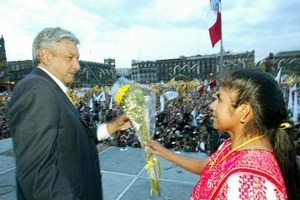
Ratifican asambleístas del PRD que no reconocerán a Calderón
Raúl Llanos : La Jornada
05/10/2006 14:15
México, D. F. En reunión privada, los 34 diputados de la fracción parlamentaria del PRD en la ALDF acordaron desplegar una intensa campaña de aclaración, en la que quede bien precisada la postura que hasta ahora han mantenido: no reconocer a Felipe Calderón Hinojosa como presidente legítimo de México, y apegarse a los resolutivos de la Convención Nacional Democrática.
En el encuentro también se estableció que en una próxima reunión tendrán que evaluarse las declaraciones emitidas la mañana de ayer por su vocea Nancy Cárdenas, quien dijo que los 34 legisladores del sol azteca reconocerían al presidente panista después del primero de diciembre.
Con todo y ello, algunos de los representante populares, sobre todo los que pertenecen a la corriente Izquierda Democrática Nacional, pidieron la remoción de Nancy Cárdenas como la vocera del grupo, pues su actuar tuvo "graves consecuencias políticas" para todos
De hecho, como primera acción, la mayoría de los diputados del PRD desplegaron en sus curules una cartulina en la que se precisa: "no al presidente espurio"
The Assembly members of the PRD ( Party of the Democratic Revolution: Mexico) said today that they would not recognize president elect Calderón.
At their meeting, 34 deputies of the parliament from the DF (Federal district) decided to develop an intense campaign to not recognize Felipe Calderon Hinojasa as the legitimate President of Mexico. They joined with the decision of the Democratic National Convention.
(Translated from La Jornada)
President elect Felipe Calderón ( not recognized) traveling in Chile was warmly greeted by Chilean President Michele Bachelet (Socialist Party). Oct. 5, 2006.
Tuesday, October 03, 2006
Mexican Left
The Balance Might be Changed
Some have talked about what's happening in Mexico in
terms of "dual power." Leon Trotsky used that term in
his History of the Russian Revolution to describe what
happens when a rising social class creates new and
alternative institutions of social power. So far we
have not seen that happen in Mexico where a real power,
the Mexican state, confronts Lopez Obrador and the CND,
an important political and social movement, but not a
movement that has been built upon or yet given rise to
alternative institutions of governance that represent a
second power. Nor is it clear that Lopez Obrador has
the will or the capacity to create them. What he has
created is a mass movement on the left with a radical
rhetoric, a movement made up of people who yearn for a
new society of democracy and social justice. While his
rhetoric promises revolution, his actions suggest a
militant struggle for reform, which is not therefore to
be discounted. Within that struggle for reform, genuine
revolutionary voices and forces may develop.
All of that having been said, social movements,
especially if they begin to have some success can grow
rapidly, and unfolding events can force them to change
their character. The balance of forces can shift
rapidly and radically under the right circumstances.
The power of mass movements has played a significant
role in the change of governments in Latin America in
the last decade. So, while Lopez Obrador and the PRD
may not yet have sufficient strength, a mistake by the
government could suddenly give a lift to the opposition
movement.
===
MEXICAN LABOR NEWS AND ANALYSIS September 2006, Vol.
11, No. 9
About Mexican Labor News and Analysis
Mexican Labor News and Analysis (MLNA) is produced in
collaboration with the Authentic Labor Front (Frente
Autentico del Trabajo FAT) of Mexico and the United
Electrical Workers (UE) of the United States, and with
the support of the Resource Center of the Americas in
Minneapolis, Minnesota. MLNA can be viewed at the UE's
international web site: www.ueinternational.org
==
Some have talked about what's happening in Mexico in
terms of "dual power." Leon Trotsky used that term in
his History of the Russian Revolution to describe what
happens when a rising social class creates new and
alternative institutions of social power. So far we
have not seen that happen in Mexico where a real power,
the Mexican state, confronts Lopez Obrador and the CND,
an important political and social movement, but not a
movement that has been built upon or yet given rise to
alternative institutions of governance that represent a
second power. Nor is it clear that Lopez Obrador has
the will or the capacity to create them. What he has
created is a mass movement on the left with a radical
rhetoric, a movement made up of people who yearn for a
new society of democracy and social justice. While his
rhetoric promises revolution, his actions suggest a
militant struggle for reform, which is not therefore to
be discounted. Within that struggle for reform, genuine
revolutionary voices and forces may develop.
All of that having been said, social movements,
especially if they begin to have some success can grow
rapidly, and unfolding events can force them to change
their character. The balance of forces can shift
rapidly and radically under the right circumstances.
The power of mass movements has played a significant
role in the change of governments in Latin America in
the last decade. So, while Lopez Obrador and the PRD
may not yet have sufficient strength, a mistake by the
government could suddenly give a lift to the opposition
movement.
===
MEXICAN LABOR NEWS AND ANALYSIS September 2006, Vol.
11, No. 9
About Mexican Labor News and Analysis
Mexican Labor News and Analysis (MLNA) is produced in
collaboration with the Authentic Labor Front (Frente
Autentico del Trabajo FAT) of Mexico and the United
Electrical Workers (UE) of the United States, and with
the support of the Resource Center of the Americas in
Minneapolis, Minnesota. MLNA can be viewed at the UE's
international web site: www.ueinternational.org
==
Subscribe to:
Posts (Atom)