by Deborah Klugman,
Labor activist and social justice crusader Dolores Huerta was participating in a 1988 protest in San Francisco when police descended on the demonstrators with tear gas and batons. Huerta, then 58, was among those brutally assaulted when an officer drove a baton with full force into her torso. Her internal injuries were extensive. She suffered three broken ribs, her spleen was shattered and had to be removed, and she spent months in recovery. But the indomitable Huerta recovered to again assume center stage in the ongoing battle for workers’ rights.
 Dolores Huerta, 1976. (Photo: George Ballis)
Co-written by Bratt and Jessica Congdon, the nimbly-paced Dolores begins by establishing a historical context for the farm workers’ movement as rooted in the same endemic racism that fostered slavery and Jim Crow. That narrative is then interwoven with the story of Huerta’s growing involvement.
Dolores Huerta, 1976. (Photo: George Ballis)
Co-written by Bratt and Jessica Congdon, the nimbly-paced Dolores begins by establishing a historical context for the farm workers’ movement as rooted in the same endemic racism that fostered slavery and Jim Crow. That narrative is then interwoven with the story of Huerta’s growing involvement.
While Martin Luther King Jr. and Cesar Chavez are ubiquitous in history textbooks, Huerta is most often sidelined. Many people, then and now, took her to be Chavez’s subordinate or assistant.
Labor activist and social justice crusader Dolores Huerta was participating in a 1988 protest in San Francisco when police descended on the demonstrators with tear gas and batons. Huerta, then 58, was among those brutally assaulted when an officer drove a baton with full force into her torso. Her internal injuries were extensive. She suffered three broken ribs, her spleen was shattered and had to be removed, and she spent months in recovery. But the indomitable Huerta recovered to again assume center stage in the ongoing battle for workers’ rights.
Footage of the assault on Huerta and other protesters is replayed in director Peter Bratt’s dynamic and informative film Dolores, a U.S. entry in the documentary category at Sundance, which will have special screenings September 8-14 at Los Angeles’ Nuart Theater. A mix of archival imagery and interviews with Huerta, her family and such prominent figures as Gloria Steinem, Angela Davis and Luis Valdez, the documentary portrays her as a pivotal yet relatively uncredited luminary in labor history.
While Martin Luther King Jr. and Cesar Chavez are ubiquitous in history textbooks, Huerta is most often sidelined, her name even expunged from some high school curricula after she opined that “Republicans hate Latinos.” Many people, then and now, took her to be Chavez’s subordinate or assistant. Arizona’s state superintendent of public instruction, Tom Horne, once called her Chavez’s “girlfriend.” In fact, she co-founded the United Farm Workers and was equally instrumental in positioning its cause, via legislation, on the political map. It was she, not Chavez, who coined the slogan “Sí se puede” — the rallying cry for striking farm workers, later adopted by Barack Obama’ s supporters in his 2008 campaign for the presidency.
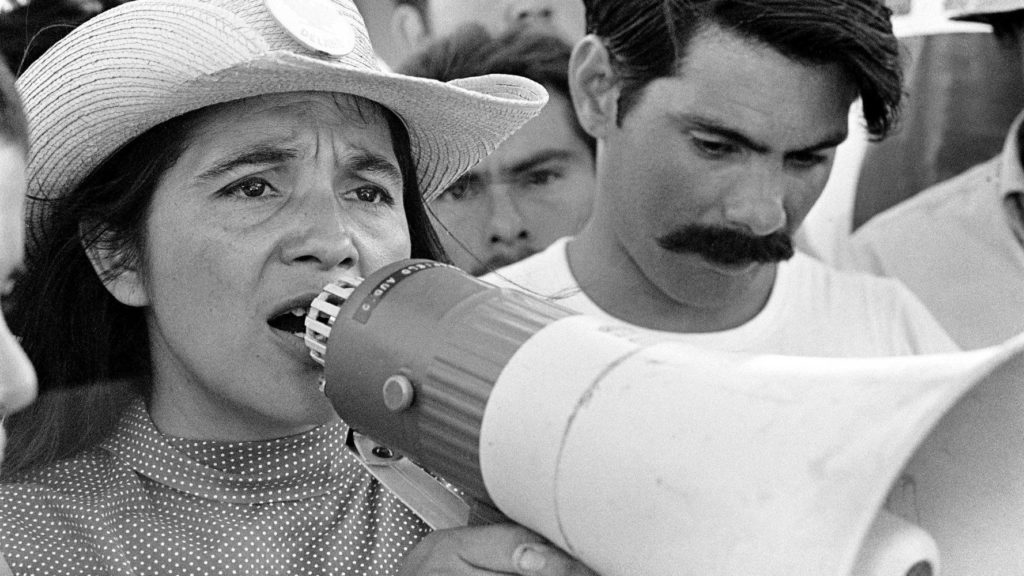 Dolores Huerta, 1976. (Photo: George Ballis)
