Featuring Dolores Huerta. At one time, a DSA Honorary Vice Chair.
Showing posts with label Dolores Huerta. Show all posts
Showing posts with label Dolores Huerta. Show all posts
Monday, September 08, 2025


Wednesday, April 10, 2024
: Happy Birthday Dolores

Saturday, February 24, 2024
Its Time to Organize
Dear Dolores Huerta Foundation Community,
We are thrilled to announce the launch of our new Get Out the Vote web page! This civic engagement hub is a one-stop destination for all your voting needs, designed to empower you with essential information and tools for the upcoming elections. Don't forget California's primary election is Tuesday, March 5, 2024!
On our Get Out the Vote page, you can:
- Learn how to register to vote
- Understand your voting rights
- Explore what's on your ballot
- Track your ballot
This page will be continuously updated with relevant voting and civic engagement information, serving as a valuable resource leading up to the elections. While it is designed for California voters, everyone is welcome to explore and benefit from its offerings.
Want to get directly involved?
Join us by phone banking from anywhere, or if you're in Kern County, why not canvass in Tulare or Bakersfield? We will host many more phone banking and canvassing efforts, so please stay tuned to our website and follow us on Instagram.
In Partnership,
-- Your Allies at the Dolores Huerta Foundation

Friday, October 06, 2023
Dolores Huerta Foundation
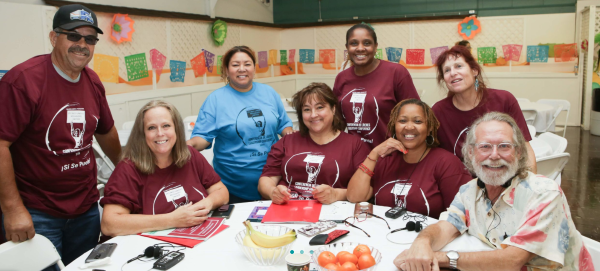
In 2005, the Dolores Huerta Foundation launched its first house meeting campaign – a foundational piece of DHF's community organizing model – and organized its first grassroots volunteer groups to work on infrastructure improvements in Kern County, California. From this effort, Vecinos Unidos was born!
In its very first year, DHF's Vecinos Unidos network successfully advocated for the Bakersfield Board of Supervisors to improve public safety by building sidewalks around three area schools that lacked them.
Within the following year, the Vecinos led a successful campaign to remove the Texas company that had been hurting the community with its mismanagement of the local water board and bring in local management. Under its new leadership – which included three Vecinos who independently ran for and got elected to the water board – the board stabilized water rates, installed water meters in residents' homes for correct water usage monitoring, exposed gross mismanagement of funds by the previous board, and called a grand jury to investigate.
Even in its earliest years, DHF's community-based model of training and organizing local volunteer leaders showed the tremendous impact that improved the daily lives of community members. It's a model – invented by legendary community organizer Fred Ross, Sr. and pioneered by our founder and namesake Dolores Huerta – that has been expanded, refined, and replicated over the past two decades, leading to the growing list of successes, the empowerment of communities, and life-changing benefits for tens of thousands of families and individuals.
Vecinos Unidos, specifically, continues to empower community leaders through hands-on training to lead civic engagement campaigns, hold elected officials accountable, and secure positive outcomes to address the needs of their community. Vecinos chapters have successfully advocated for community improvements such as more parks, paved roads, pools, sewer connections, education equity, and more.
Thanks to the ongoing dedication of our volunteers, network members, and supporters like you, we'll keep making a difference in people's lives, protecting fundamental rights, and helping marginalized and vulnerable communities find their voice in our democracy for decades to come!
Stay tuned for more stories of impact as we celebrate 20 years of the Dolores Huerta Foundation, and if you're on social media and not already doing so, follow DHF's social media channels for even more updates on our work and ways to engage:
Thank you for everything you do!
– Your friends at the Dolores Huerta Foundation
Sunday, May 10, 2020
Dolores Huerta Endorses Biden

Civil rights icon Dolores Huerta, who earlier backed Senator Kamala Harris of California for the Democratic presidential nomination, has endorsed former Biden.
Huerta, who turned 90 in April, co-founded the United Farm Workers of America with César Chávez and coined the phrase “Sí se puede.” Despite her age, Huerta remains active in a wide range of progressive causes, including the Dolores Huerta Foundation.
In an interview with The Associated Press, Huerta pledged to do “whatever I possibly, humanly can to make sure that Joe Biden gets elected.” She appeared Sunday online as part of a Todos Con Biden, or Everyone with Biden, live-streamed event with actor-comedian John Leguizamo, Congresswoman Veronica Escobar, an El Paso Democrat, and former U.S. Labor Secretary Hilda Solis.
Biden had trouble gaining ground among Latino voters in the Democratic primaries against progressive firebrand, Vermont Senator Bernie Sanders, who has since dropped out of the race. Newsweek reported this week that the Biden campaign “is launching a multimillion-dollar Latino vote campaign after recent polling showed lagging enthusiasm among [Latinos], including evidence that he needed to invest heavily to attract Latino men to help him secure the presidency…”
Biden’s outreach effort is aimed at Florida, Arizona, Colorado, Nevada, and Texas (all states with large Latino populations). In addition, targeted investments will be “aimed at smaller Latino communities in the Midwest states of Michigan, Wisconsin, and Pennsylvania, where Trump won by razor-thin margins,” Newsweek reported.
President Donald Trump’s campaign is making a major push to lure Latino voters, more than 70 percent of whom supported Hillary Clinton for president in 2016.
Vanguardia America is a free weekly newsletter. To sign up, email Editor and Publisher James E. Garcia at vanguardianews@gmail.com.
Thursday, August 01, 2019
Friday, May 10, 2019
Tuesday, April 09, 2019
Dolores Huerta Day- April 10

DOLORES HUERTA DAYApril 10, 2019
Dolores Huerta Day
Wed., April 10, 2019
10:00 a.m. – 4:00 p.m.
FREE admission for all visitors
Celebrate California’s first annual Dolores Huerta Day at the California Museum with FREE admission on Wed., April 10, 2019!
Enacted in 2018, Dolores Huerta Day recognizes the legendary Latina activist’s extraordinary work while encouraging Californians to participate in a day of community service in her honor.
Festivities include:
Friday, March 08, 2019
Dolores Huerta Opening Day - Sacramento

Dolores Huerta will be speaking at the California Museum tomorrow morning at the grand opening of the Smithsonian Dolores Huerta traveling exhibit. Here are two links - one regarding tickets for tomorrow, and the other is a youtube link where you can watch her speak live via telecast. My social studies methods students are being required to visit this exhibit at the California Museum (I am on the CA Museum Learning Advisory Board so I am also attaching the Smithsonian Dolores Huerta Community Guide that was provided to me). - Maggie
|
Celebrate the grand opening of the Smithsonian Institution’s traveling exhibit “Dolores Huerta: Revolution in the Fields / Revolución en los Campos” on Sat., Mar. 9 at the California Museum! Festivities include: • Discussion plus Q&A with Dolores Huerta and California First Partner Jennifer Siebel Newsom (Auditorium*, 10:30 – 11:30 am);• Curator presentation by Dr. Taína Caragol of the Smithsonian Institution's National Portrait Gallery (Auditorium*, 12:30 – 1:30 pm);• Screening of “DOLORES” (2017), the award-winning documentary directed by Peter Bratt (Auditorium*, 2:00 – 3:30 pm); • FREE for members or $5 reduced general admission to all current exhibits, a savings of up to $4 (10:00 am - 4:00 pm);• FREE hands-on civic engagement activities (12:00 pm – 4:00 pm);• More fun f
|
Tuesday, June 26, 2018
Dolores Huerta and Many Others - Texas
Great site.
https://www.breakbreadnotfamilies.org
Break Bread : Not Families
Border officials suspend handing over migrant families to prosecutors. NYT: “The nation’s top border security official said Monday that his agency has temporarily stopped handing over migrant adults who cross the Mexican border with children for prosecution, undercutting claims by other Trump administration officials that “zero tolerance” for illegal immigration is still in place. Kevin K. McAleenan, the commissioner of Customs and Border Protection, said his agency and the Justice Department should agree on a policy ‘where adults who bring their kids across the border — who violate our laws and risk their lives at the border — can be prosecuted without an extended separation from their children.’ Because Immigration and Customs Enforcement does not have enough detention space for the surge of families crossing the border, many families will be quickly released, with a promise to return for a court hearing. Mr. McAleenan said that the agency would continue to refer single adults for prosecution for illegally crossing the border, and that border agents would also separate children from adults if the child is in danger or if the adult has a criminal record.”
https://www.breakbreadnotfamilies.org
Break Bread : Not Families
Border officials suspend handing over migrant families to prosecutors. NYT: “The nation’s top border security official said Monday that his agency has temporarily stopped handing over migrant adults who cross the Mexican border with children for prosecution, undercutting claims by other Trump administration officials that “zero tolerance” for illegal immigration is still in place. Kevin K. McAleenan, the commissioner of Customs and Border Protection, said his agency and the Justice Department should agree on a policy ‘where adults who bring their kids across the border — who violate our laws and risk their lives at the border — can be prosecuted without an extended separation from their children.’ Because Immigration and Customs Enforcement does not have enough detention space for the surge of families crossing the border, many families will be quickly released, with a promise to return for a court hearing. Mr. McAleenan said that the agency would continue to refer single adults for prosecution for illegally crossing the border, and that border agents would also separate children from adults if the child is in danger or if the adult has a criminal record.”
Friday, March 30, 2018
Cesar Chavez Dolores Huerta, the UFW, and Strategic Racism.
 |
| Cesar Chavez & Duane Campbell. 1972 |
Once social change begins, it cannot be reversed. You
cannot un-educate the person who has learned to read. You cannot
humiliate the person who feels pride. You cannot oppress the people who are not
afraid anymore. Cesar Chávez. November 9, 1984.
On March 31, 2018, Eleven
states and numerous cities will
hold holidays celebrating labor and
Latino Leader Cesar Chavez. Conferences, marches and celebrations will occur in
numerous cities this weekend and particularly in rural farm areas of the nation. A recent film Cesar Chavez: An American
Hero, starring Michael Peña as Cesar
Chavez and Rosario Dawson as Dolores
Huerta presents important parts of this story.
Meanwhile, in March
of 2015 hundreds of farmworkers have
walked off their jobs in Baja California, Mexico, from the agricultural fields just
a few miles from the U.S. border , fields developed to provide a harvest to the
U.S. markets. Farm labor strikes and
violence against strikers remains a volatile issue. Farm workers deserve dignity, respect, and
fair wages. Achieving these goals will
require a union.
The current UFW
leadership, as well as former UFW leaders
and former DSA Honorary Chairs
Eliseo Medina and Dolores Huerta
are recognized leaders in the ongoing efforts to achieve comprehensive
immigration reform in the nation.
On immigration, UFW President Arturo Rodriquez
says, “We urge Republicans to abandon their political games that hurt millions
of hard-working, taxpaying immigrants and their families, and help us finish
the job by passing legislation such as the comprehensive reform bill that was
approved by the Senate on a bipartisan vote in June 2013,” Rodriguez
said. Similar compromise proposals, negotiated by the UFW and the
nation's major agricultural employer associations, have passed the U.S. Senate
multiple times over the last decade. The same proposal has won majority support
in the House of Representatives, even though House GOP leaders have refused to
permit a vote on the measure. “The UFW will not rest until the President's
deferred relief is enacted and a permanent immigration reform, including a path
to citizenship for all 11 million undocumented immigrants, is signed into law.” www.UFW.org
Wednesday, October 11, 2017
Dolores - A Life for Justice

Dolores – A Film Review
by Duane Campbell
There is an important new
film out – Dolores, the story of
former DSA Honorary Chair Dolores Huerta and her fight for justice. If you want to be inspired by her struggle for social justice, go
see the film.
Although at times ignored by the Anglo media, and at other times
castigated as a red and an “outside agitator,” Huerta tirelessly led the fight
for racial and labor justice alongside Cesar Chavez, becoming one of the most
important feminists of the twentieth century. If you don’t know her story, you
should ask yourself why. She continues
the fight on many fronts to this day, at age 87. With unprecedented access to
Dolores, the film reveals important parts of the struggle for dignity and
justice for farmworkers, as well as the raw, personal stakes involved in
committing one’s life to social
change.
Dolores, produced by PBS and Independent Lens, serves labor history well by
accurately describing the often overlooked role of Filipinos who initiated a
strike in Delano in 1965, which the nascent NFWA (National Farm Workers
Association) joined to create the great Grape Strike that changed labor history
in the Southwest.
Friday, September 22, 2017
DOLORES : Sacramento Showing
A great film. A tribute to a great organizer.
SACRAMENTO SCREENING
DOLORES | 1 hour 38 minutes
FRIDAY, SEP 22- THURSDAY, SEP 28
The Tower Theatre
Tickets can be purchased at https://www.readingcinemasus.com/tower/film/dolores
See this review: http://www.latimes.com/entertainment/movies/la-et-mn-dolores-review-20170907-story.html
See this review: http://www.latimes.com/entertainment/movies/la-et-mn-dolores-review-20170907-story.html
Sunday, September 03, 2017
Dolores Huerta : Labor, Chicana Heroine
by Deborah Klugman,
Labor activist and social justice crusader Dolores Huerta was participating in a 1988 protest in San Francisco when police descended on the demonstrators with tear gas and batons. Huerta, then 58, was among those brutally assaulted when an officer drove a baton with full force into her torso. Her internal injuries were extensive. She suffered three broken ribs, her spleen was shattered and had to be removed, and she spent months in recovery. But the indomitable Huerta recovered to again assume center stage in the ongoing battle for workers’ rights.
 Dolores Huerta, 1976. (Photo: George Ballis)
Co-written by Bratt and Jessica Congdon, the nimbly-paced Dolores begins by establishing a historical context for the farm workers’ movement as rooted in the same endemic racism that fostered slavery and Jim Crow. That narrative is then interwoven with the story of Huerta’s growing involvement.
Dolores Huerta, 1976. (Photo: George Ballis)
Co-written by Bratt and Jessica Congdon, the nimbly-paced Dolores begins by establishing a historical context for the farm workers’ movement as rooted in the same endemic racism that fostered slavery and Jim Crow. That narrative is then interwoven with the story of Huerta’s growing involvement.
While Martin Luther King Jr. and Cesar Chavez are ubiquitous in history textbooks, Huerta is most often sidelined. Many people, then and now, took her to be Chavez’s subordinate or assistant.
Labor activist and social justice crusader Dolores Huerta was participating in a 1988 protest in San Francisco when police descended on the demonstrators with tear gas and batons. Huerta, then 58, was among those brutally assaulted when an officer drove a baton with full force into her torso. Her internal injuries were extensive. She suffered three broken ribs, her spleen was shattered and had to be removed, and she spent months in recovery. But the indomitable Huerta recovered to again assume center stage in the ongoing battle for workers’ rights.
Footage of the assault on Huerta and other protesters is replayed in director Peter Bratt’s dynamic and informative film Dolores, a U.S. entry in the documentary category at Sundance, which will have special screenings September 8-14 at Los Angeles’ Nuart Theater. A mix of archival imagery and interviews with Huerta, her family and such prominent figures as Gloria Steinem, Angela Davis and Luis Valdez, the documentary portrays her as a pivotal yet relatively uncredited luminary in labor history.
While Martin Luther King Jr. and Cesar Chavez are ubiquitous in history textbooks, Huerta is most often sidelined, her name even expunged from some high school curricula after she opined that “Republicans hate Latinos.” Many people, then and now, took her to be Chavez’s subordinate or assistant. Arizona’s state superintendent of public instruction, Tom Horne, once called her Chavez’s “girlfriend.” In fact, she co-founded the United Farm Workers and was equally instrumental in positioning its cause, via legislation, on the political map. It was she, not Chavez, who coined the slogan “Sí se puede” — the rallying cry for striking farm workers, later adopted by Barack Obama’ s supporters in his 2008 campaign for the presidency.
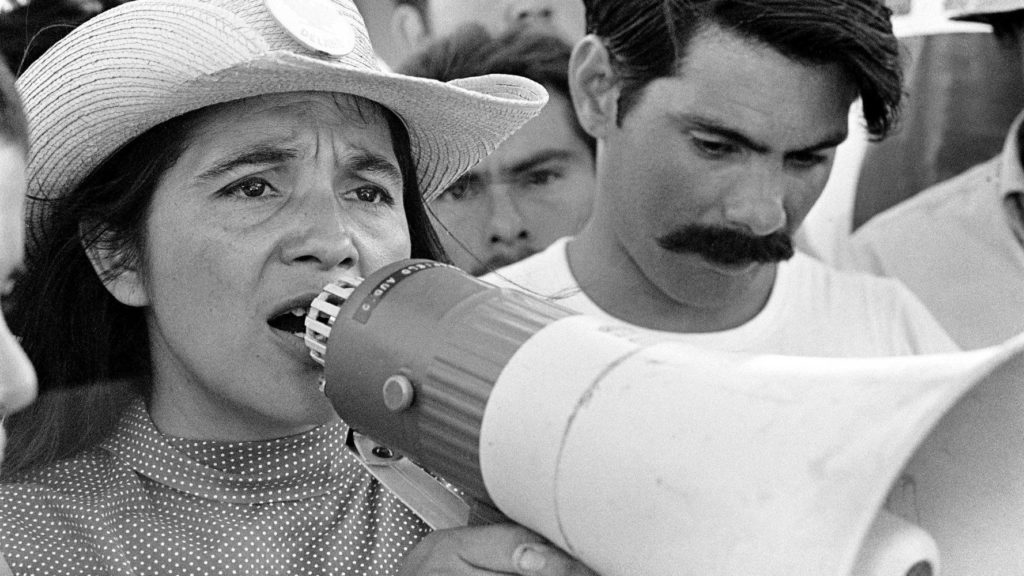 Dolores Huerta, 1976. (Photo: George Ballis)
Wednesday, July 26, 2017
Tuesday, July 25, 2017
Historic State Fair Exhibit Recognizes Farmworkers
HISTORIC STATE FAIR EXHIBIT RECOGNIZES FARMWORKERS
by David Bacon
Capital & Main, 7/25/17

Cutting the ribbon at the farmworker exhibition (left to right): Assemblymember Blanca Rubio, United Farm Workers President Arturo Rodriguez, State Sen. Ben Hueso, Assemblymembers Kevin McCarty and Freddie Rodriguez, Cesar Chavez Foundation President Paul F. Chavez, Assemblymember Anna Caballero, State Fair CEO Rick Pickering (partially obscured), Sacramento City Councilmember Eric Guera, State Sen. Ed Hernandez (partially obscured), State Treasurer John Chiang and Sacramento County Supervisor Phil Serna.
For over 160 years the California State Fair/Cal Expo has been run by growers to showcase the wonders and wealth of the state's agriculture. And for over 160 years the fair did this without mentioning the people whose labor makes agriculture possible: farmworkers.
This year that changed. Rick Pickering, chief executive officer of the California Exposition & State Fair, and Tom Martinez, the fair's chief deputy general manager, asked the United Farm Workers to help put together an exhibit to remedy this historical omission. As a result, for the first time the fair, which runs through July 30, has an exhibition that not only pays tribute to field laborers, but also acknowledges the long history of their struggle to organize unions.

Growers are not happy, and fair organizers got some pushback. But at the ceremony inaugurating the exhibition, State Senator Ben Hueso (D-San Diego), the head of the California Latino Legislative Caucus, explained why they no longer have veto power. "We wouldn't be here without the work of farmworkers," he said. "The legislature now includes members who worked in the fields themselves, or have family who did, who know what it's like to work in 100 degree heat, to suffer the hardest conditions and work the longest hours. We want our families to work in better conditions and earn more money."
Some of the farmworkers who came as guests of the fair were veterans of that long struggle. Efren Fraide worked at one of the state's largest vegetable growers, D'Arrigo Brothers Produce, when the original union election was held in 1975. However, it was only after the legislature passed the mandatory mediation law, forcing growers to sign contracts once workers voted for a union, that the first union agreement went into force at the company in 2007, covering 1,500 people.
D'Arrigo workers maintained their union committee through all the years between 1975 and 2007, organizing strikes and work stoppages to raise conditions and wages. "I'm very proud to see that we're included here," Fraide said, gesturing toward the photographs on the walls in the cavernous exhibition hall. "It shows who we are and what we went through. Si se puede!"

As the workers were introduced by UFW President Arturo Rodriguez, they stood up from their seats to applause. Rodriguez noted that some farmworkers, like those working at Monterey Mushrooms' sheds near Morgan Hill and Watsonville, now make a living wage of between $38,000 and $42,000 in year-round jobs with benefits. "This exhibition recognizes that farm labor is important work, and that it can be a decent job if it includes labor and environmental standards. It can come with job security, and can be professional work," he emphasized.
"What's been lacking is an acknowledgment of the people who do the work," charged Sacramento County Supervisor Phil Serna, son of the capital city's late mayor, Joe Serna, and nephew of former UFW organizer Ruben Serna. "This exhibition documents their political activism. We wouldn't be here if it were not for the farmworkers movement."
In the Fields of the North / En los Campos del Norte
Photographs and text by David Bacon
University of California Press / Colegio de la Frontera Norte

302 photographs, 450pp, 9”x9”
paperback, $34.95
SPECIAL OFFER:
order the book on the UC Press website:
use source code 16M4197 at checkout
receive a 30% discount
En Mexico se puede pedir el libro en el sitio de COLEF: http://libreria.colef.mx/detalle.aspx?id=7560 |
Tuesday, July 18, 2017
Stop Texas Style Immigration Crackdown: Make California a Sanctuary State

Dolores Huerta
In the seven decades I’ve been fighting for social justice and human rights, I’ve never seen a year as scary as 2017.
The Trump administration is pushing a xenophobic agenda to deport millions of people and racially profile millions more. White supremacists are marching in public, committing heinous acts, and trying to influence public policy.
With bigots and extremists sinking to new lows across the country, all of us who believe in equality and inclusion need to reach higher than ever before.
I’m counting on California to lead the way.
AS COMMUNITIES ACROSS THE NATION STAND UP AGAINST RACISM, CALIFORNIA NEEDS TO CREATE THE STRONGEST POSSIBLE COUNTERWEIGHT TO TEXAS AND TRUMP’S HATE.
Case in point: A Texas Republican legislator recently said he called immigration agents on community members protesting the state’s draconian anti-immigrant law. What’s more, he reportedly threatened to shoot a fellow legislator.
It’s no accident these threats came in the context of Texas’s odious SB 4, which embodies President Donald Trump’s most extreme ideas. That law will enlist local police in the feds’ deportation force and unleash a wave of racial profiling and arrests targeting black and brown people.
As communities across the nation stand up against racism, California needs to create the strongest possible counterweight to Texas and Trump’s hate. Gov. Jerry Brown and our Legislature must pass Senate Bill 54, the California Values Act.
This proposal by Senate President Kevin de León will make sure our local and state resources aren’t used to help the Trump administration deport millions of people.
We know firsthand that when law enforcement acts as deportation agents, that further weakens the community’s trust and confidence. And families get broken apart.
Many Californians have rallied, marched and lobbied for the California Values Act, which would limit sharing personal information with Trump’s deportation force. Also called the “sanctuary state” bill, SB 54 would help make our schools, hospitals, courthouses and libraries safe spaces for everyone in our community.
This bill stands for the simple principle that authorities should treat everyone fairly, regardless of birthplace, background or appearance. To prevent abuses, SB 54 also makes sure law enforcement won’t detain anyone for deportation without a warrant signed by a judge.
That sounds like common sense to me.
Sadly, the California State Sheriff’s Association is going out of its way to oppose the California Values Act, even though amendments have been made to address safety considerations and Los Angeles police Chief Charlie Beck has endorsed the bill.
Honestly, I worry some of our sheriffs are more aligned with Trump and Texas Republicans than with our values in California.
Take Sheriff Donny Youngblood of Kern County, where the Dolores Huerta Foundation and the United Farm Workers are based. He worked to declare our county a “non-sanctuary” and previously stated he felt the county would fit much better in Arizona.
Just a few months ago, Sheriff Youngblood and six other sheriffs met with none other than Jeff Sessions, Trump’s extremist attorney general, before he had even been confirmed. The California State Sheriff’s Association endorsed Session’s nomination.
We should all be concerned about the implications of the sheriffs’ entanglement with Sessions’ extremist agenda.
Back in the 1980s, my friend Coretta Scott King wrote: “Sessions has used the awesome powers of his office in a shabby attempt to intimidate and frighten elderly black voters.” He also has documented connections to nativist, anti-immigrant groups.
And Sessions, along with Trump and the California State Sheriffs Association, doesn’t hesitate to scapegoat, criminalize and demonize immigrants whenever it’s convenient.
We simply cannot allow this kind of extremism to poison the conversation in California and derail our progress.
We must take a clear stand for our deepest values: All people are created equal and deserve due process.
Anything less is giving in to Trumpism.
DOLORES HUERTA IS CO-FOUNDER, WITH CESAR CHAVEZ, OF THE UNITED FARM WORKERS AND PRESIDENT OF THE DOLORES HUERTA FOUNDATION. CONTACT HER AT CCHAVEZ@DOLORESHUERTA.ORG. Dolores is also a Honorary Chair of Democratic Socialists of America.
Reposted from the Sacramento Bee
Read more here: http://www.sacbee.com/opinion/california-forum/article161083894.html#storylink=cpy
Read more here: http://www.sacbee.com/opinion/california-forum/article161083894.html#storylink=cpy
Wednesday, March 29, 2017
Cesar Chavez, Dolores Huerta, and the Legacy

When we are really honest with ourselves, we must admit that our lives are all that really belong to us. So it is how we use our lives that determines what kind of people we are. ..I am convinced that the truest act of courage..is to sacrifice ourselves for others in a totally nonviolent struggle for justice.
Cesar Chavez (1927-1993)
by Duane Campbell
by Duane Campbell

Conferences, marches and celebrations will occur in numerous cities and particularly in rural areas of the nation. A recent film Cesar Chavez: An American Hero, starring Michael Peña as Cesar Chavez and Rosario Dawson as Dolores Huerta presents important parts of this union story. With the work of the Chicano/Mexican American Digital History Project their story of union organizing will begin to be covered in all public school history texts in California this year,
The current UFW leadership, as well as former UFW leaders and current DSA Honorary Chairs Eliseo Medina and Dolores Huerta are recognized leaders in the ongoing efforts to achieve comprehensive immigration reform in the nation.
UFW President Arturo Rodriquez says, “We urge Republicans to abandon their political games that hurt millions of hard-working, taxpaying immigrants and their families, and help us finish the job by passing legislation such as the comprehensive reform bill that was approved by the Senate on a bipartisan vote in June 2013,” Rodriguez said. “The UFW will not rest until the President's deferred relief is enacted and a permanent immigration reform, including a path to citizenship for all 11 million undocumented immigrants, is signed into law.” www.UFW.org

Thursday, September 15, 2016
Dolores Huerta: A Legacy
Ken Burt, For Hispanic Heritage Month. See video link at the end.

Seventy-seven years ago, in March 1939, Juan Fabian Fernandez of New Mexico opened a session of El Congreso de los Pueblos Mexicanos e Hispanos Americano de los Estados Unidos (National Congress of the Mexican and Spanish-Speaking Peoples of the United States) in downtown Los Angeles. He stood out as the only Latino state legislator present, but he was not the only politico there. Seeking to bring the New Deal to California, Latinos, labor and the left had banded together the previous year to elect a slate of progressives, led by California Governor Culbert Olson.
Members of El Congreso cheered when the new lieutenant governor, Ellis Patterson, addressed them: “I pledge to you that President Roosevelt and the present administration in California is sincerely fighting to bring real democracy into being!”
Author and Olson administration official Carey McWilliams also spoke about the anti-immigrant bills in Congress, then being championed by representatives from the segregated Deep South. Elements of this California New Deal coalition clearly supported El Congreso. Sponsors included actor Melvyn Douglas and his wife Helen Gahagan Douglas, a future California Congresswoman.
Politics in California, then as now, was to the left of New Mexico’s. However, voters in New Mexico had done a much better job of electing Spanish-speaking elected officials, beginning with Dennis Chavez, who was then serving in the U.S. Senate.
Latinos had been in New Mexico for 400 years, and Representative Fernandez, who had run for office to improve the lot of working families, symbolized a long tradition of civic engagement. While serving in the state legislature, the 31-year-old miner also served as secretary-treasurer of the 600-member CIO Mine-Mill workers’ union local at the American Metal Company in Tererro, a gritty coal town. He was allied with a group of labor and community activists that included leaders of the Liga Obrera de Habla Español, or Spanish-Speaking Workers League. Together, these Latino leaders developed an agenda revolving around the right to organize workers and an increase in the level of relief for the unemployed. What was needed was someone to promote the agenda in New Mexico’s state capitol. So Fernandez and an AFL official secured the Democratic Party nomination and won seats in the state’s House of Representatives.
The founding of El Congreso provided the opportunity to meet with like-minded people from around the nation and held the promise of forming a national movement to empower Latinos within the framework of President Roosevelt’s New Deal.
Unfortunately, El Congreso proved to be short-lived, and Fernandez served only one term in the state legislature. Still, this New Mexico Solon deserves greater recognition and placement in the pantheon of Latino political pioneers. From the vantage point of history, Fernandez’s most lasting legacy is not his role within El Congreso or a legislative bill or a negotiated union contract. His greatest legacy is his daughter: Dolores Huerta.
In her speech to the 2016 National Democratic Convention in Philadelphia, the Latina icon spoke proudly of her father, a man who became a long-distance mentor after she moved, as a young girl, with her mother from New Mexico to Stockton, California.
In 1960, then working for the Community Service Organization, Huerta played a leading role in registering 140,000 Mexican Americans to vote for John F. Kennedy, before she became a principal leader of the farm-workers movement. She is also a Honorary Chair of DSA. To better understand her Philadelphia reference to her legislator father—his foray into Latino politics during the 1930s and her connection to that history—watch Huerta’s speech.
reposted from Capitol and Main
Ed. note. Campaign materials for the Defeat Trump: Defeat Racism effort are available. contact campd22702@gmail.com
Thursday, September 01, 2016
Mexican American Votes Will Count
‘Why Would They Be Trying to Suppress Them?’: Dolores Huerta on What’s at
Stake in 2016
Ally Boguhn, Rewire
Republican
nominee Donald Trump launched his campaign for president in June 2015 with
a speech notoriouslyclaiming [1] Mexican immigrants to the
United States “are bringing drugs, and bringing crime, and their rapists.”
Since
then, both Trump’s campaign [2] and the Republican Party at
large have continued to rely upon anti-immigrant [3] and anti-Latino rhetoric to
drum up support. Take for example, this year’s Republican National Convention
in Cleveland, where Sheriff Joe Arpaio—whose departmentcame under fire [4] earlier this year for racially
profiling Latinos—was invited to take the stage to push [5] Trump’s proposed 2,000-mile border wall. Arpaio told
the Arizona Republic that Trump’s campaign had worked with the
sheriff to finalize his speech.
This
June, just a day shy of the anniversary of Trump’s entrance into the
presidential race, People for the American Way and CASA in Action hosted
an event highlighting what they deemed to be the presumptive Republican
nominee’s “Year of Hate.”
Among
the advocates speaking at the event was legendary civil rights leader Dolores
Huerta, who worked alongside [6] César Chávez in the farm
workers’ movement. Speaking by phone the next day with Rewire,
Huerta—who has endorsed [7] Democratic nominee Hillary Clinton—detailed
the importance of Latinos getting involved in the 2016 election, and what
she sees as being at stake for the community.
The
Trump campaign is “promoting a culture of violence,” Huerta told Rewire, adding
that it “is not just limited to the rallies,” which have sometimes ended in violent incidents [8], “but
when he is attacking Mexicans, and gays, and women, and making fun of disabled
people.”
Subscribe to:
Posts (Atom)