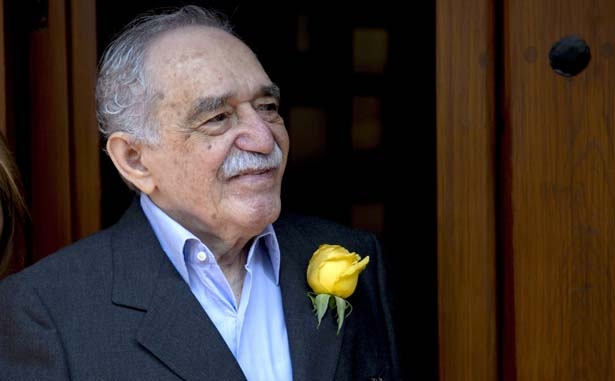
Born in 1927, Gabriel García Márquez was 87 when he died
last week. According to his younger brother, Jaime, he had been suffering
from complications caused by chemotherapy, which saved his life but
accelerated his dementia, a disease that apparently ran in his family. He’d
call his brother and ask to be reminded about simple things. “He has problems
with his memory,” Jaime reported a few years back.
Remembering and forgetting are García Márquez’s great
themes, so it would be easy to read meaning into his senility. The writer was
fading into his own solitude, suffering the same fate he assigned to the
inhabitants of his fictional town of Macondo, in his most famous novel, One
Hundred Years of Solitude. Struck by an insomnia plague, “sinking
irrevocably into the quicksand of forgetfulness,” they had to make signs
telling themselves what to remember. “This is a cow. She must be milked.”
“God exists.”
The narrative of that book is straightforward. Macondo is
founded, it grows, catastrophe strikes. Its people, though, experience time
not as progressive motion but as circular repetition, engaging in ever more
desperate efforts to ward off the forces of oblivion. Life and history are
lineal, García Márquez seemed to want to say, but memory, which makes us
human, is reiterative. Or, as he wrote at the beginning of his memoir, Living
to Tell the Tale, published in English in 2003, “Life is not what one lived,
but what one remembers and how one remembers in order to recount it.”
The climax of One Hundred Years of Solitude is
famously based on a true historical event that took place shortly after
García Márquez’s birth: in 1928, in the Magdalena banana zone on Colombia’s
Caribbean coast, not far from where the author was born, the Colombian
military opened fire on striking United Fruit Company plantation workers,
killing an unknown number. In the novel, García Márquez uses this event to
capture the profane fury of modern capital, so powerful it not only can
dispossess land and command soldiers but control the weather. After the
killing, the company’s US administrator, “Mr. Brown,” summons up an interminable
whirlwind that washes away not only Macondo but any recollection of the
massacre. The storm propels the reader forward toward the novel’s famous last
line, where the last descendant of the Buendía family finds himself in a room
reading a gypsy prophesy: everything he knew and loved would be “wiped out by
the wind and exiled from the memory of men...because races condemned to one
hundred years of solitude did not have a second opportunity on earth.”
|