Monday, December 05, 2016

Statement of the Standing Rock Sioux Tribe - Pipeline Blocked

Standing Rock Sioux Tribe’s Statement on U.S. Army Corps of Engineers Decision to Not Grant Easement

http://standwithstandingrock.net/
Portside Date: 
December 4, 2016
Author: 
Dave Archambault II
Date of Source: 
Sunday, December 4, 2016
Standing Rock Sioux Tribe

Cannon Ball, N.D.- The department of the Army will not approve an easement that will allow the proposed Dakota Access Pipeline to cross under Lake Oahe. The following statement was released by Standing Rock Sioux Tribal Chairman Dave Archambault II.
"Today, the U.S. Army Corps of Engineers announced that it will not be granting the easement to cross Lake Oahe for the proposed Dakota Access Pipeline. Instead, the Corps will be undertaking an environmental impact statement to look at possible alternative routes. We wholeheartedly support the decision of the administration and commend with the utmost gratitude the courage it took on the part of President Obama, the Army Corps, the Department of Justice and the Department of the Interior to take steps to correct the course of history and to do the right thing.
The Standing Rock Sioux Tribe and all of Indian Country will be forever grateful to the Obama Administration for this historic decision.
We want to thank everyone who played a role in advocating for this cause. We thank the tribal youth who initiated this movement. We thank the millions of people around the globe who expressed support for our cause. We thank the thousands of people who came to the camps to support us, and the tens of thousands who donated time, talent, and money to our efforts to stand against this pipeline in the name of protecting our water. We especially thank all of the other tribal nations and jurisdictions who stood in solidarity with us, and we stand ready to stand with you if and when your people are in need.
Throughout this effort I have stressed the importance of acting at all times in a peaceful and prayerful manner - and that is how we will respond to this decision. With this decision we look forward to being able to return home and spend the winter with our families and loved ones, many of whom have sacrificed as well. We look forward to celebrating in wopila, in thanks, in the coming days.
We hope that Kelcey Warren, Governor Dalrymple, and the incoming Trump administration respect this decision and understand the complex process that led us to this point. When it comes to infrastructure development in Indian Country and with respect to treaty lands, we must strive to work together to reach decisions that reflect the multifaceted considerations of tribes.
Treaties are paramount law and must be respected, and we welcome dialogue on how to continue to honor that moving forward. We are not opposed to energy independence, economic development, or national security concerns but we must ensure that these decisions are made with the considerations of our Indigenous peoples.
To our local law enforcement, I hope that we can work together to heal our relationship as we all work to protect the lives and safety of our people. I recognize the extreme stress that the situation caused and look forward to a future that reflects more mutual understanding and respect.
Again, we are deeply appreciative that the Obama Administration took the time and effort to genuinely consider the broad spectrum of tribal concerns. In a system that has continuously been stacked against us from every angle, it took tremendous courage to take a new approach to our nation-to-nation relationship, and we will be forever grateful.
Learn more about the Standing Rock Sioux Tribe at standwithstandingrock.net [1]. For incremental updates please follow our Facebook page at Standing Rock Sioux Tribe or follow us on Twitter @standingrockst.

The System IS Rigged!—The Electoral College and the 2016 Election | Portside

The System IS Rigged!—The Electoral College and the 2016 Election | Portside


Slave holding and the Electoral College.  Bob Wing, Bill Fletcher Jr.

Sunday, December 04, 2016

California Legislature to Protect Undocumented Immigrants


New York Times.
LOS ANGELES — Top Democratic lawmakers in California are moving to enact sweeping legislation to protect undocumented immigrants from deportation, the first sign of what they say will be an effort to resist immigration policies championed by President-elect Donald J. Trump.

The measures, which will be introduced Monday, would provide free legal help to undocumented immigrants during deportation proceedings, offer more assistance in criminal court, and further limit local law enforcement’s cooperation with federal immigration agents. The measures contrast sharply with the kind of policies that Mr. Trump pressed on the campaign trail.

“Throughout the presidential campaign and since, the president-elect has made many troubling statements that run counter to the principles that define California today,” said Kevin de León, the Senate president pro tempore, who is backing the package. “There is no greater policy area than immigration where the comments run headlong to the values we share as Californians.”

The legislation suggests the level of opposition Mr. Trump may face in California, a state where 40 percent of the population is Latino. The leaders of both chambers of the Legislature are Latino, as is the state’s attorney general-designee, Xavier Becerra. Mr. de León said that pushing immigration measures would be a priority of the Legislature.

The bills are likely to pass, as both the chambers of California’s Legislature, as well as the governor’s office, are controlled by Democrats. The measures are the latest in a long line of immigrant-friendly policies passed by the Legislature, whose members include a number of immigrants and the children of immigrants. The state already offers in-state college tuition rates and driver’s licenses for undocumented immigrants.

Thursday, December 01, 2016

The Coming Immigration Wars: How can communities resist Trump's Immigration Actions ?

Maria Elena Durazo knows about immigrant workers, labor and civil rights. She has been the hospitality union UNITE HERE’s General Vice President for Immigration, Civil Rights and Diversity since 2014. Before that she was the first woman executive secretary-treasurer of the Los Angeles County Federation of Labor, which represents 600,000 workers, many of whom are immigrants and Latinos. She became a force for labor and living standards in the nation’s second-largest city—and a thought-leader for the rest of the nation.
When she was growing up, Durazo’s farm-worker family picked crops up and down the West Coast. Recalling that time, she told film maker Jesús Treviño, “As migrant farm workers, my dad would load us up on a flatbed truck and we would go from town to town and pick whatever crop was coming up. I think of my dad when he had to negotiate with contratistas [contractors]. I knew we worked so hard and the contratistas were chiseling us down to pennies. What was pennies to them meant food on the table for us.”
Durazo spoke with Capital & Main about the threats to working people and immigrants from a new Trump administration—and how to fight back.

About This Series


Capital & Main: Let’s begin with the Big Question: What do you see as the next battle fronts for labor and immigration — what needs defending?
Maria Elena Durazo: There is a great degree of worry about Trump giving permission to do harm in our communities, to immigrant families and immigrant neighborhoods–permission for people to attack, to harass kids, adults.
Our job in the labor movement is to create safe-work places. Here in Los Angeles, and in a number of cities, officials are standing up and saying we’re not going to allow our local police to cooperate with ICE [U.S. Immigration and Customs Enforcement.] Our schools are saying we’re not going to allow ICE to come in.
Families have an earthquake plan. Who do you call? How do you react? How do we protect ourselves? That’s the very first level, and we have to give confidence to our communities. We know how to be safe. Let’s remember that and do that stuff right away.
The president-elect has said he intends to cut federal funds to cities that don’t collaborate with federal authorities on immigration policies. Local municipalities are saying no—Los Angeles Mayor Eric Garcetti has staked out his position–but what happens? Los Angeles could lose $500 million this fiscal year.
Remember the threats around apartheid? There were threats that pension funds in cities that divested from South Africa would be breaking the law…threats of lawsuits. Then divestment happened across the board. But it took a few to start it, to have the courage to say we’re not going to be threatened that way.
Some people called President Obama the “deporter-in-chief”—news reports cite 2.4 million “removals” during his administration. Is that title fair? 
He certainly dramatically increased the number of border patrol agents. We in the labor and immigrant rights movement had big clashes with President Obama. He did try to do a version of [having] local law enforcement cooperate with ICE. We fought that.
At first he didn’t agree with giving deferred action to young people. [DACA, or Deferred Action for Childhood Arrivals — the Dreamers.] We pushed back, and he eventually agreed with it. He tried very hard to get a complete overhaul of the immigration laws and immigration system. He tried in his way. We certainly pushed in our way. We got as far as bipartisan Senate approval of a piece of legislation.
Other Republicans were adamant about blocking him at every single step. He only got as far as the enforcement part of it, which is why he was given the title. But other than DACA, he was never able to get the other pieces of legislative immigration reform.
What lies ahead for the DACA students? There are some 750,000 young people completing their educations and working under a temporary protected status — it seems that makes them a very vulnerable population for deportation.
Unless we fight back harder they present an opportunity for Trump to be able to say, “See? I’m doing things. I told you I was going to do something.”
How real is President-elect Trump’s immigration rhetoric–“round them all up”? Should people be as afraid as they feel?
We should be worried about that. Not just worried, we should be acting on what he pledged to do, and what he continues to say he’s going to do.
The people that he’s considering for these different [government] positions are very serious. It’s not a threat. It’s a very explicit promise.
The other danger is to use the term “criminals” as a pretext to deport millions. [Trump] never said the majority of immigrants are hard-working men and women. There are at maximum a few hundred thousand immigrants [and] some that have had a run-in with law enforcement. That’s the pretext for going after millions. That’s the scary part because he knows people in this country could fall for that.
How many civil rights laws in our history have been violated–as recently as George W. Bush, as far back as what was done to Japanese Americans? In the 1950s we had the deportations of Mexican Americans and Mexican immigrants. It wasn’t in the millions, but it certainly was at least in the hundreds of thousands. We’ve been through this. Are we in a position to fight back and refuse?
How do we refuse?
There’s no doubt in my mind we have all the makings across this country to push back and show him. We won marriage equality, we’ve pushed and we’ve won a number of things on the environmental front.
A million people march in the streets. We’ll disobey and we’ll have solidarity. We’re showing that in Los Angeles. We’re showing that in other cities. We have police chiefs saying they will not cooperate. That’s a very powerful thing that we have on our side. Community-based organizations saying we’re going to set up family safety procedures. The school districts saying, “We’re not going to allow that.”
I spoke with Reverend James Lawson, the other day– when I talked to him he said, “We know how to win. We’ve got these victories. Feel proud and great about them. This guy, there’s no way we’re going to let him destroy our country.”
Major industries in this country benefit from the immigration system being broken. Are they going to go along with mass deportations– an enormous disruption in the economic system?
It’s a new opportunity to exploit immigrant workers even more. Wage theft will just go through the roof because there will be such a dramatic increase in this atmosphere of fear. There are sectors of our economy where employers will love it because they’ll be more in control. They know that 12 million people are not going to be deported overnight. But they’re going to take advantage of that fear.
A chicken-processing plant in a Southern right-to-work state wouldn’t be happy if all its undocumented workers were deported.
No, they wouldn’t be happy, but let’s say Trump says, “You’re not going to like that. But how about if I give you unfettered guest workers?” They’ll be provided an alternative on that level. That’s one way that they could look at it.
Look at these high-tech industry leaders that pretend to be so liberal. What do they want? Guest worker status for “highly skilled” workers—to be able to have them here, to work them. They don’t care about them being permanently allowed to live in this country.
There are industries like hospitality, where I expect those employers to defend their work force. In the past they’ve shown courage by publicly being on the side of [immigration] legislation. But they haven’t really taken much risk. Now it’s going to take more risk to defend their work force. Courage. Leadership. They’re going to have to do more than just sign off on legislation.
Reposted from Capital & Main

Wednesday, November 30, 2016

Immigrant Communities Brace for Trump

IMMIGRANT COMMUNITIES BRACE FOR TRUMP
By David Bacon
The American Prospect, November 22, 2016
http://prospect.org/article/immigrant-communities-brace-trump


Immigrants and others protest in front of Oakland City Hall the evening after Election Day.

Donald Trump promised to deport two million "criminal illegal immigrants" in his first 100 days in office. Immigrants and their allies are already organizing, protesting, and defending "sanctuary cities."


The state of Nebraska went red on Election Day, voting for Donald Trump and the Republican ticket, but working-class Omaha, Nebraska's largest city, went blue, voting for Hillary Clinton and the Democrats. Clinton won urban Omaha-Douglas County-by 3,000 votes, but lost the city's electoral vote. In 2010, redistricting had joined Omaha to the wealthier suburbs of Sarpy County, delivering Trump a 12,000-vote advantage this year. Incumbent Democratic House member Brad Ashford lost his seat to Republican Don Bacon on November 8 for the same reason.

Nevertheless, all 18 precincts of Ward 4 voted against Trump by a two-to-one margin, thanks to years of patient organizing by the immigrant Mexican community of South Omaha. African American North Omaha voted solidly against Trump as well. The Omaha results highlight both the achievements of years of organizing in U.S. immigrant communities, as well as the vulnerability of those same communities under a Trump administration.

"We have built institutions in which immigrants are winning power in the middle of a corporate culture," says Sergio Sosa, director of Nebraska's Heartland Workers Center. He describes a 20-year history of community and workplace organizing. "We resisted immigration raids in meatpacking plants under the Clinton and Bush administrations, and mounted marches and demonstrations for immigration reform. For eight years, we've fought deportations under President Obama, while building a precinct-by-precinct power base."

Reaching beyond Omaha, the center helped Latinos organize in Schuyler, one of many small Midwestern towns where immigrants now make up the bulk of the workforce in local meatpacking plants. In many of these towns, Latinos are a majority of the population. In this recent election, Schuyler voted its first Latino, Mynor Hernandez, onto the school board. There he will help implement the town's new policy of multilingual education for its racially diverse children.

"The reality, though, is that people in Schuyler are very scared of what a Trump victory will mean for them, as are people in South Omaha," Sosa warns. "This is one of the big contradictions here-that we've achieved some degree of power on a local level while the danger from the national election results has increased dramatically."


ON THE CAMPAIGN TRAIL, Trump gained notoriety for referring to Mexican immigrants as "criminals" and "rapists." He also won infamy for promising to build an "impenetrable, physical, tall, powerful, beautiful, southern border wall" across the 2,000-mile-long U.S.-Mexico border.

His policy proposals, however, are far more dangerous than his insults. During the election he pledged in his "100-day action plan to Make America Great Again" to "begin removing the more than two million criminal illegal immigrants from the country" on his first day in office.

Thursday, November 24, 2016

Trump: The Privatization of Public Education


It is hard to find anyone more passionate about the idea of steering public dollars away from traditional public schools than Betsy DeVos, Donald J. Trump’s pick as the cabinet secretary overseeing the nation’s education system.

For nearly 30 years, as a philanthropist, activist and Republican fund-raiser, she has pushed to give families taxpayer money in the form of vouchers to attend private and parochial schools, pressed to expand publicly funded but privately run charter schools, and tried to strip teacher unions of their influence.

A daughter of privilege, she also married into it; her husband, Dick, who ran unsuccessfully for governor of Michigan a decade ago, is heir to the Amway fortune. Like many education philanthropists, she argues that children’s ZIP codes should not confine them to failing schools.

But Ms. DeVos’s efforts to expand educational opportunity in her home state of Michigan and across the country have focused little on existing public schools, and almost entirely on establishing newer, more entrepreneurial models to compete with traditional schools for students and money. Her donations and advocacy go almost entirely toward groups seeking to move students and money away from what Mr. Trump calls “failing government schools.”

Conservative school choice activists hailed her on Wednesday as a fellow disrupter, and as someone who would block what they see as federal intrusion on local schools.

Tuesday, November 22, 2016

Crossing The Line - Immigrants

by Laura Carlson
The weather is undecided. One day is winter and the next day, spring. Today, fortunately, it is springtime in New York City and we carry our coats, caps and scarves on our arm as we cross the Brooklyn Bridge on foot.
The group of migrants has decided to walk across the city’s characteristic bridge to call for “fewer walls, more bridges.” Among them are mothers and children who had not seen each other in more than 20 years, and grandparents who had never met their grandchildren who grew up in this huge city far away from the villages their parents were born in.
They’re part of a group of 21 families brought back together by the Popular Assembly of Migrant Families, a binational organization of migrants and their families in Mexico and New York. The grassroots organization obtained visas and support so the parents could visit their children for the first time.
There’s a mixture of joy and concern in the air. To finally embrace their relatives – a dream that seemed impossible for years – filled them with happiness. They come from indigenous and farm towns in Guerrero’s Costa Chica, the mountains of Puebla, the small state of Tlaxcala. A man tenderly takes the arm of his small mother as they walk the streets of New York chatting in Mixteco. For the visitors, the cityscape is impressive, but even more so the gaze of the son-turned-father who left home decades ago and became a man here.
On the other hand, Mexican migrants living in New York know they are under siege. Donald Trump’s campaign has made them the target of the frustration and anger of a large part of the population that feels someone has stolen the “American dream.” In a country built on racism to justify the dispossession of indigenous peoples, slavery and continued exploitation of migrants, it was surprisingly easy for Trump to channel discontent into xenophobia.

Monday, November 21, 2016

Latinos and the Fracturing Democratic Party Coalition


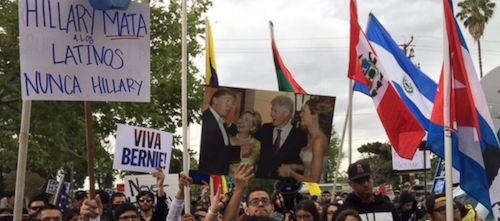
Protesters greet Hillary Clinton at East Los Angeles College, May 2016.

The 2016 U.S. Presidential Elections saw old alliances and loyalties shattered by the fall of the Democratic Party and the rise of con man Donald Trump into so many pieces that they, like Humpty Dumpty, can never be put together again. Politics as we know them are beyond repair.

Although Latinos formed a vital piece of this makeup, the non-Latino American public made little effort to learn anything about them. The political pundits reduced them to numbers and stereotypes. Absent were Mexican American newscasters or political players; to the media, every brown-skinned person was an immigrant. Latinos — Hispanics in polite society — looked and thought alike.

The lack of intelligent an analysis failed to counter the fake news Trump and his supporters spread via social media and the networks. Truth be told, Latin American nationalities share colonial history but that is far as it often goes. They are racially and culturally different. Not all Latinos, for example, enjoy or eat spicy foods, and they do not all live in the same places.

Immigration Summit at Sac State Today

Keep the Dream Alive
Keeping the Dream Alive Summit featuring Pulitzer Prize-winning journalist, filmmaker and media publisher Jose Antonio Vargas as the keynote speaker. Vargas is the founder of Define American, a media and culture nonprofit that seeks to elevate the conversation around immigration and citizenship in America; and the founder .

BY STEPHEN MAGAGNINI
Jose Antonio Vargas left the Philippines for Northern California at 12 and has spent 23 years fighting to become a legal resident. He hasn’t succeeded, despite sharing in a Pulitzer Prize at The Washington Post in 2008.
Now he says he is fighting for thousands of “Dreamers” – young undocumented immigrants brought here as children who finished high school and legally obtained their work permits but could face deportation by the Trump administration, which has called for the removal of the country’s 11 million undocumented immigrants.
On Monday, Vargas – founder of Define American, a nonprofit media and culture organization built around immigration and citizenship, and editor of #EmergingUS – will be the keynote speaker at the Keeping The Dream Alive Summit from 8:30 a.m. to 2 p.m. in Sacramento State’s University Union Ballroom.
The summit is sponsored by the school’s Dreamer Resource Center and Full Circle Project to help the campus’s estimated 700 undocumented students, plus those whose parents are undocumented, said program coordinator Norma Mendoza.

Sunday, November 20, 2016

DSA Position on the Election Results


Statement from DSA’s National Political Committee
November 13, 2016


How Trump Won: Seizing the Anti-Establishment Ground through Racial and Economic Nationalism
On November 8, voters in the United States narrowly elected an openly racist, misogynist and nativist candidate for president. Donald Trump succeeded in defining himself as an anti-establishment candidate who will end dynastic rule in Washington, D.C., by elites who care little for “forgotten Americans.” The grain of truth in this rhetoric masked an ideological appeal to a “white identity” that Republicans have long cultivated — in this instance, focusing on fear of immigrants, Muslims and people of color. The facts go against the liberal media’s narrative that “poor white people” were the primary force behind Trump’s rise. We must understand “Trumpism” as a cross-class white nativist alliance; the median family income of the 62 percent of white voters who supported Trump was higher than that of Hillary Clinton voters and wealthier than Bernie Sanders’ primary base.
Governing elites have long used racism to divide working people. The Left must understand the centrality of racism to capitalism and speak directly to how racism has hurt the interests of the white working class. The far Right in Europe and the United States has succeeded in speaking to the anger of people long abandoned by the bipartisan conservative and center-left consensus in favor of unbridled corporate globalization. Trump’s victory should show once and for all the dire consequences of leaving the Left’s response to economic insecurity in the hands of corporate-aligned centrists like the Clintons.
Read the entire statement here: http://www.dsausa.org/we_fight_for_socialism_dl_npc  

The Bourgeois' Dilemma

By
Rodolfo F. Acuña
The other day a colleague called it to my attention that I was wearing New Balance so in some way I was breaking a boycott. I pointed out that they were the only shoes I had. In retrospect I was becoming so gringo. I have never been for the indiscriminate application of boycotts. In 2010, the early stages of Arizona assault on immigrants and then on Mexican American Studies I questioned the call for a boycott of Arizona. I felt that it isolated Tucson and prevented friends for going there to show their support by visiting the Wall and standing in solidarity. Not all boycotts were like the Farm Worker Boycott.
Getting back to the New Balance Boycott, I will certainly not buy that brand again just like I won’t buy at Walmart. However, I believe it would be stupid for me to throw away a pair of shoes that I wear for health reasons. Having diabetes, shoes are a big deal! You’d know if you had it. New Balance is one of the few brands that have triple width shoes. In my estimation if would be a bit more strategic to pass out buttons emphasizing not to buy New Balance. While I respect the sentiments of Debra Messing and Swae Lee, they are not my teachers.

Tuesday, November 01, 2016

Former Miss Universe Alicia Machado Slams Donald Trump At Clinton Rally ...

The Mexican American Vote


PHOENIX — In an office suite not far from the airport, Irma Maldonado, 18, expertly role-played what she’d be doing on the city’s streets in half an hour: knocking on the doors of residents and exhorting them to vote. But not everything was a game. Before a group of young canvassers headed out for the day, a team leader at the community organizing group LUCHAmentioned that someone had earlier pulled a gun on two members of the team.


“Everything was OK,” the organizer said, but Maldonado and the 15 or so other teens and 20-somethings were given safety whistles before hitting the streets.


Maldonado has a personal stake in America’s immigration debate, which has been making headlines throughout the election, particularly because of Donald Trump’s description of Mexicans as rapists and his desire to have Mexico pay for a border wall.


“Before going into high school — it was the summer of 2012 — my mother decided to self-deport to Mexico” with her two youngest children, Maldonado said. Maldonado, who was born and grew up in New Mexico, had a hard time adjusting to life in Nayarit, Mexico, a small state on the Pacific coast north of Puerto Vallarta, especially given that she hadn’t known her family’s status. “I think it was right when we had to move when I actually realized that my mom wasn’t actually legal here in the United States, when I was 14 years old,” she said. Her father, who has a green card, continues to work in New Mexico; Maldonado now is a first-year nursing student and lives with her 23-year-old sister in Arizona. Her mother and brother remain in Mexico.


Mexican-Americans such as Maldonado may help determine the political future of Arizona — and the nation — in a landmark election year. In an August survey, respondents were asked if Trump and Clinton made their respective parties more welcoming or more hostile to Latinos. Nine percent of Mexican-Americans said Trump made the GOP more welcoming; 74 percent said he made it more hostile. By contrast, 59 percent said Clinton made the Democratic party more welcoming; 9 percent said more hostile. An October poll by Latino Decisions found that 17 percent of Latino voters nationwide said they support Trump or are leaning toward him; 70 percent supported Clinton.