Showing posts with label Race. Show all posts
Showing posts with label Race. Show all posts
Thursday, March 17, 2016


Friday, January 22, 2016
I don't do diversity, I do triage..
Rage Against the Narrative: "I don't do diversity, I do triage"
Date of Source:
Wednesday, January 13, 2016
Praxis Center
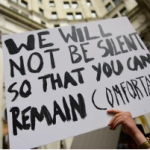
On November 3, 2015, Jonathan Butler, a graduate student at the University of Missouri’s flagship campus in Columbia, Missouri, launched a hunger strike. Fed up with “institutional racism” and the university’s unwillingness to seriously tackle it, he stated that he and other black students “felt unsafe” [1] on campus. Mizzou’s students recounted scary drive-by insults, being called the n-word, and racist “pranks” as regular occurrences.[1] [2]
On November 9, 2015 Yale students protested. It was sparked by a white girls only frat party[2] [3] and an email from “associate master” of Silliman College Erika Christakis [4] saying that Halloween costumes, such as black face, are a matter of free speech. Further, she wrote, “there should be room for a …young person to be a little bit obnoxious … a little bit inappropriate and yes, offensive.”
By late November, students from Duke, Princeton, John Hopkins, Ithaca College and many more had launched actions. As historian Barbara Ransby [5] wrote recently:
On most campuses, there was a specific incident that sparked protests; the real issues are much broader and ongoing. The protesting students are not simply angered by a single incident or racial epithet; they are fed up with duplicitous campus cultures that tout diversity and tolerate pervasive racist practices, symbols and policies.
Within a month, student-led coalitions issued demands [6] of at least 82 institutions. As Ransby points out, “Black student struggles historically have had deep roots and strong ties to movements beyond the campus.” Many black students are from communities that James Baldwin termed Occupied Territory [7], so it is not surprising that movements for black lives would inspire students to stand up on the campuses that they attend.
Sunday, July 26, 2015
Sanders on Racism- at the SCLC
Remarks by Senator Sanders at the Southern Christian Leadership Conference
JULY 25, 2015
https://berniesanders.com/remarks-senator-sanders-southern-christian-leadership-conference/
Thank you for inviting me to be with you tonight. Thank you for the work you continue to do as leaders in civil rights. You have always been a voice for the voiceless and champions for social justice.
Your courageous history dates back to the Montgomery Bus Boycott when one person, Rosa Parks, by the simple act of sitting down at the front of the bus, inspired a whole community to stand up and bring the transportation system in Montgomery to its knees, to capture the imagination of the nation and to cause what my friend John Lewis calls “a nonviolent revolution.”
You knew then, what the American people are beginning to remember now – that real change takes place when millions of people stand up and say “enough is enough,” and when we create a political revolution from the ground up. That is what the Southern Christian Leadership Conference has always been about. That is what is beginning to happen today. The American people are sick and tired with establishment politics, with establishment economics and with establishment media. They’re sick of being told that they don’t matter. They fully understand that corporate greed is destroying our economy, that American politics is now dominated by a handful of billionaires and that much of the corporate media is prepared to discuss everything except the most important issues facing our country.
I realize that many of you don’t know me very well. So let me take a moment to let you know a little bit about my background. I was mayor of Burlington, Vermont, from 1981-1989, Vermont’s lone congressman from 1990-2006 and a U.S. senator from Vermont from 2007 until today.
I was born in Brooklyn, New York. My father came to this country from Poland at the age of 17 without a penny in his pocket and without much of an education. My mother graduated from high school in New York City. My father worked for almost his entire life as a paint salesman and we lived with my brother in a small rent-controlled apartment. My mother’s dream was to move out of that three-room apartment into a home of our own. She died young and her dream was never fulfilled. As a kid I learned what lack of money means to a family, a lesson I have never forgotten.
When I was a young college student, I came to Washington, D.C., to participate in the March on Washington for Jobs and Freedom. I heard this organization’s first president, the Rev. Martin Luther King Jr., deliver his famous speech, and he inspired me, just as he inspired a whole generation – black and white – to get involved in the civil rights movement. In Chicago, I worked for housing desegregation and was arrested protesting public school segregation. During that time I was active in what was a sister-organization to the SCLC, the Congress of Racial Equality of CORE, which was headed up by the late James Farmer.
Since I have been an elected official, I have used my influence to stand with those who have no power, and to take on virtually every element of our current ruling class – from Wall Street, to the insurance companies, to the drug companies to Big Energy, to the Koch Brothers to the Military Industrial Complex. That’s what I do.
The decision to run for president was a very difficult one for me and my family. I love my job as Vermont’s senator and love spending time in Vermont with my four kids and seven beautiful grandchildren – something, needless to say, that I am less able to do today.
My family and I decided that I should run for president because the reality is that this country today faces more serious problems than at any time since the Great Depression and, if you include the planetary crisis of climate change, it may well be that the challenges we face now are more dire than any time in our modern history. And to address these crises we need leadership that is prepared to rally the American people, to create the political revolution that this country desperately needs, to take on the wealthy special interests that wield so much power.
Let me take this opportunity to quote from an excellent article by the columnist Eugene Robinson which appeared in the Washington Post. Here are some excerpts from that article:
As we celebrate King’s great achievement and sacrifice, it is wrong to round off the sharp edges of his legacy. He saw inequality as a fundamental and tragic flaw in this society, and he made clear in the weeks leading up to his assassination that economic issues were becoming the central focus of his advocacy.
Nearly five decades later, King’s words on the subject still ring true. On March 10, 1968, just weeks before his death, he spoke to a union group in New York about what he called “the other America.” He was preparing to launch a Poor People’s Campaign whose premise was that issues of jobs and issues of justice were inextricably intertwined.
“One America is flowing with the milk of prosperity and the honey of equality,” King said. “That America is the habitat of millions of people who have food and material necessities for their bodies, culture and education for their minds, freedom and human dignity for their spirits. . . . But as we assemble here tonight, I’m sure that each of us is painfully aware of the fact that there is another America, and that other America has a daily ugliness about it that transforms the buoyancy of hope into the fatigue of despair.”
Those who lived in the other America, King said, were plagued by “inadequate, substandard and often dilapidated housing conditions,” by “substandard, inferior, quality-less schools,” by having to choose between unemployment and low-wage jobs that didn’t even pay enough to put food on the table.
The problem was structural, King said: “This country has socialism for the rich, rugged individualism for the poor.”
Eight days later, speaking in Memphis, King continued the theme. “Do you know that most of the poor people in our country are working every day?” he asked striking sanitation workers. “And they are making wages so low that they cannot begin to function in the mainstream of the economic life of our nation. These are facts which must be seen, and it is criminal to have people working on a full-time basis and a full-time job getting part-time income.”
King explained the shift in his focus: “Now our struggle is for genuine equality, which means economic equality. For we know that it isn’t enough to integrate lunch counters. What does it profit a man to be able to eat at an integrated lunch counter if he doesn’t earn enough money to buy a hamburger and a cup of coffee?”
But what King saw in 1968 — and what we all should recognize today — is that it is useless to try to address race without also taking on the larger issue of inequality. He was planning a poor people’s march on Washington that would include not only African-Americans but also Latinos, Native Americans and poor Appalachian whites. He envisioned a rainbow of the dispossessed, assembled to demand not just an end to discrimination but a change in the way the economy doles out its spoils.”
And that is the theme that I wish to pursue this evening. The need to simultaneously address the structural and institutional racism which exists in this country, while at the same time we vigorously attack the grotesque level of income and wealth inequality which is making the very rich much richer while everyone else – especially the African-American community and working-class whites – are becoming poorer.
Let’s go to an issue that is rightly on everyone’s mind, the continuing struggle for racial justice in America and the need to combat structural racism. Let’s start with the facts. The horrible facts.
If current trends continue, one in four black males born today can expect to spend time in prison during their lifetime. This is an unspeakable tragedy.
Blacks are imprisoned at six times the rate of whites.
People of color are incarcerated, policed and sentenced to death at significantly higher rates than their white counterparts.
One in every 15 African-American men is incarcerated, compared to one in every 106 white men.
A report by the Department of Justice found that blacks were three times more likely to be searched during a traffic stop, compared to white motorists.
African-Americans are twice as likely to be arrested and almost four times as likely to experience the use of force during encounters with the police.
African-Americans make up two-fifths of confined youth today.
African-American women are three times more likely than white women to be incarcerated.
Once convicted, black offenders receive longer sentences (10 percent longer) than white offenders for the same crimes.
Thirteen percent of Africa-American men have lost the right to vote due to felony convictions.
But as bad as those statistics are, and they are indeed a tragedy, the situation for many people of color is worse yet.
Too many African-Americans today are simultaneously having to deal the crisis of racial justice while coping with the effects of poverty and economic deprivation, such as drugs, crime, and despair.
Of course the majority of people of color are trying to work hard, play by the rules and raise their children. But there are neighborhoods where mothers are afraid to let their children outside for fear of gang violence and drugs. And they are also afraid of their children being targeted by the police because of the color of their skin. No person should have to worry that a routine interaction with law enforcement will end in violence or death.
As Martin Luther King, Jr., said; Law and order exist for the purpose of establishing justice and when they fail in this purpose they become the dangerously structured dams that block the flow of social progress.
Across the nation, too many African-Americans and other minorities find themselves subjected to a system that treats citizens who have not committed crimes like criminals. A growing number of communities do not trust the police and police have become disconnected from the communities they are sworn to protect.
Sandra Bland, Michael Brown, Rekia Boyd, Eric Garner, Walter Scott, Freddie Gray, Tamir Rice. We know their names. Each of them died unarmed at the hands of police officers or in police custody. The chants are growing louder. People are angry. I am angry. And people have a right to be angry. Violence and brutality of any kind, particularly at the hands of law enforcement sworn to protect and serve our communities, is unacceptable and must not be tolerated.
We must reform our criminal justice system. Black lives do matter. And we must value black lives.
We must move away from the militarization of police forces. We must invest in community policing. Only when we get officers into the communities, working within the neighborhoods before trouble arises, do we really develop the relationships necessary to make our communities safer.
We need a federal initiative to completely redo how we train police officers in this country and give them body cameras. States and localities that make progress in this area should get more federal justice grant money. Those that do not should get their funding slashed. The measure of success for law enforcement should not be how many people get locked up.
For people who have committed crimes that have landed them in jail, there needs to be a path back from prison. The federal system of parole needs to be reinstated. We need real education and real skills training for the incarcerated.
We must end the over incarceration of non-violent young Americans who do not pose a serious threat to our society. It is an international embarrassment that we have more people locked up in jail than any other country on earth – more than even the Communist totalitarian state of China. That has got to end.
The war on drugs has been a failure and has ruined the lives of too many people. African-Americans comprise 14 percent of regular drug users but are 37 percent of those arrested for drug offenses. From 1980 to 2007, about one in three adults arrested for drugs was African-American.
It is an obscenity that we stigmatize so many young Americans with a criminal record for smoking marijuana, but not one major Wall Street executive has been prosecuted for causing the near collapse of our entire economy. This must change.
We need to end prisons for profit, which result in an over-incentive to arrest, jail and detain, in order to keep prison beds full. We need to invest in drug courts and medical and mental health interventions for people with substance abuse problems, so that they do not end up in prison, they end up in treatment.
But we have to go beyond just violence perpetuated by the state. As we saw so horribly in South Carolina, there are still those who seek to terrorize the African American community with violence and intimidation. We need to make sure the federal resources are there to crack down on the illegal activities of hate groups. We need a new social movement to let all the racist haters out there know that they will no longer be accepted in a civilized society.
In addition to the physical violence faced by too many in our country we need look at the lives of black children and address a few other difficult facts. Black children, who make up just 18 percent of preschoolers, account for 48 percent of all out-of-school suspensions before kindergarten. We are failing our black children before kindergarten! Black students were expelled at three times the rate of white students. Black girls were suspended at higher rates than all other girls and most boys. According to the Department of Education, African American students are more likely to suffer harsh punishments – suspensions and arrests – at school.
We need to take a hard look at education system. Black students attended schools with higher concentrations of first-year teachers, compared with white students. Black students were more than three times as likely to attend schools where fewer than 60 percent of teachers meet all state certification and licensure requirements.
We must get into our schools and keep kids in school. We must ensure that children graduate from high school and don’t drop out. This is a complicated problem and I’m not going to stand here and say I have all the answers.
But one thing that will help kids stay in school is if they have a belief that they will be able to get a college education. For too many families college seems like an impossibility. We have got to change that. We need to give our children, regardless of their race or their income, a fair shot at attending college. That’s why I support making all public universities tuition free.
Communities of color also face the violence of economic deprivation. Let’s be frank: neighborhoods like those in west Baltimore, where Freddie Gray resided, suffer the most. However, the problem of economic immobility isn’t just a problem for young men like Freddie Gray. It has become a problem for millions of Americans who, despite hard-work and the will to get ahead, can spend their entire lives struggling to survive on the economic treadmill.
We live at a time when most Americans don’t have $10,000 in savings, and millions of working adults have no idea how they will ever retire in dignity. God forbid, they are confronted with an unforeseen car accident, a medical emergency, or the loss of a job. It would literally send their lives into an economic tailspin. And the problems are even more serious when we consider race.
Most black and Latino households have less than $350 in savings. The black unemployment rate has remained roughly twice as high as the white rate over the last 40 years, regardless of education. This is unacceptable. The American people in general, want change – they want a better deal. A fairer deal. A new deal. They want an America with laws and policies that truly reward hard work with economic mobility. They want an America that affords all of its citizens with the economic security to take risks and the opportunity to realize their full potential.
Income and Wealth Inequality
Today, we live in the wealthiest nation in the history of the world, but that reality means little because almost all of that wealth is controlled by a tiny handful of individuals.
There is something profoundly wrong when the top one-tenth of 1 percent owns almost as much wealth as the bottom 90 percent, and when 99 percent of all new income goes to the top 1 percent. There is something profoundly wrong when we have a proliferation of millionaires and billionaires at the same time as millions of Americans work longer hours for lower wages and we have the highest rate of childhood poverty of any major country on earth. There is something profoundly wrong when one family owns more wealth than the bottom 130 million Americans. This grotesque level of inequality is immoral. It is bad economics. It is unsustainable. That is why we need a tax system that is fair and progressive, which makes wealthy individuals and profitable corporations begin to pay their fair share of taxes. This type of rigged economy is not what America is supposed to be about. This has got to change and, together we will change it.
We need to send a message to the billionaire class: “You can’t have it all. You can’t get huge tax breaks while children in this country go hungry. You can’t continue sending our jobs to China while millions are looking for work. You can’t hide your profits in the Cayman Islands and other tax havens, while there are massive unmet needs on every corner of this nation. Your greed has got to end. You cannot take advantage of all the benefits of America, if you refuse to accept your responsibilities as Americans.”
Economics
But it is not just income and wealth inequality. It is the tragic reality that for the last 40 years the great middle class of our country – once the envy of the world – has been disappearing. Despite exploding technology and increased worker productivity, median family income is almost $5,000 less than it was in 1999. Throughout this country it is not uncommon for people to be working two or three jobs just to cobble together enough income and some health care benefits to survive.
The truth is that real unemployment is not the 5.5 percent you read in newspapers. It is close to 11 percent if you include those workers who have given up looking for jobs or who are working part-time when they want to work full-time. And here is something we don’t hear much about. According to a recent analysis of Census Bureau data by the Economic Policy Institute, real youth unemployment in this country has reached crisis proportions. If you include those who are not working, who have given up looking for work or who are working part-time, white high school graduates aged 17-20 have an unemployment rate of 33 percent, Hispanics in the same age group have an unemployment rate of 36 percent while black youth have an unemployment rate of 51 percent. Today, shamefully, we have 45 million people living in poverty, many of whom are working at low-wage jobs.
Raising Wages and Benefits
Let us be honest and acknowledge that millions of Americans are now working for totally inadequate wages. The current federal minimum wage of $7.25 an hour is a starvation wage and must be raised. The minimum wage must become a living wage – which means raising it to $15 an hour over the next few years. The benchmark of full time work in America should be simple and concrete – that no full-time worker should live in poverty.
And a living wage should not only be fair, it should be equitable. That is why we must establish pay equity for women workers by law. It’s unconscionable that women earn 78 cents on the dollar compared to men who perform the same work. We must also end the scandal in which millions of American employees, often earning less than $30,000 a year, work 50 or 60 hours a week – and earn no overtime.
Further, the United States must end the international embarrassment of being the only major country on earth, the only one, which does not guarantee workers paid medical and family leave, paid sick time and paid vacation time. Last place is no place for America. That is why I will fight for 12 weeks of paid family leave, at least 10 days of paid vacation time and seven days of paid sick time. My Republican colleagues talk a lot about “family values.” Well, let me be very clear. It is not a family value to force the mother of a new born baby to go back to work a few days after she gives birth, because she doesn’t have the money to stay home and bond with her baby. That is not a family value. That is an insult to everything that I know about what family is about.
Today, as a result of the collapse of our middle class and declining wages, the American people are working longer hours than the people of any other country – 137 hours a year more than the Japanese, 260 more hours per year than the British and 499 hours a year more than the French. Well, 100 years later we still have not achieved that. Incredibly, today, 85 percent of working men and 66 percent of working women work more than 40 hours a week. And do you know what? Many workers in this country get no or very little paid vacation time. That has got to end.
Protecting Our Most Vulnerable
At a time when millions of Americans are struggling to keep their heads above water economically, at a time when senior poverty is increasing, at a time when millions of kids are living in dire poverty my Republican colleagues are trying to make a terrible situation even worse. If you can believe it, the Republican budget throws 27 million Americans off health insurance, makes drastic cuts in Medicare, throws millions of low income Americans, including pregnant women off nutrition programs, and makes it harder for working-class families to afford college or put their kids into Head Start. And then, to add insult to injury, they provide huge tax breaks for the very, very wealthiest families in this country while they raise taxes on working families.
Well, let me tell my Republican colleagues that I respectfully disagree with their approach. Instead of cutting Social Security, we need to expand Social Security benefits. Instead of cutting Head Start and childcare, we need to move to a universal pre-k system for all the children of this country. As Franklin Delano Roosevelt reminded us: “The test of our progress is not whether we add more to the abundance of those who have much, it is whether we provide enough for those who have little.” And that is a test that we as a nation must once again meet and master.
We need to make health care a basic right in our society.
We need to make sure every parent has quality affordable child care and where all of our qualified young people, regardless of income, can go to college, by making a 4-year education at every public college and university in this country free. If Germany, Sweden and Denmark can afford to do this, then so can we.
We need to invest in jobs and job training, rather than to be building more and more jails and to be locking up more and more people. That is why I have submitted legislation to spend $5.5 billion dollars to fund job-training programs for inner city youth. Instead of building more and more prisons, we need to be building more and more meaningful lives where young people can have a future, not be stuck in a dead end with no hope or opportunity.
If we are serious about reversing the decline of the middle class we need a major federal jobs program that puts millions of Americans back to work at decent paying jobs. At a time when our roads, bridges, water systems, rail and airports are decaying, the most effective way to rapidly create meaningful jobs is to rebuild our crumbling infrastructure. That’s why I’ve introduced legislation that would invest $1 trillion over 5 years to modernize our country’s physical infrastructure. This legislation would create and maintain at least 13 million good-paying jobs, while making our country more productive, efficient and safe. And I commit to you that as president, I will lead that legislation into law.
This is an ambitious program that would lift millions of families out of poverty and provide a pathway to greater economic security for all Americans. The right to a college education, the right to health care, and a guaranteed right to employment. It will not heal all wounds or relieve all tensions, but it would go beyond anything we have tried before, and it would send a clear signal that black lives matter.
Citizens United and Campaign Finance Reform and Voting Rights
I want to talk about our democracy. The billionaire class is controlling our political and economic lives because of the disastrous Citizens United case. The Supreme Court unconscionably gutted the Voting Rights Act. Make no mistake, we watching the erosion of our democracy and the gains that we have fought so hard to achieve.
Some of you may not see the connection between an out-of-control campaign financing system and the gutting of our voting rights, but you should not be fooled – they are two sides of the same coin. Our access to our democracy is being ripped away. The billionaires do not want people to vote.
My friends – let me be as blunt as I can while telling you what you already know. As a result of the disastrous Supreme Court decision in the Citizens United case, the American political system has been totally corrupted, and the foundations of American democracy are being undermined. What the Supreme Court essentially said was that it was not good enough for the billionaire class to own much of our economy. They could now own the U.S. government as well. And that is precisely what they are trying to do.
If we are serious about creating jobs, about climate change and the needs of our children, our veterans and the elderly, about reforming our criminal justice system, we must be deadly serious about campaign finance reform. That is why in my campaign for president, I have said that I will not nominate any justice to the Supreme Court who has not made it clear that he or she will move to overturn that disastrous decision which is undermining our democracy. Long term, we need to go further and establish public funding of elections, so that the dark money of American politics is stopped before democracy is bought and paid for by a handful of billionaires and corporations.
American democracy is not about corporations and billionaires being able to buy candidates and elections. It is not about Wall Street and big oil or the Koch brothers and Sheldon Adelson spending billions of dollars to elect candidates who will make the rich richer and everyone else poorer. According to media reports the Koch brothers alone, one family, will spend more money in this election cycle than either the Democratic or Republican parties. This is not democracy. This is oligarchy. The defining principle of American democracy is one person, one vote – with every citizen having an equal say – and no voter suppression. And that’s the kind of American political system we have to fight for.
Not only are big moneyed interests trying to buy the American electorate, Republican-controlled legislatures have done everything in their power to make it more difficult to vote.
Voting is becoming more difficult, not less. The Voting Rights Act has been gutted by the Supreme Court, and efforts to repair it in Congress have been sidelined. Voter suppression today is alive and well in the form of unnecessary voter ID laws, restrictions on registering to vote, improper purging of voter rolls, felon disenfranchisement, and a staggering array of deceptive practices that are preventing eligible voters from participating in the political process. It is embarrassing that the United States’ voting system is so dysfunctional.
We need to remember the price that was paid for the right to vote. We must restore our democracy’s promise of one man, one vote. We must repeal Citizens United and take the political process back from the billionaire class. We need to extend early voting, extend voting hours, make Election Day a holiday or move it to a weekend.
One area that I have been interested in is voter registration. Unsurprisingly, most other advanced democracies make voter registration much easier than we do here in the United States. Some countries, such as Argentina, Belgium, and Germany, maintain a national or municipal population database and local election officials add eligible voters to the rolls based on those lists. Some countries hire workers to go door-to-door and register all eligible voters, including Great Britain and Indonesia. Mexico deploys such workers to rural areas.
France automatically registers 18-year-olds to vote when they register with the Selective Service. Canada uses info collected from other government agencies to add eligible citizens to the rolls—British Columbia uses DMV records; Quebec uses health insurance records. If more info is needed, the government reaches out by mail and sends the potential voter a registration form, with a postage-paid return envelope.
The U.S. is one of the few countries which puts the onus of registration on the voter, not the state. This is ridiculous.
In 2009, the Brennan Center released a study of worldwide voter registration rates, based on citizen voting-age population. Here are a few countries:
Argentina (2007): 100%
Great Britain (2008): 97%
Belgium (2007): 94%
Canada (2008): 93%
Germany (2005): 93%
Australia (2008): 92%
France (2007): 91%
United States (2006): 68%
The Census Bureau Population Survey says in 2012, 71.2 percent of Americans were registered to vote. The number varies by age—only 58 percent of 18-29-year-olds were registered to vote, but 79 percent of those older than 70 were registered.
We should be making voting easier, not harder.
Let us also be very clear that the stakes are very high. The right to vote is preservative of all other rights. And when in this last election in November 63 percent of the American people chose not to vote; 80 percent of young people chose not to vote; and almost 75 percent of low-income workers chose not to vote, it should not come as a surprise that the stranglehold that the billionaire class has on the economy is tightening around the middle class.
And when we talk about voting rights, we have to address the reality of over 2 million African-Americans who have been disenfranchised due to criminal convictions. This is not the way to help bring people returning from prison back into their communities. If you can believe it, in some states over 20 percent of the African-American population is disenfranchised. Florida – 23 percent. Virginia – 20 percent. Kentucky – 22 percent. But the percentages don’t necessarily give the entire picture because in many, many states with large African American populations, the percentage may be lower but the number of individuals who can’t cast a ballot is high. Georgia – almost 160,000 people; Texas – over 150,000 people; Alabama – over 135,000 people; Mississippi – over 107,000 people. That is why I am a sponsor of legislation introduced on the House side by Rep. John Conyers called the Democracy Restoration Act which would restore federal voting rights.
We must remember that the struggle for our rights is not a struggle for one day, or one year, or one generation – it is the struggle of a lifetime, and one that must be fought by every generation.
All of you in this room know it, but it bears saying out loud: civil rights are not just about for voting rights, but economic and social equality – and most importantly, jobs. 50 years later, it remains the great unfinished business of the civil rights movement.
In conclusion, I’ve been traveling this country for over a year now. People are ready for a new movement – a political revolution – to transform our country economically, politically, socially and environmentally. In other words, we are building a movement of millions of Americans who are prepared to stand up and fight back.
I believe the time has come to say loudly and clearly: enough is enough. This great nation and its government belong to all of the people, and not to a handful of billionaires, their Super-PACs and their lobbyists.
Now is not the time for thinking small. Now is not the time for the same-old, same-old establishment politics and stale inside-the-beltway ideas.
Now is the time for millions of working families – black and white, Latino and Native American, gay and straight – to come together, to revitalize American democracy, to end the collapse of the American middle class and to make certain that our children and grandchildren are able to enjoy a quality of life that brings them health, prosperity, security and joy – and that once again makes the United States the leader in the world in the fight for economic and social justice, for environmental sanity and for a world of pe
Friday, November 07, 2014
Bill Fletcher: A few quick notes on the election

(1)There is almost always a low turnout during a midterm election and the party which controls the White House tends to lose. This is definitely true but should not let us off the hook.
(2)The Democratic base largely stayed home except in certain important races, such as in North Carolina. I think that we have to face the reality that the base that would be expected to vote Democratic was dis-spirited. It is not just the ads that the Republicans ran. The Obama administration has not led in a progressive direction. There are certainly some major accomplishments, but there had been great expectations by many that after the 2012 election he would come out swinging. I never had such expectations, but many people did. Instead the administration continued to be stuck in various crises but also was not articulating a clear direction. The Republicans were able to make Obama out to be the problem despite certain important facts, e.g., the economy has improved; troops had been pulled out of Iraq.
(3)Though the economy has improved, the condition for the average working person has not. Yes, unemployment is down but we are still dealing with structural unemployment that is weighing on everyone. The damage from the foreclosure crisis is far from over. And the rich are the ones who are benefiting from the improved economy. To turn any of this around masses of working people need to be organized to fight for a division of the wealth. Yes, that means building and supporting labor unions. But when the President does not make that a clarion call–except when speaking with union members–he has no answer to the public that is asking for their share.
Tuesday, April 01, 2014
Wednesday, December 18, 2013
Chicano Studies y Los Pochos
Los Pochos y Los Vendidos

“Viví
en el monstruo y le conozco las entrañas”
By
Rodolfo F.
Acuña Dec. 2013.
When I sat down to conceptualize Chicana/o Studies,
I was forced to distinguish it from Mexican Studies. If I had not done so, I
would have never gotten it through the committees. I also had to differentiate
CHS from race studies as well as Latin American Studies. I was fortunate that I
had taught U.S. history and government, and specialized in U.S. History for my
Masters. My PhD was in Latin American studies so that was icing on the cake.
Academe was caught flatfooted in responding to the
challenge of ethnic studies, and it has never really got a handle on them. Many
perceive them as race studies, so the inclination is to lump Chicana/o Studies
into their flawed model.
I believed that if Chicana/o Studies was to grow; it
had to find its own identity. Very early the main thrust of our program was pedagogical.
We were there to teach more than a subject; it involved teaching students
identity and skills. The truth be told, years of marginalization had damaged
Chicanas/os.
Wednesday, June 26, 2013
Responding to the Supreme Court on Affirmative Action
|
The problem that people of color face... is that the advantages are never in our corner.
| |||
My first response to the Supreme Court's decision in the University of Texas case was to breathe a sigh of relief. I had been expecting affirmative action to be ruled illegal. Instead the Court, in effect, said that the University had to prove that non-racial methods were ineffective in creating greater diversity.
We should, however, not be truly relieved by the decision. Affirmative action has been under attack since the 1970s. And since then, the objective of the political Right has been to steadily weaken it, in part through an ideological assault suggesting that it is really not necessary. The results of that ideological assault can be seen in the opinion polls that suggest that only 45% of respondents believe that affirmative action is any longer necessary.
To conclude that affirmative action is no longer necessary one must be looking at a different United States of America. One must be looking at a country that possesses no racial differential in treatment; one must be looking at a USA that has no dead cities with large concentrations of people of color; one must be looking at a USA where funding for schools is not disproportionately biased against communities of color; one must be looking at a USA that has not witnessed the evaporation of land owned by African American and Latino independent farmers. To conclude that affirmative action is no longer necessary, therefore, one must have decided to focus more on the fact that there is an African American in the White House rather than looking at the realities facing people of color in the USA on a daily basis.
| |||
Monday, May 27, 2013
When racists do research- even at Harvard
The Inside Story of a Harvard Dissertation Too Racist for the Heritage Foundation
How Jason Richwine finally found a place to explore his absurd theories linking IQ to race at the elite university. Zack Beauchamp Think Progress May 22, 2013 http://www.alternet.org/inside-story-harvard-dissertation-too-racist-heritage-foundation
What is a Hispanic?
The idea that some racial groups are, on average, smarter than others is without a doubt among the most discussed (and debunked) “taboos” in American intellectual history. It is an argument that has been advanced since the days of slavery, one that helped push through the draconian Immigration Act of 1924, and one that set off a scientific firestorm in the late 60s that’s hardly flagged since.
Yet every time the race and IQ hypothesis reclaims the public spotlight, we are caught slackjaw, always returning to the same basic debates on the same basic concepts.
The recent fracas sparked by Dr. Jason Richwine’s doctoral dissertation is a case in point. The paper is a dry thing, written for an academic audience, yet its core claim, that Latino immigrants to the United States are and will likely remain less intelligent than “native whites,” has proved proper tinder for a public firestorm. The Heritage Foundation’s Senior Policy Analyst in Empirical Studies is now a former Senior Policy Analyst — Heritage could not risk further tainting an immigration report it hoped would be influential by outright defending its scholar’s meditations on the possibly genetic intellectual inferiority of immigrants from Latin America.
It might seem like the book is closed on l’affaire Richwine: he’s left his job, Heritage is left with a black eye, and not a single mind has been changed about the value of research into race and IQ. But there’s still one major unanswered question.
If the dissertation was bad enough to get him fired from the Heritage Foundation, how did it earn him a degree from Harvard?
|
Wednesday, April 24, 2013
For some conservatives, Its all about Race
For Conservatives, It's All About Race
http://www.tampabay.com/opinion/columns/maxwell-for-conservatives-its-all-about-race/2116264
Author: Bill Maxwell
Date of Source:
Friday, April 19, 2013
Tampa Bay Times
When I was a journalism professor in 2005 at Stillman College in Tuscaloosa, a white student from the University of Alabama came to my campus and handed me a bullet-ridden sheet of standard copy paper.
It was a target that had been used at a local shooting range.
The image on the target was an enlargement of my photograph published in the Tuscaloosa News with my weekly column. Most of my forehead was shot out, and my eyes and nose were gone. The student said many whites in Tuscaloosa hated me and advised me to be "extra careful."
I was reminded of that experience after reading about Sgt. Ron King, the white firearms instructor recently fired from the Port Canaveral Police Department. He allegedly offered fellow officers shooting targets with a silhouette resembling Trayvon Martin, the unarmed black 17-year-old shot and killed last year in nearby Sanford by neighborhood watchman George Zimmerman.
Thursday, January 24, 2013
Why does race, ethnicity matter in public schooling?
Start at about 24 minutes into the recording.
Diversity Forum: Why Race and Culture Still Matter
Keynote Speaker: Dr. Tyrone Howard
December 5, 2012
California State University, Fullerton
Access the Full Video:
http://distance-ed.fullerton.edu/bbpresentations/Diversity_Forum_12-5-2012/player.html
Thursday, July 26, 2012
Anaheim: 9 things you should know
Racial Tensions and Questionable Killings by Police in Anaheim: 9 Things You Should Know
Alternet.
July 26, 2012 |
The city of Anaheim, California may be best-known as home to the "happiest place on Earth.” But on Tuesday, just four miles away from Disneyland, a cloud of tear gas swept over Anaheim. Angry residents smashed business windows, hurled rocks, and started trash-can fires as the police shot bean bag bullets, pepper balls, and tear gas at them.
The majority-Latino town appears to have imploded, as residents demand answers for a police killing they say is proof of racial biases.
Saturday afternoon was the last time twenty-five-year-old Manuel Diaz saw daylight. Residents say Diaz was unarmed and running when police shot him from behind. That afternoon, angry neighbors gathered near the incident in protest. Video shows Anaheim police firing bean bags and pepper spray into a crowd full of families. By Sunday, about 50 demonstrators marched to the Anaheim Police Department's headquarters, but the Anaheim PD had already killed again. This time, the dead was “documented gang member” Joel Acevedo, who allegedly fired at police pursuing his stolen vehicle. Demonstrations continued into Tuesday, when tensions erupted in a near- warzone just miles away from Mickey Mouse and Donald Duck.
The people of Anaheim are demanding justice. What will happen next is uncertain, and anger rages on. Here are nine things you need to know about Anaheim’s past four days, and the building tension erupting in Southern California.
1)The Shot That Started It All
Residents first were in a uproar about the nature of Diaz’s killing, which appears to be an overt abuse of force. According to witness accounts [3], police first shot Diaz in the leg, bringing him down to his knees, before firing again at his head. Mayor Tom Tait called reports that Diaz was shot in the head and leg "unsettling." On Tuesday, Diaz's family filed a civil rights lawsuit for $50 million in damages from the city of Anaheim and the Anaheim police department. They say Diaz was not threatening, but was shot while running away.
In some reports, police claim they approached Diaz for “suspicious” [4] behavior -- hurling something they “believe” to have been heroin onto nearby roofs. Still, drug allegations have not been substantiated, with no recovery of the alleged heroin.
2. Child Victims of Police Brutality
Children were present at Saturday’s demonstration when police unleashed attack dogs and rubber bullets into the crowd. According to this heartbreaking video [5], some of Anaheim’s youth were not spared the police department’s force. Police dogs knocked over a stroller and a bit a young boy. One little girl said, “They’re saying they let the dog go out by accident but it was on purpose.”
Friday, October 22, 2010
Monday, June 22, 2009
Race and the U.S. Left

Bill Fletcher
Race and the Left
It is almost a cliché to speak in terms of "race" as a socio-political construct, nevertheless, "race", as we have come to know it since the 1500s, is undeniably so. For the purposes of this essay the critical features of an understanding of contemporary race and racism in the USA include:
Ø The lack of scientific relationship to biology since there is only the human race.
Ø The creation of categories of inferior and superior based upon arbitrary characteristics and definitions.
Ø The creation and perpetuation of a system of oppression of the "inferior" group in all aspects.
Ø The reinforcement of a relative differential in treatment—and its ideological justification—between those considered inferior and those considered superior.
Ø The use of race as a principal means for social control.
Ø Rendering irrelevant the experiences and viewpoint of the subordinated population except and insofar as interpreted by dominant population. This specifically has been applied to African descendents, Indigenous peoples, Asians and Latinos, those usually referenced as "people of color."
Race is, then, not a state of mind, but a socio-political reality. Even though there is no scientific basis for race, it occupies a real space and the institutions of the racial-capitalist society reinforce this reality every day.
Much of the Left, particularly what is described as the "white Left", has failed to appreciate the significance of race. The dominant approach has been to either attempt to ignore it or to attempt to inoculate against race and racism. These two approaches are often linked. In the popular movements and the Left notions of avoidance, either through "see no evil" or "inoculation" mediums, are recurring themes. In either case, the mistake comes from viewing race and racism as matters of the mind, or perhaps of the imagination, rather than being the mortar of US capitalism.
"Inoculation" generally takes the form of concentrating on so-called common economic issues as a way of taking everyone's eyes (and minds) off of race. This practice is very common in the labor union movement, but it is not restricted to organized labor. The Alinskyist approach to community organizing also contains this feature. In addition, this obsession with common economic issues was associated with the old Socialist Labor Party, the Socialist Party, and the early Communist Party. The Industrial Workers of the World, a revolutionary syndicalist labor federation, had a complicated understanding of race, on the other hand. More than most other US radicals, particularly white radicals, they appreciated the significance of race as a divisive force and held that racism must be opposed. At the same time, their understanding of race and racism was limited to a ‘divide and conquer' analysis and, as such, was not at all linked to national oppression and self-determination.
The white Left's failure to appreciate the significance of racist oppression also could be found in their misappraisal of the importance of Reconstruction and its ultimate overthrow. The white Left in the 19th century was not only divided on the question of slavery, but later divided over how to interpret Reconstruction. It did not see in Reconstruction a revolutionary moment in which Black freedom could have been won and which represented a challenge to class forces dominating the USA. In fact, for much of the white Left, Reconstruction was, at best, a footnote. Standing in contrast, W.E.B. Dubois' Black Reconstruction in America (a leftist challenge to the maligning of Reconstruction) is a must-read, even today, for any radicals attempting to understand the historical reality of race and social control.
Another important example of both the construction of race and the inconsistent approach of the white Left towards it revolves around Asian immigrants. It is ironic that as intense as was racist oppression against African Americans, Asians were regularly excluded from otherwise progressive formations that would include African Americans. In the mass movements this was in evidence in organized labor with the exclusion of Asians from the Knights of Labor, and later their exclusion from many unions affiliated with the American Federation of Labor. [Note: There is the infamous example in the AFL of the effort by the Japanese Mexican Labor Union of California to affiliate only to be told that the Mexicans would be accepted but the Japanese must be left out. The Mexicans rejected this "offer."]
The capitulation to anti-Japanese bias during World War II is one of the more ignominious moments in the history of the Communist Party, USA. This capitulation, taking the form of support for the interning of Japanese and Japanese Americans, did not come out of nowhere, however. It was rooted in the demonization of Asians and a stereotypical portrayal as being sly, sneaky and otherwise untrustworthy. The betrayal, later acknowledged and self-criticized, nevertheless undercut the important work that the CPUSA had carried out over the years to organize Asian immigrants.
Thus, if there were one feature or characteristic of the US Left that can be identified as being at the root of its dilemma, it would be a form of "economism," to borrow Lenin's term, i.e., the belief that the pure economic struggle is the road to the emergence of revolutionary consciousness. This economism, by the way, played itself out both with regard to race but also with the matter of empire, as shall be discussed below.
Settlerism and the National Question
The USA is not only characterized by a racial capitalism, but a racial-settler capitalism. Specifically, capitalism in the USA was constructed within the context of a settler state. By a settler state we mean a state based upon the forceful imposition of an alien population onto an indigenous population. Settler states are always racial, but not all racial states are settler states as such. Northern Ireland, Australia, New Zealand, South Africa, Israel and Canada can be described as settler states. The settlers did not seek to accommodate the indigenous population at all, absorb them, nor did they simply set up outposts and attempt to control indirectly. The aim of the settler state is generally to remove the indigenous entirely, by whatever means is necessary. This may or may not involve extermination (Note: in the case of the USA there was a combination of displacement and extermination).
With a settler state comes the assumption of who is civilized and who is not. It is also accompanied by a variety of myths, most of which are religious or quasi-religious. The settler state acts on behalf of the settler, seeking the territory that it believes that the alien population is entitled to control. As such two (or more) different worlds come into existence; the world of the settler and the world of the indigenous, this resulting in a complete distortion in any notion of class struggle or democratic struggle. It is not an exaggeration to speak of two worlds. An examination of Israel, for instance, reveals that there are political forces that are on the right, center and left WITHIN the world of Israel, nevertheless with regard to the Palestinian Question may adjust where they fall dramatically on the ideological spectrum. An example of this was the "Black Panther" movement that arose in Israel in the early 1970s. Adopting their name from the Black Panther Party of the USA, this was a movement within Israel largely of Jews from the Arab World. Their principal claim was that Afro-Asian Jews were being discriminated against by the European Jews. While this may appear to be a progressive struggle, the irony was that the "Black Panthers" were in no way sympathetic to the plight of the Palestinians! Thus, as settlers they were on the "left" within the context of the settler state and the settler world, but with regard to the Palestinians, their position was far from being on the Left.
It is in the context of the creation and expansion of a settler state that the national question and US imperialism can better be understood. Each of these, of course, is linked with race and racist oppression, however, they also have their own respective identities. Most of the US Left has chosen to ignore the matter of a settler state and the national question entirely, or to submerge it within the broad category of race; the assumption being that the borders of the USA are the borders and, in effect, that which was done—Manifest Destiny and the like—was done and there is no turning the clocks back. This is why, unfortunately, so many people on the Left (and not just the white Left) see the demand for reparations as both fanciful and unrealistic, not to mention, lacking relevance to the contemporary struggle.
The construction of a settler state complicates the matter of the determination of what actually constitutes a "nation." Most definitions of a "nation" diverge little from the notion that they are a people, usually the inhabitants of a specific territory, who share common customs, origins, history and frequently language or related languages. (The American Heritage Dictionary of the English Language). In Marxism the notion of nations is identified with the emergence of capitalism, recognizing that other forms of organization and relationship preceded (and often overlap) its development (e.g., tribes; ethnic groups).
Yet the notion of a "nation" is more often than not associated with the development of nations in Europe, and ultimately with the development of the European nation-state. In its attempts to look at the development of nations, the Russian Bolsheviks did not alter this basic view until the 1930s, at which time they elaborated an intriguing notion called "national-territorial delimitation." The theory in essence proposed—under socialism—the creation of modern nations out of peoples who existed as tribes or ethnic groups, but had not yet approached the contemporary notion of a nation. [Note: among other groups, national-territorial delimitation was applied toward Jews in the USSR who had been viewed by most Russian Marxists as not a nation but a national minority. Nevertheless a Jewish republic was established in Birobizhan, though by all accounts it was a failure.]
European colonialism, a subset of which was the settler state, encountered existing peoples who lived as tribes, ethnic groups, kingdoms and empires. In some cases, these peoples were developing or near developing capitalism. In other cases they lived in what Samir Amin has described as "tributary social formations" (e.g., feudalism); and in still other situations their social formations were less developed. In any case, the entrance of European colonialism, to borrow from Amilcar Cabral, took these peoples out of their own history. Among other things this meant that their economic and social development was shaped around the needs and aspirations of colonialism rather than their internal needs.
In this sense, nations in what we today term the "global South" (Asia, Africa, Latin America) developed very differently than in Europe. In some cases one could argue that nations, as such, did not develop even though nation-states did.
Settler capitalism in the thirteen colonies in North America and then in the USA created a nation-state, initially through the amalgamation of many European peoples who came to be defined as "white." The characteristic of the settler state was that of being a "white" settler state whose raison d'être was the protection of the interests of the white bloc, i.e., the settlers.
The settler state found itself defining its existence largely through a definition of the "Other." The first clear "Others" were the African slaves and the Native Americans. The racial settler state acted in the interests of the white settlers on multiple levels including land acquisition. The racial settler state, through its aggression, forced the annihilation, removal or amalgamation of peoples. In the case of African Americans it forced a reconfiguration among hitherto separate peoples; what had not existed—a nation—slowly came into existence.
The oppressed nations that emerged in the USA over the last two hundred years did so as a direct result of the calculations of the settler state. This does not mean that the settler state set out to create oppressed nations. More accurately, it means that a binary system exists between settler states and oppressed nations. Ethnic groups, tribes, and similar kinships take on a different existence and, indeed, are transformed through the mechanisms of the oppressor/settler state. They are forced to assume an identity (not in a post-modern sense) and a collective history that they may not have once thought possible.
In the case of the Native American, the great Shawnee leader from the early 19th century, Tecumseh, attempted to articulate the path toward Indian nationhood as a necessary and conscious step. His was not a vision simply of an alliance of tribes against the white USA but rather the development of a structure to counter the invasion—an Indian nation-state. In certain respects Tecumseh's vision was not altogether different from that of the Japanese elite that pursued the Meiji Restoration later in the 19th century in response to the aggressiveness of the USA and Western Europe. From the standpoint of the Native American and other oppressed peoples, Tecumseh's efforts unfortunately failed.
In the US Southwest, the Mexicano/Chicano people developed an independent history from Mexico with the annexation of the northern part of Mexico by the United States in 1848. The US settler state constructed a de facto Jim Crow existence for the annexed population, subordinating them to white settlers. Ironically, while the Treaty of Guadalupe-Hidalgo of 1848 classified the annexed Mexicans as "whites" [the alternative was to be classified as Black (slave) or Indian] and guaranteed them their land rights, they were treated as anything but white. Though annexed, the soon-to-become Chicanos did not cease to have contact or a relationship with Mexico. Nevertheless, their existence was to be defined by their relationship with the settler state and its efforts to shape the annexed population (or displace them) to meet the needs of the settler state. The defining feature of the annexed population, then, was (a)their annexation, and (b)their relationship with the settler state. To that extent efforts undertaken by many theorists to define the independent identity of the Chicano people, while historically important, are in many respects secondary to the question of annexation.
Puerto Rico, on the other hand, was annexed wholesale. A population that was moving toward nationhood with the fusion of European, African and Taino blood, was recast when turned over to the USA by Spain and deprived of its right to self-determination. Within the borders of the USA, Puerto Rico, and Hawaii provides examples of more of the classic colonial mold, whereas the development of African American, Chicano, and Native American nations has come about for the most part due to their relationship to the racial settler state.
With national oppression emerge forms of national consciousness, not all of which are progressive. Yet the development of national consciousness is a critical step in the development of nationhood and the possibility for emancipatory action. During the post war period and through the 1970s the revolutionary aspect of national consciousness was very much apparent (and as noted by Frantz Fanon, was a step towards internationalism). This was true both domestically and internationally. Again drawing from Cabral, national consciousness sought to return oppressed and marginalized people to their own histories. As such it represents an effort to create a new ‘identity' for peoples that had existed, hitherto, as isolated (and often hostile) pockets within a given territory.
National consciousness in the USA was very much linked with this international phenomenon (the rise of anti-colonial and pro-national liberation movements). It was, to a great extent, racial/national in that it represented the rejection of racism and racist oppression. It represents the rejection of racist categories and subordination, and the rejection of even the notion of racial privilege. It was (and is) also racial in that it did not always conform to specific ethnic groups. African American national consciousness was/is at the same time "Black" [i.e., not white; being of the Diaspora] and African American [of the population that had been brought to the USA as slaves, added to which were Cape Verdeans and Caribbeans who integrated into the greater fabric of the African American people]. National consciousness among Asians did not necessarily conform to their individual identities as Chinese, Filipino, etc., but overlapped both the individual national identities as well as the broader "racial" category of "Asian". [Note: Asians in the USA would not correspond, in either numbers or their relationship with the settler state, to one or several oppressed nations. Nonetheless, this does not make them in any sense less important social movements. It is simply a different categorization.]
Frantz Fanon pointed out what he termed the "pitfalls of national consciousness." There are many. In the USA it became evident from the 1970s on, that among oppressed nationalities there was a devolution away from a radical national consciousness. Our movements have tended more in the direction of an ethno-nationalist consciousness where the particular ethnic group, nation or nationality counterposes its interests to other groupings, including but not limited to other oppressed groupings, rather than against the oppressor state. Among African Americans this could be seen earlier, for sure, in the contention between African Americans whose roots lay in North American slavery vs. those from the Caribbean (and in a different way, those from the Cape Verde Islands). Nevertheless, "Black America" underwent significant demographic changes and racial/national consciousness served as something of a unifying force. By the 1970s, however, the devolution had begun such that—and despite progressive efforts such as Rev. Jesse Jackson's Rainbow Coalition—African American racial/national consciousness (or at least a segment of this consciousness) was being counterposed to the interests of other oppressed groups, most notably more recent Latin American immigrants.
A final point about racial/national consciousness. Racial/National consciousness in the context of the USA has historically both a domestic and international character in that it offers a challenge to domestic racism, as well as to global imperialism. Pan Africanism, in general, serves as one example, having promoted various solidarity movements with struggles against colonialism and imperialism over the years. Forms of Indigismo and Raza consciousness have represented an analogous tendency in opposing domestic national/racial oppression, but also US imperialism in Latin America. The relationship, then, between race and empire were and are keen elements in racial/national consciousness.
A significant section of the US Left has failed to appreciate these features of the "national movements" in the USA. For much of the white Left (and a small numbers of leftists from among oppressed nationalities), any form of racial/national consciousness is perceived as threatening, if not divisive. Thus, the fact that racial/national oppression results in the potential for a multi-class anti-imperialist project can be portrayed by segments of the Left as class collaboration (in the obviously negative sense, as opposed to class alliances). For example, despite the vigilance of their anti-racism, the IWW nevertheless failed to get the national character of the struggles of African Americans, or for that matter the Chicanos (Note: though as internationalists they did seem to recognize that the Chicano struggle and the Mexican struggle—in Mexico—were interrelated.] For the IWW, the only struggle was the class struggle, therefore making the IWW allies of a component of the struggle against racist and national oppressions.
The empire
The westward expansion of the settler state was deeply linked to the development of empire. As noted elsewhere, the Founding Fathers saw no necessary contradiction between a [white] democratic republic and an empire. The first steps towards empire involved, in fact, the westward expansion and the defeat of the Native Americans. This is not simply a historical footnote. Often, it is stated that the USA did not seek a territorial empire (with colonies). That was true at a certain moment and to a certain extent. The expansion westward, much like the Russian expansion eastward toward and into Siberia (and actually into Alaska and northern California), did not involve the absorption of uninhabited territories. Territories and peoples were forcefully absorbed into the USA and concurrently the construction of a system was undertaken to ensure the suppression, passivity or complacency of the indigenous population. It was after the securing of the continental USA that the ruling circles could generally agree to an overseas expansion, albeit a complicated one that did not place a priority on the direct rule of significant numbers of colonies.
The point is that for the USA, the settler state and its expansion was linked to the development of empire. It is not the case in every settler state. Moreover, it historically accurate that the vast expansion did not go unchallenged, even from within the settler population. The US war of aggression against Mexico, for instance, and certainly the war of aggression against the Philippines witnessed significant domestic opposition, coupled with the resistance from the victims of the aggression. The reasons for the domestic opposition were not always noble, but resistance it was nevertheless.
Particularly because the US empire did not rely, primarily, on direct colonies, defense of empire was less about territory and more about ‘mission.' Mission was treated as being equivalent to patriotism. As a result, each action by the USA overseas was supposed to be accepted as having a righteous objective. What compounded this was a particular form of isolationism that became quite popular in the USA whereby there would be tolerance for US activity overseas particularly when it did not necessitate the deployment (and loss of lives) of US troops.
The US Left has historically been very divided over whether and how to challenge empire, in part because challenging empire has been portrayed by the mainstream as precisely the challenging of patriotism. When challenges are mounted they tend to be at times of military conflict, but much less attention is devoted to non-military involvement, or for that matter, even covert military operations. The accumulation of wealth that results in the centers of capitalism from imperialism is, as an issue, either sidestepped or is the source of moralizing. The US Left rarely engages in a concrete discussion concerning the need for a global wealth redivision. Rather, it is more likely to engage in the assumption that wealth redivision need not be discussed because with the advent of a post-capitalist society everything will be taken care of for everyone. This is the global counterpart to domestic economism when it comes to matters of race (related, indeed, to what Lenin termed "imperialist economism" during World War I when he was pressing Marxists to address the national question). That is, in recognizing that the matter of global wealth redistribution (and how the wealth came to be so unequally divided in the first place!) is a hot-button matter, much of the Left would rather take a pass or reserve such discussions for study groups rather than to ascertain a means to make that a significant component of the mass left politics that need to be articulated and practiced.
The US Left, then, is challenged by the need to take on, that is confront, imperial consciousness, something that it cannot do successfully through an ‘economist' framework. Empire will not be challenged by promoting the notion that a rising tide raises all boats. Global wealth redistribution will necessitate a different way of living in the global North, and throughout the entire world for that matter. The need for wealth redistribution does not necessitate poverty, although it will indeed represent a frontal assault on capitalist consumerism. Further, it will necessitate a challenge to the manner in which wealth is distributed within the capitalist states of the global North.
Implications for socialist strategy
Socialism, at least according to its original theorists, was/is to represent an expansion of democracy. For Lenin and those Marxists who followed him, socialists were to be those upholding the struggle for what he termed "consistent democracy," the basic notion being that democratic capitalism is, by definition, wholly inconsistent. This ranges from the division of wealth to the control over the means of production. It also, and all too often overlooked, relates to other features of society, particularly areas of gender and nationality/race. Therefore, socialists should be the ones that are at the forefront of struggles against the unjust and undemocratic practices of capitalism and through such struggles represent in practice the sort of world that we wish to bring into being.
When it comes to racist oppression and national oppression, 20th century socialism (and now 21st century socialism)—and not just in the USA—was been inconsistent. While generally better than practices in the capitalist states, socialists—in and out of power—often stumbled when it comes to race and national oppression (not to mention gender and sexuality), often in the name of keeping issues of class central. The reality is that rather than keeping matters of class central, these socialists have fallen prey to the economism and economic determinism that Lenin and others warned about so long ago.
In reviewing the successes and failures of US socialists in addressing race, national oppression and empire since the 19th century, there are important conclusions that need to be placed squarely on the table for further examination:
(1)Race and the national question keep "getting in the way": Attempts by those on the Left to avoid race and national oppression are doomed to failure. Similarly, focusing exclusively on economics or in the post-modern framework putting all "oppressions" on the same plane, are approaches that are doomed to failure. The history of the USA should demonstrate the particular power that exists when it comes to race and national oppression. Not only does ambivalence on racist oppression and national oppression lead to alienating groups historically victimized by racism and national oppression, but it ensures that whites continue to live in a dream world that ignores the realities of structural oppression.
(2)Right-wing populism and imperial consciousness will block the revolutionary potential of a significant percentage, if not a majority of whites: This is a controversial point but one that needs serious attention. The US Left has generally assumed that most whites can, eventually, be won to be part of the historic bloc that brings into being a revolutionary post-capitalist (what I would describe as socialist) system. This may not be the case. Right-wing populism and imperial consciousness exert a very strong pull on white America. It is very much wrapped up with the myth of US history and the blindspots that have continue to exist when it comes to racism, national oppression and empire. Challenging these myths and embracing what can be described as a counter-narrative regarding US history will be central to uniting with a Left historic bloc by whites in the USA. Thus, a historic bloc in the USA may be a majority of its people, but it may not be a majority of whites.
A second aspect of this point is that right-wing populism and imperial consciousness exist as a cancer in the US political scene. This particular cancer can metastasize into significant right-wing social movements, one of which could be neo-fascist. Concretely, this means that active work against right-wing populism—at the ideological and practical level—must be a central component of the work of the Left.
(3)Anti-racism must be more than diversity, and instead go to the heart of power: In an age when mainstream discourse revolves around the myth of "post-racialism" it is critical for the Left to identify the concrete manifestations of structural racist and national oppression. The political Right is doing all that it can to redefine racism as an abstract concept that is equivalent to personal prejudice. We, on the other hand, must demonstrate that racist and national oppressions are real world and manifest themselves in a differential in treatment in all spheres, including but not limited to education, health, jobs, housing and political participation. Demonstrating this differential involves more than policy papers. Progressive struggles must be conducted that identify these sites and forms of oppression and work to demolish them.
(4)Movements of internal oppressed nations in the USA will continue to be waged for self-determination, even if the demand for self-determination is not explicit: "Self-determination" is a term that has a very broad usage in popular language, but in this instance it refers to the right of a nation to determine its own destiny, including matters of sovereignty. It goes way beyond the notion of ‘we can do it on our own.'
There are not currently major movements in the USA, with the exception of Native Americans, that have made territorial sovereignty a plank of their central demands. This does NOT mean that the demand for land has disappeared. In both the African American and Chicano movements there continue to be demands for land (e.g., African American farmers; Chicano land and water rights demands). In the case of African Americans and Chicanos, however, while there are political tendencies that have and continue to demand secession and the establishment of an independent homeland, these tendencies are small.
The limited discussion regarding the matter of land and sovereignty may lead many to believe, mistakenly, that the demand for self-determination is outdated or otherwise inappropriate. Self-determination, in the sense of national sovereignty, is more complicated today due to the realities of globalization. For those of us in the USA, it is further complicated by being in the heart of the empire. Despite this, self-determination remains a critical demand for nationally oppressed groups. In the 21st century, the form that it takes may change a great deal from struggles that have taken place in other countries and at other times.
The USA, unlike Czarist Russia (which contained many oppressed nations), has geographic areas that have large concentrations of oppressed nationalities, e.g., the Black Belt South (African Americans); the Southwest (Chicanos), however, these areas are not so separate nor so overwhelmingly populated by these respective nationalities that territorial separation can be viewed as a realistic option in the foreseeable future unless dramatic political and demographic changes take place. [Note: Puerto Rico is an obvious exception to this, where in fact, there is an independence movement, albeit weaker than it once was.] Those geographic areas can, however, be major base areas for these national movements as well as for democratic and left-wing multi-racial/multi-national movements. In Czarist Russia, for instance and by contrast, the territory that is now known as Uzbekistan had few ethnic Russians (though those there existed in a relatively privileged position over the native Uzbeks) and was clearly controlled by the Czarist regime. In effect, it was colonized. The expansion of the US settler state created the conditions for an African American and Chicano nation but never allowed those areas of concentration to be significantly separate from both the Anglo/white population (except in a Jim Crows sense) and their integration into the overall US political system.
Self-determination in a US context may more take the form of the demand for reparations, whether or not the term "reparations" is used. It may take the form of concrete demands and struggles around the end to structural oppression. Within that the demand for land will be important, but not necessarily as a demand for a separate national-territorial existence. Reparations, then, is part of a global struggle for a re-division of the wealth as well as being a demand of the nationally oppressed groups in the USA who have been robbed of their histories, land and labor.
(5)Movements of racially/nationally oppressed peoples in the USA can challenge imperialism domestically as well as building alliances with external anti-imperialist movements: The demands of the racially and nationally oppressed peoples are counter to the inconsistencies that are contained in democratic capitalism, but also to the external practices of US imperialism. These movements have seen the underside of the "American Dream" and their demands challenge the myths of US history. Insofar as their demands call for an expansion of democracy, they are key allies of other progressive social movements. Indeed, these movements are generally the leading forces in the cause of consistent democracy.
Yet, these are multi-class movements, a fact with which sections of the Left—as noted earlier—have difficulty. They are multi-class because the various classes within these racially and nationally oppressed peoples have an interest in the end of racism and national oppression. The situation has changed dramatically, however, since the 1970s, as desegregation partially materialized. Desegregation led to erosion in the economic barriers—in place since slavery, and certainly since Jim Crow segregation was established—that had often allowed a weak ‘internal' bourgeoisie to develop among these peoples that was based almost exclusively on the market created by these racially/nationally oppressed groups. An example would be the African American cosmetics firm Johnson Products that, for years, was protected from competition from the larger white firms because the latter had no interest in the African American market. This changed in the 60s and 70s when the white firms discovered the ‘green' in the African American market. Resistance was futile, forcing firms such as this to adjust their entire strategies, or in some cases, to be absorbed into larger white and transnational firms, or go out of business altogether. In political terms, the change was evident in the declining support by the Black elite for progressive social movements after the victories against legal segregation (and externally, in the victory over white minority rule in southern Africa). We should be clear that for the Left, multi-class alliances within these national movements can be particularly tricky and, therefore, must be approached carefully.
The conclusion from all of this is that the movements of the racially and nationally oppressed must be recognized as central to the historic bloc the Left needs to win socialism.
(6)Challenging imperial consciousness means challenging the empire: Socialist strategy, which is always purported to be internationalist, must identify at least three key components in the struggle against empire:
Ø Immigration: The fight is not simply for improved immigration policies. There has to be a broader recognition in the US public that current immigration is largely the direct result of imperialism. The massive waves of migrants are directly related to the legacy of colonialism, neo-colonialism, and the destruction of economies in the global South. Far from an external invasion, immigrants are refugees from the literal and figurative battles carried out over more than two hundred years by imperialism. In fact, the current migratory patters and the anticipation of its increase the world over require that immigration policies must reflect the current objective conditions.
Ø Democratic foreign policy: The immediate struggle must be for a dramatic shift in US foreign policy, a shift that actually speaks to matters of respect for national self-determination and global governance. This includes the closing of US military bases around the world; de-nuclearization; commitment to international agreements to address the global environmental crisis; revising or rewriting trade agreements; and the end to US bullying. While, as Leftists, we realize that imperialism cannot change its spots, at the same time we recognize that there can be significant policy changes that give other countries the requisite breathing room in order to exert their sovereignty.
Ø Reparations and global wealth redistribution: Reparations is not only a domestic demand, but an international one as well. It is a demand that falls before the countries of the global North and particularly the main centers of historic imperialism, e.g., the so-called G-8 nations, which have enriched themselves directly through the suppression, pillage and rape of the global South. The demand for reparations and global wealth redistribution is not a demand that can await socialism, but must be one that we act upon now through our struggles for reform in the international arena.
Read the entire essay at http://www.zmag.org/znet/viewArticle/21673
Subscribe to:
Posts (Atom)